


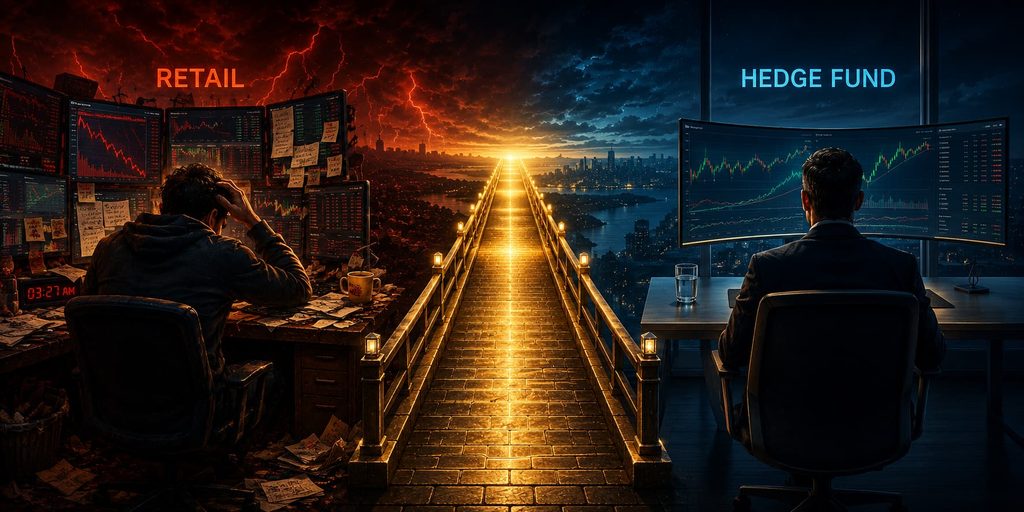
You might be shocked to hear this, but there aren’t many differences between you and a professional hedge fund manager. The only real differences are the balance of your trading account and your ability to control yourself. The world’s top money managers all started on a path similar to yours; they had to learn how to trade just like you, they had to master their craft, fine-tune their strategy and learn to master their emotions and control their behavior in the market. Mastering one’s emotions and controlling behavior is probably the biggest thing that separates the pros from the amateurs. This is the foundation of successful fund trading.
Hedge funds, often shrouded in mystery, are investment funds that utilize sophisticated strategies to achieve high returns. They employ techniques like arbitrage, leveraging, and strategic trades across various markets to maximize profits. According to Investopedia – Hedge Fund Strategies, hedge funds employ techniques like arbitrage, leveraging, and strategic trades across various markets to maximize profits. By understanding these approaches, you can learn to invest with a mindset similar to hedge fund managers, potentially enhancing your investment outcomes. This guide will show you how to apply hedge fund principles to your own fund trading.
For more on the mental discipline required in trading, see our guide on trading psychology and discipline.
What Separates Hedge Fund Managers from Amateur Traders
With enough screen time and experience, if you stick around long enough, just about anyone can begin to call a market quite confidently. But as many of you will all know by now, that alone isn’t enough. What really separates the ‘men from the boys’, is the ability of the pros to treat each trade as just another execution of their edge, without little to no emotional connection to it. Trading multi-million or billion-dollar hedge funds is certainly no easy feat and definitely not for the weak-minded.
The only way anyone could successfully trade these huge sizes and successfully trade for high net-worth clients, is by having complete and utter control of their minds and actions in the market. This is the essence of professional fund trading.
The ability to change how you think about the money in your trading account is what you really need to succeed at this game. What professional hedge fund traders know and do, is think about the accounts they trade as score boards, keeping score in a giant world-wide game. The score is the trading account balance and to them, it’s nothing more than digits on a screen, the more zeros they rack up after the first couple digits the better they are doing. This mindset is crucial for effective fund trading.
Imagine managing a billion dollar position the same as you would manage a $1,000 position? The only way to accomplish this is by remembering it’s all just zeros; it’s just digits on a screen. If you start allowing yourself to truly “feel” the power of the money, you have already lost. This psychological detachment is a hallmark of professional fund trading.
Lesson 1: Think of Money as Just Numbers
The ONLY true weapon you have as a small retail trader, is not allowing yourself to be affected by the money you have at risk in your account. This can be accomplished a number of different ways:
- Don’t trade with money you really can’t afford to lose.
- Know your overall net-worth, liquid money left over after debt.
- Risk a very small amount of your liquid money per trade.
- Do the “sleep test”; if you are able to sleep with your position on, then you’re good.
If you are doing all of the above, then the final step to trading your account like a hedge fund manager lies in how you think about the money you’re trading. I can tell you from personal experience, that the only thing more potentially nerve-racking than trading your own real money, is trading someone else’s money. Thus, a hedge fund manager needs to have “ice in their veins” (discipline, self-control), otherwise they are not going to get above average returns for their clients. This mental toughness is essential for fund trading.
By thinking of the money in your trading account as “just numbers”, a trader with a really big “baller” sized account, can remove the emotion from their trading decisions. They are simply thinking about their money differently than you are, and as a result, they are able to function in the market essentially as if they’re trading a demo account. This is the ultimate goal of fund trading.

Have you ever traded a demo account successfully and then when you transitioned over to a real account you blew it out in a month? Why did this happen? Well, it’s simple; you were letting the money control you on the real account rather than you controlling how you thought about it (like you did on demo). Don’t let it affect you. You do this by following the 4 bullet points above and then remembering it’s just numbers, nothing more, just zeros on a computer screen. This is the mindset of successful fund trading.
You have to take the power back from the money, don’t let the money control you, you control you and as a result, you control the money in your account. This might sound like some type of gigantic cliché motivational speaker type stuff to you, especially if you’ve just come off a bad streak of trading losses. But, I am telling you, from personal experience, that it’s a FACT that how you think about the money in your trading account directly influences whether or not you succeed or fail at trading. This is the most important lesson in fund trading.
Whether you think you can or you can’t, you’re right. Your mindset really has everything to do with your trading performance. The first step in achieving anything in life is convincing yourself you can do it and really believing it. In trading, you really have to “fake it till you make it” because that is the only way you will stay consistent and disciplined in your approach. This is the foundation of successful fund trading.
Lesson 2: Prioritize Cash Flow Over Earnings
Hedge funds can come in all shapes and sizes. Some may place a heavy emphasis on arbitrage situations (like buyouts or stock offerings), while others focus on special situations. Others still may aim to be market neutral and profit in any environment, or employ complicated dual long/short investment strategies. Understanding these approaches is key to fund trading.
While many investors track metrics such as earnings per share (EPS), many hedge funds also tend to keep a very close eye on another key metric: cash flow. Cash flow is important because bottom-line EPS can be manipulated or altered by one-time events, such as charges or tax benefits. Cash flow and the cash flow statement tracks money flow, so it can tell you if the company has generated a large sum from investments, or if it has taken in money from third parties, as well as how it’s performing operationally.
Because of the detail and the breakup of the cash flow statement into three parts (operations, investing, and financing), it’s considered to be a very valuable tool for fund trading.
This statement can also tip off the investor if the company is having trouble paying its bills or provide a clue as to how much cash it might have on hand to repurchase shares, pay down debts or conduct another potentially value-enhancing transaction. This focus on cash flow is a key differentiator in professional fund trading.
Lesson 3: Optimize Trades and Use Arbitrage
When the average individual purchases or sells a stock, they tend to do so through one preferred broker. The transaction is generally simple and straightforward, but hedge funds, in their effort to squeeze out every possible gain, tend to run trades through multiple brokers, depending on which offers the best commission, the best execution, or other services to assist the hedge fund. This attention to execution is a hallmark of professional fund trading.
Funds may also purchase a security on one exchange and sell it on another if it means a slightly larger gain (a basic form of arbitrage). Due to their larger size, many funds go the extra mile and may be able to pick up a couple of extra percentage points each year in returns by capitalizing on minute differences in price. This is a key strategy in fund trading.
Hedge funds may also look for and try to seize upon mispricings within the market. For example, if a security’s price on the New York Stock Exchange is trading out of sync with its corresponding futures contract on Chicago’s exchange, a trader could simultaneously sell (short) the more expensive of the two and buy the other, thus profiting on the difference. This willingness to push the envelope and wait for the biggest gains possible can easily tack on a couple of extra percentage points over a year’s time as long as the potential positions truly do cancel each other out. This arbitrage approach is a key element of fund trading.
Lesson 4: Leverage Investments and Derivatives
Hedge funds typically use leverage to magnify their returns. They may purchase securities on margin, or obtain loans and credit lines to fund even more purchases. The idea is to seize on or take advantage of an opportunity. The short version of the story goes that if the investment can generate a big enough return to cover interest costs and commissions (on borrowed funds), this kind of trading can be a highly effective strategy. This is a common practice in fund trading.
The downside is that when the market moves against the hedge fund and its leveraged positions, the result can be devastating. Under such conditions, the fund has to eat the losses plus the carrying cost of the loan. The well-known 1998 collapse of hedge fund Long-Term Capital Management occurred because of just this phenomenon. This is a cautionary tale for anyone engaging in fund trading.
Hedge funds may purchase options, which often trade for only a fraction of the share price. They may also use futures or forward contracts as a means of enhancing returns or mitigating risk. This willingness to leverage their positions with derivatives and take risks is what enables them to differentiate themselves from mutual funds and the average retail investor. This increased risk is also why investing in hedge funds is, with a few exceptions, reserved for high-net-worth and accredited investors, who are considered fully aware of (and perhaps more able to absorb) the risks involved. This risk management is crucial in fund trading. For more on derivatives and leveraged trading, visit the CME Group – Derivatives Trading resource page.
Lesson 5: Leverage Insider Insights and Relationships
Many mutual funds tend to rely on information they obtain from brokerage firms or their research sources and relationships they have with top management. The downside to mutual funds, however, is that a fund may maintain many positions (sometimes in the hundreds), so their intimate knowledge of any one particular company may be somewhat limited. Hedge funds—particularly those that maintain concentrated portfolios—often have the ability and willingness to get to know a company very well. This is a key advantage in professional fund trading.
In addition, they may tap multiple sell-side sources for information and cultivate relationships they’ve developed with top management, and even, in some cases, secondary and tertiary personnel, as well as perhaps distributors the company uses, ex-employees, or a variety of other contacts. Because fund managers’ profits are intimately tied to performance, their investment decisions are typically motivated by one thing—to make money for their investors. This is the driving force behind successful fund trading.
Mutual funds cultivate somewhat similar relationships and do extensive due diligence for their portfolios as well. But hedge funds aren’t held back by benchmark limitations or diversification rules. Therefore, at least theoretically, they may be able to spend more time per position; and again, the way hedge fund managers get paid is a strong motivator, which can align their interests directly with those of investors. This alignment is a key feature of professional fund trading.
Why Hedge Fund Managers Have Better Discipline
Do you think a hedge-fund manager or simply a trader with a million-dollar account is sitting in front of his screens everyday, day trading? Would you do that if you had a large trading account? No, you wouldn’t, and here’s why…
First, anyone who’s been around the trading world long enough knows that day-trading is the hardest way to make money and the most stressful. Put simply, there just aren’t a lot of high probability trading signals each week in the market to make a day-trading something that is more skill than gambling. This is why professional fund trading focuses on quality over quantity.
Hedge-fund traders do a lot of research, they have access to information that regular retail traders do not. They take a macro view of events and then check for opportunities via the price action on the charts. They are not just diving in and out of the market all day because some line crossed over another line. This strategic approach is the essence of fund trading.
The advantage that you have as a smaller retail trader, is price action is the great equalizer, the true footprint of money on the charts, it literally shows you what the hedge funds are doing. Then, you can combine that price action analysis with sickening self-control, consistency and discipline in your trading. This is literally the ‘recipe’ for retail trading success. This is how you master fund trading.
You literally have to trade your small trading account AS IF it’s a big account! How would a hedge-fund trade a big account? Slowly. Consistently. Masterfully. This is the approach to successful fund trading.
You aren’t looking for quantity, you’re looking for quality of trades. One or two good trades a month is all you really need. You may have to wait patiently like a crocodile for days or even weeks either for an ideal trade to form or maybe for one you entered to play out. Either way, this slow, methodical approach, is what works. Using price action and intense self-discipline is how you will make your money as a smaller retail trader. This is the essence of professional fund trading.
You aren’t going to ramp-up a tiny account into something you can live off of overnight. So, you have to fake it, until you make it. Trade that $1,000 account only risking $10 – $50 per trade for a year or two. Then, if you’ve proved to yourself you can do it, maybe you’ve doubled it. $1,000 profit may not sound like a lot over a year or two, but that’s a 100% return. Now, add a few zeros onto that $1,000 account and tell me if THAT amount matters? This is the path to successful fund trading.
Knowing the Right Time to Exit Investments
Many retail investors seem to buy into a stock with one hope in mind: to watch the security’s price climb in value. There’s nothing wrong with wanting to make money, but very few investors consider their exit strategy, or at what price and under what conditions they’ll consider selling. This is a critical lesson in fund trading.
Hedge funds are an entirely different animal. They often get involved in a stock to take advantage of a particular event or events, such as the benefits reaped from the sale of an asset, a series of positive earnings releases, news of an accretive acquisition, or some other catalyst. This event-driven approach is common in fund trading.
However, once that event transpires, they often have the discipline to book their profits and move on to the next opportunity. This is important to note because having an exit strategy can amplify investment returns and help mitigate losses. This discipline is a hallmark of professional fund trading.
Mutual fund directors often keep an eye on the exit door as well, but a single position may only represent a fraction of a percent of a mutual fund’s total holdings, so getting the absolute best execution on the way out may not be as important. So, because they often maintain fewer positions, hedge funds usually need to be on the ball at all times and be ready to book profits. This is the standard of professional fund trading.
The Bottom Line: What Separates You from a Hedge Fund Manager
Where most traders fail is in not understanding this simple point… Until you can trade a small account successfully over a significant period of time, you will not be able to trade a larger account successfully. Thus account size, simply doesn’t matter. This is the most important lesson in fund trading.
Here’s what matters:
- Your ability to trade with discipline
- Your ability to trade with consistency
- You having mastered a simple yet highly effective trading method like price action
- Daily chart, end of day trading
- Low-frequency trading
- Money management
You know that dream you have in your head? The one where you are trading from a beach and making thousands of dollars per week without having to be stuck in traffic or talked down to by some a-hole boss? Don’t give it up. Don’t even think about it. It IS possible. This is the goal of fund trading.
What you have to understand and truly believe, is that trading is a game that is almost entirely mental. The trade entry is not the hardest part of trading. The hardest part is what happens after that; how you process the feelings that come along with trading, your thoughts, your hopes and fears. This is the ultimate challenge of fund trading.
The lessons shared here are literally what keeps successful traders going. The feeling of not having to be to work “on time” or having to answer to some boss who doesn’t really care about you, the feeling of being able to make money from a beach or from a coffee shop, that is what keeps traders motivated. It is possible if you simply change how you think about the money in your trading account and remember that you have the power to control how you feel and how you behave. Once you take that power back, you are on the right track. This is the path to successful fund trading.
Where most traders fail is in not understanding this simple point… Until you can trade a small account successfully over a significant period of time, you will not be able to trade a larger account successfully.
For more on why traders give up too soon, see our guide on why most traders quit (path: /trading-plateau-why-traders-quit/).
Disclaimer
This article is for educational and informational purposes only. It does not constitute financial advice, trading recommendations, or an offer to buy or sell any asset. Trading forex, commodities, indices, cryptocurrencies, and futures carries significant risk and may not be suitable for all investors. You can lose more than your initial deposit. Past performance does not guarantee future results. Always read full terms, contract specifications, and risk disclosures before trading. Do your own research. Consult a licensed financial advisor if you need professional investment advice.