


After working with thousands of traders over the years, I have noticed one painful pattern that repeats itself again and again:
People usually quit at the exact moment they are closest to improving.
It rarely happens at the start of the journey. Most traders enter the markets highly motivated and excited to learn. The real challenge begins a few months later; when they hit the trading plateau.
This is the phase where traders finally begin recognizing their mistakes, understanding market behavior, and seeing what needs to change… but they have not yet spent enough time correcting those habits consistently.
That gap between awareness and results is where most people walk away.
And honestly, it is heartbreaking to watch because many of them are far closer than they realize.
I have seen two traders start from the exact same position. One quits because the process feels too slow. The other stays patient just a little longer and suddenly everything starts clicking.
The difference was never talent. It was persistence.
The trading plateau is where most traders quit. But it’s also where real skill is built. Nothing feels like progress here, but everything is being developed in silence.
Why the Trading Plateau Feels So Frustrating
Trading growth is not a straight line.
Most people expect consistent progress every single week, but that is not how skill development works in the markets. Often, you will feel stuck for weeks or even months before experiencing a sudden leap in understanding and execution.
One breakthrough can completely change your confidence, discipline, and consistency overnight.
But the difficult part is this:
That breakthrough usually happens after the uncomfortable phase, not before it. The trading plateau creates doubt because externally, it feels like nothing is happening. But internally, you are building pattern recognition, emotional control, and market understanding that eventually compounds into real results.
If you currently feel stuck, frustrated, or mentally exhausted, it does not automatically mean you are failing.
In many cases, it means you are in the middle of the growth phase that most traders never stay long enough to overcome.
The Hidden Work Happening During the Trading Plateau
During the trading plateau, your brain is doing more than you realize. It is rewiring itself to recognize patterns faster, process information more efficiently, and respond to market conditions with less emotional interference. This is neuroplasticity in action. The trading plateau is not stagnation; it is consolidation.
Think of it like building muscle. When you lift weights, you don’t grow stronger during the workout. You grow during the recovery period. The trading plateau is your recovery period. It is where the real learning consolidates.
For more on [trading psychology and discipline], our guide covers the mental discipline required to push through difficult phases.
The Dangerous Trap of Comparing Yourself to Others
One of the biggest reasons traders quit early is comparison.
Social media makes trading look fast and easy. You constantly see screenshots of profits, funded accounts, luxury lifestyles, and massive winning trades.
What you rarely see are:
- The months of losses
- The emotional breakdowns
- The blown accounts
- The self-doubt
- The years it took to become consistent
Many traders destroy their own progress because they compare their chapter one to someone else’s chapter ten. This is especially dangerous during the trading plateau, when progress feels invisible.
The truth is:
Every profitable trader you admire once struggled with the same confusion, fear, and inconsistency you are dealing with right now.
The only difference is they stayed long enough to improve. They survived the trading plateau when others gave up.
Why Social Media Distorts Reality
Social media platforms are designed to show highlight reels, not behind-the-scenes struggles. The profitable screenshots you see are often the result of years of failure. The luxury lifestyle posts are frequently marketing tactics, not genuine representations of daily trading life.
When you are in the trading plateau, this distortion is particularly dangerous. You see others succeeding and assume you are falling behind. In reality, you are exactly where most successful traders were at your stage of development.
Your Journey Is Unique
No two trading journeys are the same. Some traders take months to become consistent. Others take years. The trading plateau hits everyone at different times and lasts for different durations.
Comparing your timeline to someone else’s is a recipe for frustration. Focus on your own growth. Measure yourself against your past self, not against strangers on the internet.
Why Discipline Matters More Than Strategy
A lot of struggling traders believe they are only one strategy away from success.
In reality, most traders already know enough to become profitable.
The real issue is execution.
- They overtrade after losses.
- They become impatient during slow market conditions.
- They revenge trade emotionally.
- They abandon their plan after a few bad trades.
- They constantly switch strategies before mastering one.
This is why emotional discipline becomes the true separator. The trading plateau phase is not only teaching you technical analysis.
It is teaching you patience, self-control, emotional stability, and risk management.
And those are the skills that create long-term consistency. The trading plateau is where these skills are forged.
Strategy Switching Is a Trap
Many traders in the trading plateau believe the solution is to find a better strategy. They switch from one system to another, hoping that the next one will be the magic bullet.
This is a trap. Strategy switching prevents you from mastering any single approach. It keeps you perpetually in the learning phase, never moving to the execution phase.
The trading plateau requires the opposite approach: commit to one strategy and master it. Give it enough time to prove itself. Most strategies fail because traders abandon them too early, not because the strategy itself was flawed.
The Role of Process in Breaking Through
The trading plateau is broken by process, not brilliance. Traders who consistently journal, review, and refine their approach eventually break through. Those who rely on intuition and hope stay stuck.
The process is simple but not easy:
- Define your rules clearly
- Follow them without exception
- Review your performance daily
- Identify what worked and what didn’t
- Make small, incremental improvements
This is how you survive the trading plateau. This is how you become consistent.
For more on [mastering the trading mindset], our guide covers the psychological blueprint for consistent trading.
How Environment Changes Everything
This is exactly why your environment matters more than most traders realize.
When you are isolated, every losing streak feels personal. Every slow month feels like proof that you are not improving. The trading plateau starts feeling permanent.
But inside the right environment, you begin to realize something important:
Every consistent trader has gone through this phase before. The trading plateau is a universal experience.
Being surrounded by disciplined traders, structured guidance, and people pushing toward the same goal makes it much easier to stay focused during the difficult periods.
The trading plateau is not a sign that you are failing. It is a sign that you are in the phase most people never stay long enough to finish.
The Power of Community
The trading plateau is more manageable when you have a support system. Fellow traders who understand the struggle can offer perspective when you lose it. They can remind you that this phase is normal and temporary.
Trading communities also provide accountability. When you know others are watching, you are more likely to stick to your rules. The trading plateau becomes less isolating.
Structured Guidance Matters
Having a mentor or structured program can accelerate your journey through the trading plateau. A guide who has already navigated this phase can show you the shortcuts. They can point out the pitfalls you haven’t seen yet.
This is why many traders benefit from coaching or education programs. The trading plateau is a difficult phase, and you don’t have to navigate it alone.
How Isolation Intensifies the Plateau
Isolation is one of the biggest dangers during the trading plateau. When you trade alone, every negative thought amplifies. Doubt becomes overwhelming. Progress feels impossible.
Trading with a community or mentor grounds you. It provides a reality check. The trading plateau is still frustrating, but it becomes manageable.
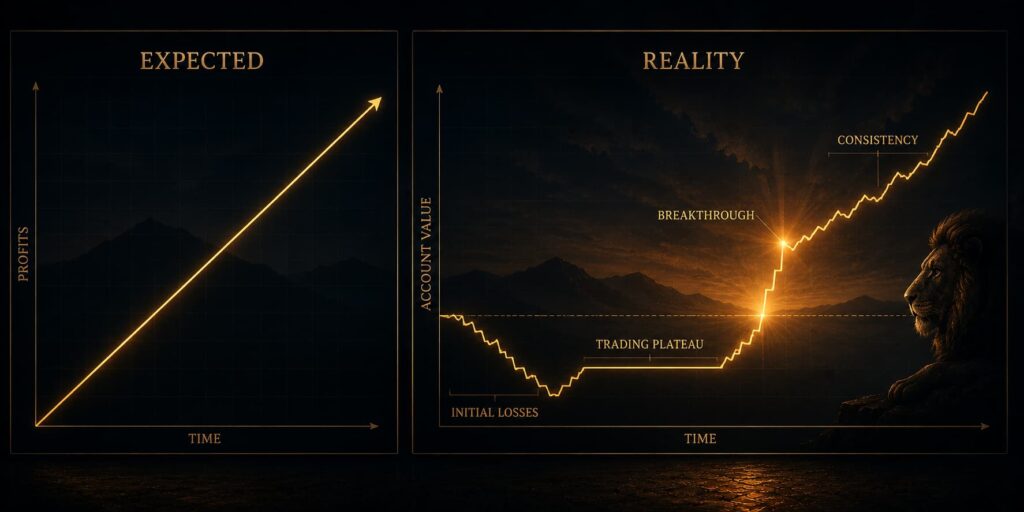
The Profit Curve is Never Linear
Trading is one of the few professions where the rewards are public, but the reality is hidden.
You’ll see screenshots of profits. Fancy cars. “Financial freedom” hashtags.
But here’s the truth:
Most traders quit before they ever give themselves a real chance to win.
Most traders quit because their expectations look like this:
Effort → Immediate Profits
But real trading looks like this:
Effort → Losses & Lessons → Refinement → More Lessons → Small Consistency → Sustainable Profits
Quitting too early means you stop before the curve bends in your favor. The trading plateau is that bend in the curve.
The market isn’t a get-rich-quick machine. It’s a get-wise-slowly system. The trading plateau is where wisdom is built.
Understanding the Real Profit Curve
The real profit curve in trading is not a straight line upward. It is a series of steps:
- Initial excitement – New traders are optimistic and motivated. They learn quickly and feel progress.
- The reality check – Losses start to mount. The trading plateau begins. Confidence wanes.
- The grind – This is the trading plateau. Progress is invisible. Frustration is high. This is where most traders quit.
- The breakthrough – Suddenly, things start to click. Pattern recognition improves. Emotional control strengthens. The trading plateau ends.
- Consistency – Profits become more regular. Drawdowns are smaller. The trader has emerged from the trading plateau.
The trading plateau is the stage most traders never complete. It is the filter that separates long-term winners from short-term quitters.
The Breakthrough Happens When You Least Expect It
The breakthrough after the trading plateau often happens suddenly. One day, you just “get it.” The confusion clears. The market makes sense.
This breakthrough is the reward for enduring the trading plateau. It is the compounding of all the invisible work you did during the frustrating phase.
But you have to stay long enough to experience it.
Why Most Traders Quit Too Early
The market doesn’t just test your technical skills. It tests:
- Your patience.
- Your emotional control.
- Your ability to manage risk.
- Your consistency, even after losses.
Most traders focus on entry-exit strategies, but real success lies in self-mastery. And sadly, many quit before this truth even clicks.
The Learning Curve is Uncomfortable
Trading looks easy on YouTube thumbnails, but in reality:
- Losses hurt.
- Emotions cloud judgment.
- Uncertainty is constant.
- Patience is rarely taught.
Most people step into the market expecting instant profits, but trading is a skill. And like any skill, it demands time, practice, and failure.
“The market is a place where the patient take money from the impatient.”
The pain of early losses forces people out — not because they’re unfit for trading, but because they couldn’t endure the learning phase. They couldn’t survive the trading plateau.
The Reality of Early Losses
Early losses are not a sign that you should quit. They are a sign that you are learning. Every profitable trader has a history of losses. The trading plateau is where you learn to accept them.
Losses become less painful when you reframe them. They are tuition for the market. Each loss teaches you something. The trading plateau is where you collect these lessons.
The Impatience Trap
Impatience is the enemy of the trading plateau. Traders who want quick results will always be disappointed. The market rewards patience, not speed.
The trading plateau forces you to slow down. It demands that you focus on process rather than outcome. This is uncomfortable, but it is necessary.
For more on [risk management strategies], our guide covers how to protect your capital during challenging periods.
How to Survive the Trading Plateau
Here are practical steps to survive the trading plateau:
1. Stick to risk management. Never risk more than you can afford to lose on a single trade. This keeps you in the game long enough to see the trading plateau through.
2. Journal every trade. Write down why you entered, why you exited, and what you felt. This builds awareness and helps you identify patterns during the trading plateau.
3. Review your mistakes. After each session, review what went wrong and what went right. The trading plateau is a feedback loop.
4. Stay emotionally neutral. The market doesn’t care about your feelings. Emotional control during the trading plateau is what separates winners from quitters.
5. Focus on process, not money. When you focus on execution, results follow. The trading plateau is about building process.
Create a Routine
Routine is essential during the trading plateau. When the market feels random, a routine provides structure. It anchors you when everything else feels chaotic.
Your routine should include:
- Pre-market preparation
- Trading session rules
- Post-session review
- Weekly performance assessment
The trading plateau is easier to navigate when you have a routine to fall back on.
Take Breaks
Sometimes the best thing you can do during the trading plateau is step away. Taking a break doesn’t mean quitting. It means giving yourself space to reset.
When the trading plateau feels overwhelming, take a day or two off. Come back with fresh eyes. Often, you will see things you missed before.
Seek Feedback
The trading plateau is isolating, but it doesn’t have to be. Seek feedback from more experienced traders. Share your journal with a mentor. Let someone else review your process.
External perspective can break the trading plateau because it shows you what you cannot see in yourself.
The Hidden Cost of Quitting Right Before the Breakthrough
Here is the part most traders never consider:
When you quit during the trading plateau, you don’t just lose the money you’ve already lost.
According to Brett Steenbarger – Trading Psychology , one of the leading trading psychologists, the traders who succeed are not the ones who never struggle. They are the ones who struggle and stay.
You lose the investment you made in yourself.
Every hour spent studying charts, every journal entry written, every loss analyzed, every strategy tested — it all becomes worthless if you walk away before it compounds.
Think about what you have already survived:
- The confusion of the first few months
- The blow to your ego when you took that big loss
- The sleepless nights replaying trades in your head
- The frustration of watching the market move without you
- The discipline you built by sticking to your rules
That is not nothing. That is momentum. That is the foundation of your future success.

Final Thoughts
The plateau is where most traders quit; but it’s also where real skill is built.
Nothing feels like progress here, but everything is being developed in silence.
If you’re stuck, you’re not behind. You’re in the phase most people never stay long enough to finish.
Stay consistent a little longer. That’s where things start to shift.
The difference between a losing trader and a winning one is simple:
The winning trader stayed in the game long enough to learn. They survived the trading plateau.
Don’t quit before the breakthrough.
Don’t judge yourself by your last trade.
Judge yourself by your commitment to growth.
Because trading is not about perfect calls — it’s about survival, adaptation, and staying power.
Keep going. The best is yet to come.
Disclaimer
This article is for educational and informational purposes only. It does not constitute financial advice, trading recommendations, or an offer to buy or sell any asset. Trading forex, commodities, indices, cryptocurrencies, and futures carries significant risk and may not be suitable for all investors. You can lose more than your initial deposit. Past performance does not guarantee future results. Always read full terms, contract specifications, and risk disclosures before trading. Do your own research. Consult a licensed financial advisor if you need professional investment advice.