


Probability trading is the only path to long-term consistency in the markets. There are only so many ways to say “markets are watching the Fed,” “geopolitics remains a risk,” or “investors await the next data print” before the whole exercise starts to sound like it was assembled in a windowless committee room with the coffee already cold.
That is not why I started writing this blog.
At the end of the day, the only god of trading is probability.
Not conviction. Not narrative. Not a favourite economist. Not the chart pattern everyone discovers after the move has already happened. Not the central-bank whisper. Not even the Bloomberg headline that hits your screen with enough urgency to make your coffee jump. The only thing that matters over time is whether you are consistently better than the crowd at assigning odds to uncertain outcomes, sizing those odds properly, and knowing when the price on the screen is paying you enough to take the other side of the world’s anxiety.
That is probability trading. Everything else is costume.
For more on the mental discipline required in trading, see our guide on trading psychology and discipline .
What Is Probability Trading?
Probability trading is the practice of viewing every trade as a bet with known odds, unknown outcomes, and a clear edge. It is the opposite of certainty trading, where the trader believes they know what will happen next. Probability trading forces you to accept that uncertainty is permanent.
In a random market environment, there are so many external factors that can affect the outcome of the trade that a trader cannot know all those factors. What you know is your edge, which is certain in an uncertain market environment. If your edge has a positive outcome, you can produce a consistent result in a random environment through probability trading.
The market is not a morality play. It is not a debate club. It is not a courtroom where the best argument wins. The market is a probability machine with a bad temper. It rewards people who can estimate odds under incomplete information, update without ego, and survive long enough for the edge to matter. It punishes people who confuse a strong narrative with a strong probability.
That distinction is everything in probability trading.
The simple version: You don’t know which trade will win or lose. You only know that over 100 trades, your edge will produce a positive result. Probability trading is about accepting that uncertainty and playing the game correctly.
Philip Tetlock and the Art of Updating Probabilities
Philip Tetlock’s work on superforecasting matters because it cuts straight through the illusion that markets are mostly about sounding smart. His research showed that expert forecasting is often far messier than the expert class likes to admit, and that the best forecasters are usually not the people with the boldest grand theory of the world.
They are the ones who update.
They break big questions into smaller ones. They think in probabilities rather than certainties. They are willing to move from 55% to 62% when the evidence changes, rather than waiting for some thunderbolt of confirmation. They track their errors. They learn from misses. They do not confuse confidence with accuracy. This is exactly how probability trading works.
According to Tetlock’s research, the best forecasters share specific habits:
- They think in probabilities, not certainties
- They update frequently when new information arrives
- They break big questions into smaller, more manageable ones
- They track their errors and learn from misses
- They do not confuse confidence with accuracy
That is exactly how good probability trading works.
The tricky thing with market probabilities is that, unlike probabilities in a casino, they are not known. In blackjack, roulette, or dice, the structure of the game is fixed. The distribution may hurt you, but at least you know the machine you are playing against.
Markets are different. The wheel changes shape while it is spinning. The dealer gets new information. The rules shift when central banks panic. The crowd changes its mind. Liquidity disappears exactly when your model needs it most. The distribution is not carved into the table. You have to estimate it in real time.
That is why probability estimation is the trader’s real craft. Probability trading is the skill that separates professionals from amateurs.
Why Views Are Cheap in Probability Trading
Anyone can have a view. Views are cheap. The market is drowning in them. The hard part is assigning the correct probability to that view and then comparing it with the price being offered.
A trader is not paid for saying “oil can go higher.” A trader is paid for knowing whether the market is pricing a 30% chance of disruption when the real probability is closer to 45%, and whether the option structure, futures curve, liquidity profile, and positioning backdrop make that gap worth expressing.
That is the difference between commentary and edge in probability trading.
Most market forecasts begin, whether people admit it or not, with the current price and the recent trend. If something is going up, the street usually finds reasons it can go up more. If something is falling, the research machine discovers fresh reasons it can keep falling. This is not because analysts are stupid. Many are extremely smart. It is because humans are wired to overweight recent information. The thing that just happened feels more important because it is available, emotional, visible, and easy to explain.
That is extrapolation bias, and markets are built on it.
When oil is at $100, the world suddenly has 100 reasons it is going to $130. Inventories are tight. Geopolitical risk is rising. Spare capacity is thin. Demand is resilient. The curve is backwardated. The refiners are screaming for barrels. Every argument sounds sophisticated because the price is already confirming it. Then oil trades at $25 and the same world discovers 100 reasons it is going to $15. Storage is full. Demand is dead. Producers are irrational. The curve is broken. The old bullish thesis is not revised; it is buried.
The market does not just change price. It changes the story people are willing to believe.
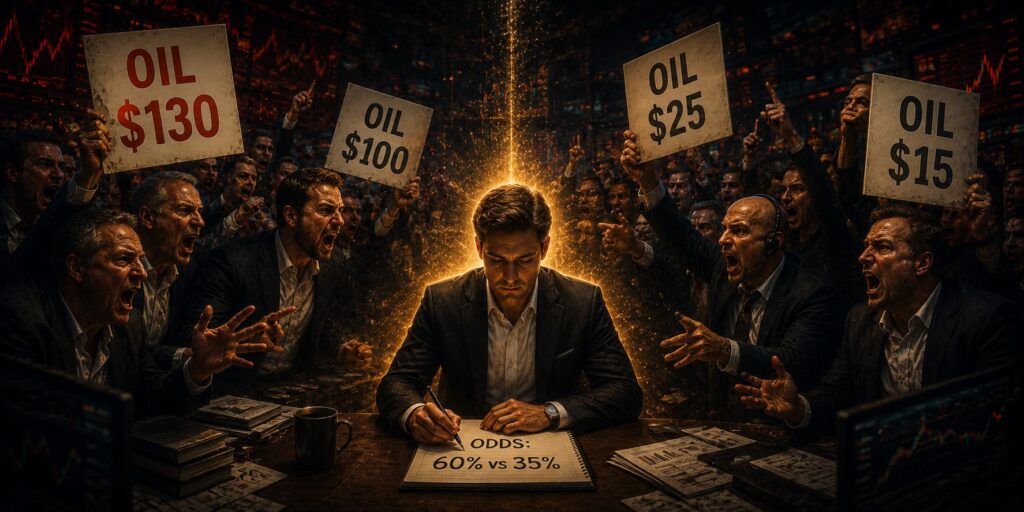
That is why the best probability traders are usually not the loudest forecasters. They are the best updaters. They live in probability space, not certainty space. They know when the base case is still alive but the distribution has widened. They know when a 20% tail is being priced like a 5% tail. They know when the market has fallen in love with a clean story and stopped paying attention to the messy alternatives.
This is where Tetlock’s world and the trading floor meet. Probability trading is the bridge.
Price vs Probability: The Real Edge
The amateur wants the market to tell him what will happen. The professional wants to know what is already priced, what is mispriced, and what happens if the crowd has to change its probability map in a hurry.
That is why a 60% view can be a great trade and a 90% view can be a terrible one in probability trading.
If the 60% outcome is priced at 35%, you may have edge. If the 90% outcome is priced at 99%, you may have nothing but crowded certainty and bad convexity. Price is the bookmaker. Probability is the religion.
This is also why the middle of the probability distribution is easier than the tails. Humans are generally more comfortable estimating things around 40%, 50%, or 60%, because the consequences of being wrong are psychologically softer. The harder task is estimating very high and very low probabilities. Is something really a 5% risk, or is it 15%? Is something really a 95% certainty, or is it 80% dressed up in a good suit?
That difference sounds academic until you trade it. In markets, the tails are where portfolios blow up, hedges suddenly matter, and the crowd discovers that “almost impossible” was just another way of saying “underpriced.”
Probability trading helps you see these gaps.
Tail Risks Matter in Probability Trading
A low-probability event is not the same thing as an irrelevant event. A 10% risk can dominate the entire trading landscape if the payoff is large enough, the market is positioned the wrong way, or the event path forces liquidation.
Likewise, a high-probability event can be useless if everyone already owns it, the price has already moved, and the residual upside is tiny compared with the downside if the consensus is even slightly wrong.
That is why I spend so much time thinking about tail risks.
Not because every tail risk happens. Most do not. That is why they are tails. But markets do not wait for the tail to happen before they move. They reprice the probability of the tail. That repricing can be enough.
Oil does not need the Strait of Hormuz to shut completely for crude to carry a risk premium. USD/JPY does not need the Bank of Japan to shock the world for traders to start paying up for a wider distribution around the meeting. Gold does not need the monetary system to collapse to rally when real yields fall, fiscal credibility erodes, and investors start marking a higher probability of policy error.
Markets trade probability before they trade fact. Probability trading prepares you for this.
Calibration: Are Your Odds Accurate?
Probability is not enough by itself. You also need calibration. A trader who calls everything 70% is not a forecaster; he is a man with one dial. A strategist who constantly predicts dramatic outcomes may occasionally look brilliant, but without scoring the misses, there is no way to know whether the process has any value.
The same is true of the market itself. A contract priced at 70 does not automatically mean the real-world probability is exactly 70%. It means the marginal price, under that market’s liquidity, participation, constraints, and incentives, is 70. That distinction matters.
The crowd can be wise, but it can also be crowded.
This is where Tetlock’s world and probability trading meet perfectly. Good forecasters track their errors. Good traders do the same, although usually in the harsher language of P&L. If your 60% trades win 60% of the time over a meaningful sample, you are calibrated. If your 80% trades win 55% of the time, you are not unlucky; you are miscalibrated.
The market is giving you feedback. The question is whether you are humble enough to listen before the drawdown becomes your teacher.
That is why probability is not cold or academic to me. It is survival. Probability trading is survival.
For more on why most traders quit too early, see our guide on why most traders quit.
Think in Batches: The 20/50/100 Trade Mindset
An event that has a probable outcome can produce consistent results if you have the odds in your favor and there is a large enough sample size, a series of trades generated by your edge.
You have to think in probabilities and take every single trade which meets the criteria of your system. You don’t know the outcome of any trade before taking the trades. You don’t know which trade is going to be a winner or loser. Unless you know a way to travel in time, you cannot select between the trades. You have to play all.
Every event is independent of the previous one. If your last 2 trades are losers, it doesn’t mean the next will also be a loser. Markets are random and you can make consistent results if you have odds in your favor.
The batch mindset:
| Batch Size | Why It Matters |
|---|---|
| 20 trades | Too small to judge. Noise dominates. |
| 50 trades | Starting to see the edge. Still noisy. |
| 100 trades | Meaningful sample. Edge should show. |
When you think in batches, you stop caring about individual trade outcomes. A single loss is just one data point. A winning streak is just noise. The only thing that matters is whether your edge holds over 100 trades.
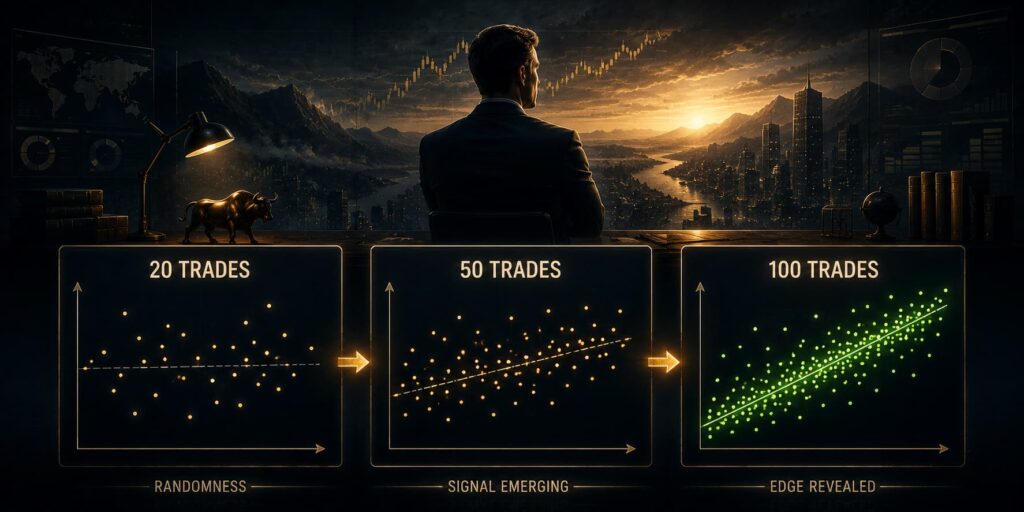
This is the essence of probability trading.
Real-World Trade Example: Probability Trading in Action
Imagine you have a strategy that wins 55% of the time with a 1.5:1 risk-to-reward ratio.
Over 100 trades:
- 55 winners at +1.5R = +82.5R
- 45 losers at -1R = -45R
- Net result: +37.5R
That is a profitable edge. But here is the catch: you will not win exactly 55 out of 100 trades every time. You might win 45 in a row or lose 45 in a row. That is variance. That is probability trading.
The trader who thinks in probabilities understands this. They take every trade. They do not skip trades because they “feel” like a loser. They do not double down after a loss. They simply execute the edge and let the law of large numbers do the work.
The trader who thinks in certainties panics after a losing streak. They tweak the strategy. They skip trades. They overcomplicate everything. They destroy their edge before it has a chance to play out.
Which trader are you? Probability trading demands the first approach.
How to Start Thinking in Probabilities
Here are actionable steps to adopt a probability mindset:
1. Track your trades. Record every trade, including your probability estimate before entry. Over time, check if your 60% trades actually win 60% of the time. This is the foundation of probability trading.
2. Focus on process, not outcome. Did you follow your rules? Did you take every valid trade? Those are the questions that matter in probability trading.
3. Accept randomness. You cannot control the outcome of any single trade. You can only control your process. Probability trading requires this acceptance.
4. Stop tweaking. If you have a proven edge, let it work. Constant tweaking destroys sample size and prevents you from knowing if your edge is real. Probability trading demands patience.
5. Judge yourself over 100 trades. A single trade or even 20 trades is noise. 100 trades is a meaningful sample. This is the heart of probability trading.
6. Think in probabilities, not certainties. Replace “this trade will win” with “this trade has a 60% chance of winning.” That is probability trading.
7. Calibrate regularly. Track your forecast accuracy. Are your 70% trades winning 70% of the time? If not, you are miscalibrated. Probability trading requires calibration.
Crowd-Sourced Probabilities and Prediction Markets
That is also where crowd-sourced probability tools, prediction markets, and places like Polymarket become interesting. I am not saying they are gospel. They are not. They have their own liquidity issues, participant biases, domain distortions, and moments where the crowd is simply leaning too far into its own reflection.
But they are useful because they force the conversation into numbers. Not vibes. Not “likely.” Not “could.” Not “watching closely.” A price-based probability forces you to ask: what odds is the crowd actually assigning to this outcome?
That alone is valuable.
Markets are full of language designed to avoid accountability. Strategists say risks are “elevated.” Economists say the balance of risks is “skewed.” Central bankers say policy is “data dependent.” Traders say something “feels heavy.” None of that is useless, but none of it is a probability.
The discipline comes from forcing the vague into the numerical. Is this a 20% risk or a 40% risk? Is the market pricing 2 cuts when the real distribution says 1.3? Is the crowd paying for insurance after the house has already stopped smoking?
That is where edge starts to appear.
According to Investopedia, understanding probability in trading is essential for long-term success because it shifts the focus from individual trade outcomes to the statistical edge that drives consistent performance. Probability trading is that shift.
The Key Takeaways: Probability Trading Summary
- Probability is the real operating system of trading. Views are cheap, but edge comes from assigning better odds than the market and knowing when the price compensates you for the risk. Probability trading is the answer.
- Tail risks matter because markets reprice probabilities before facts arrive. A low-probability event can dominate the tape if the payoff is large, positioning is wrong, or liquidity is fragile. Probability trading prepares you for this.
- Prediction markets and crowd-sourced odds are useful, but they are not gospel. They are another input into the probability map, not a replacement for judgment, calibration, and trader discipline. Probability trading requires judgment.
- Think in batches. One trade is meaningless. 20 trades is noise. 100 trades is where your edge shows. Probability trading demands this mindset.
- Track your errors. If your 60% trades are not winning 60% of the time, you are miscalibrated. Probability trading requires calibration.
- The market is not a prediction contest. It is a probability contest with leverage attached. Probability trading is the framework.
- Price is the bookmaker. Probability is the religion. Probability trading is the practice.
- You do not know which trade will win or lose. Accept that uncertainty and play the game correctly. That is probability trading.
Conclusion: Probability is Survival
Every trader eventually learns that the market does not care how much work you put into the view. It does not care how many bank notes you read, how many charts you marked up, or how elegant the thesis sounded when you explained it at 6 AM. The only thing the market cares about is whether the odds, price, timing, and size were aligned.
You can be directionally right and lose money. You can be intellectually right and structurally wrong. You can spot the macro turn and still get carried out because the entry, carry, volatility, or positioning was wrong.
Probability is not just about being right. It is about being paid correctly for being right and surviving when you are wrong.
That is why I keep coming back to the same idea: markets are not prediction contests. They are probability contests with leverage attached. The objective is not to have the most dramatic forecast. The objective is to find where the market’s implied odds are wrong, where the crowd is extrapolating too aggressively, where the tail is underpriced, and where a small change in probability can force a large change in price.
That is the real game. That is probability trading.
The world can keep its certainty. I will take probability.
Disclaimer
This article is for educational and informational purposes only. It does not constitute financial advice, trading recommendations, or an offer to buy or sell any asset. Trading forex, commodities, indices, cryptocurrencies, and futures carries significant risk and may not be suitable for all investors. You can lose more than your initial deposit. Past performance does not guarantee future results. Always read full terms, contract specifications, and risk disclosures before trading. Do your own research. Consult a licensed financial advisor if you need professional investment advice.