


Gold and the Dollar: 3 Reasons the Old Correlation Is Breaking
Gold and the US dollar usually move in opposite directions.
When the dollar strengthens, gold falls. When the dollar weakens, gold rises. This inverse gold dollar correlation has been a reliable rule of thumb for decades. It is grounded in simple logic. Gold is priced in dollars. A stronger dollar makes gold more expensive for foreign buyers. Demand falls. Price drops.
But in 2024 and 2025, something unusual happened. Both gold and the dollar demonstrated significant strength simultaneously. Gold surged past $3,000 per ounce and set new all-time highs. The US Dollar Index remained resilient. The traditional gold dollar correlation broke down.
This article explains the traditional relationship, the three reasons it broke, and what traders should watch now. Understanding the gold dollar correlation is essential for any gold trader. As we covered in our [gold trading strategies], this relationship has held true for most of the past two decades – until recently.
Part 1: The Traditional Inverse Relationship
The inverse gold dollar correlation is grounded in several fundamental market principles.
First, gold is priced in dollars globally. When the dollar strengthens, it takes fewer dollars to buy the same amount of gold. Foreign buyers need more of their local currency, reducing demand. This is the direct currency effect, and it is the primary driver of the gold dollar correlation.
Second, when the dollar strengthens and US interest rates rise, gold becomes less attractive as a non-yielding asset. Investors seeking returns prefer dollar-denominated assets that pay interest. The opportunity cost of holding gold rises. This interest rate channel reinforces the inverse gold dollar correlation.
For most of the past twenty years, this relationship held. Dollar up, gold down. Dollar down, gold up. It was one of the most reliable patterns in financial markets.
Then 2024 happened.
Part 2: The 2024-2025 Anomaly – When Both Rose Together
In 2024 and 2025, the traditional gold dollar correlation broke. Gold and the dollar rallied together.
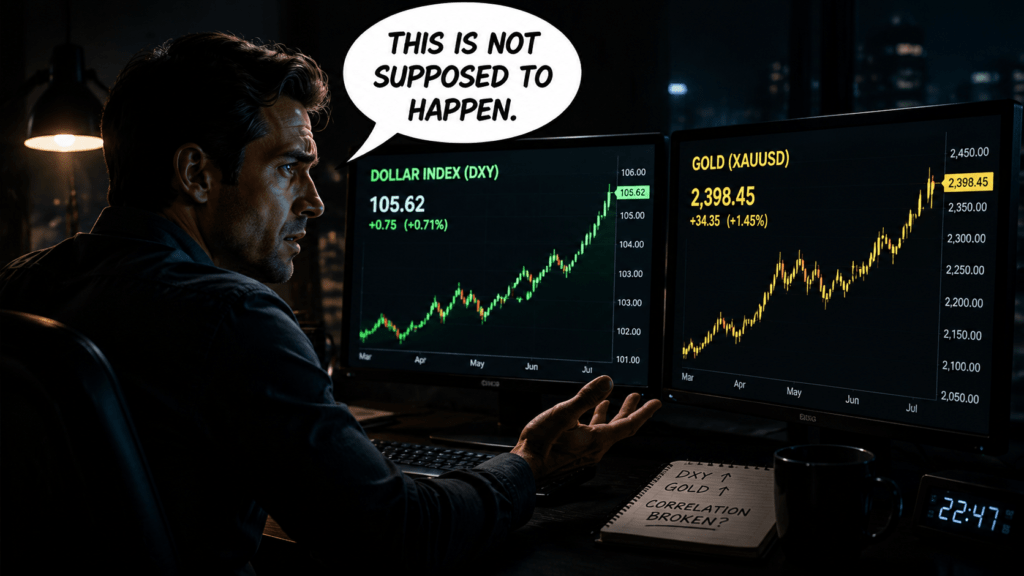
Gold prices surged past $3,000 per ounce and set record highs. The US Dollar Index remained strong. This was not supposed to happen according to the textbook model of gold dollar correlation.
According to analysis from [CME Group], several factors drove this unconventional market behavior. Understanding these factors is key to updating your view of the gold dollar correlation.
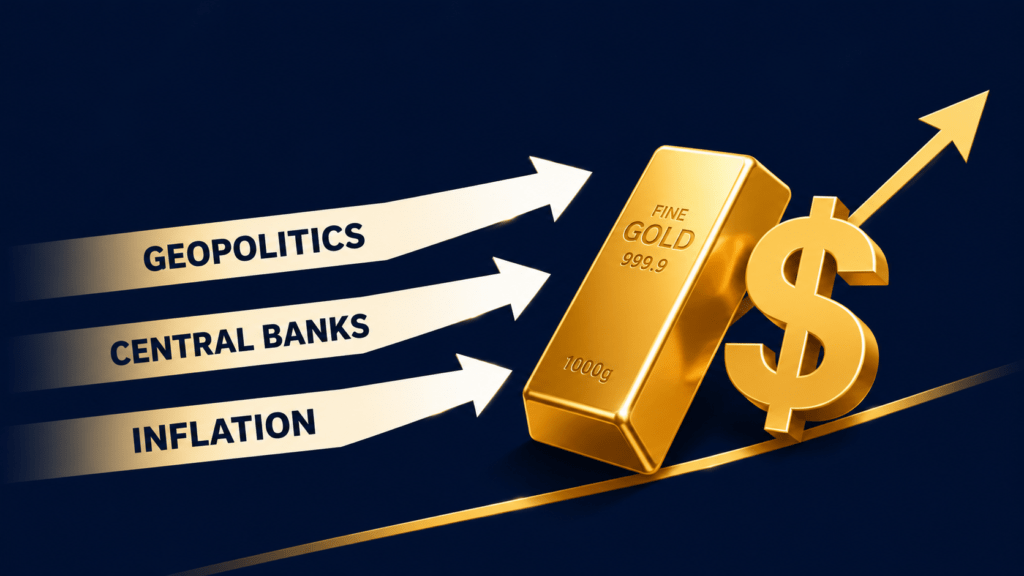
Reason 1: Geopolitical Tensions
Geopolitical tensions, including the Russia-Ukraine conflict and Middle East instability, drove safe-haven demand for both gold and the dollar. In times of global uncertainty, investors flock to traditional safe harbors regardless of their typical gold dollar correlation.
When the Strait of Hormuz crisis escalated in early 2025, both assets rose together. The dollar benefited from its status as the world’s reserve currency. Gold benefited from its status as the ultimate store of value. The gold dollar correlation temporarily inverted.
Reason 2: Central Bank Gold Purchases
Central bank gold purchasing reached historic levels in 2024 and 2025. China, Russia, and several emerging market economies significantly increased their gold reserves to diversify away from dollar-denominated assets.
This demand is not speculative. It is strategic. And it supports gold prices regardless of what the dollar does. The traditional gold dollar correlation assumes that private investors drive both markets. When central banks enter the picture, the dynamics change.
Reason 3: Persistent Inflation Concerns
Despite the Federal Reserve’s aggressive tightening cycle, persistent inflation concerns kept gold attractive as a traditional inflation hedge. While higher interest rates typically pressure gold, market sentiment suggested inflation might remain sticky, sustaining gold’s appeal.
Gold functions as an inflation hedge specifically when the Fed is not actively combating inflation through rate hikes. When the market anticipates rising inflation but expects the Fed to remain accommodative, the gold dollar correlation can break.
For a deeper look at [how the Fed shapes the dollar], our guide covers the transmission channels from rates to currencies. This context is essential for understanding when the gold dollar correlation holds and when it breaks.
Part 3: What This Means for Traders
The traditional inverse gold dollar correlation is a reliable starting point. But it is not a law of physics. Traders who rely on it exclusively will get hurt when the relationship breaks.
Here is what you need to watch.
Watch Real Interest Rates, Not Just the Dollar
The gold dollar correlation is driven partly by interest rates. When real rates (nominal rates minus inflation) are low or negative, gold becomes more attractive regardless of the dollar. When real rates are high, gold struggles.
In 2024-2025, real rates remained low even as the dollar strengthened. That helped gold rally.
Watch Central Bank Behavior
Central banks are now major players in the gold market. Their buying is structural, not speculative. As long as they continue to diversify away from dollar reserves, gold has a support floor that the gold dollar correlation does not capture.
Watch Geopolitical Risk
In a risk-off panic, both gold and the dollar can rise together. This is the most common exception to the inverse gold dollar correlation. When headlines drive fear, the usual relationship breaks.
Part 4: Key Levels to Watch Right Now
| Asset | Support | Resistance |
|---|---|---|
| Dollar Index (DXY) | 98.30 | 99.50 |
| Gold (XAU/USD) | $4,500 | $4,800 |
If the dollar breaks above 99.50, the traditional gold dollar correlation would suggest gold tests $4,400 support. But remember the lessons of 2024-2025. If central banks keep buying or geopolitical risk spikes, gold could hold its ground even if the dollar rallies.
If the dollar breaks below 98.30, gold could rally toward $4,800. That move would be consistent with the traditional gold dollar correlation.
For more on [position sizing and risk management] when trading gold, our guide covers the formulas you need.
Part 5: Is the Relationship Normalizing?
The traditional inverse gold dollar correlation appears to reassert itself in certain market conditions. As the Federal Reserve transitions from its tightening cycle to potential easing, the mechanics driving both assets could realign more traditionally.
However, heightened global uncertainties, including ongoing trade disputes and geopolitical conflicts, can drive simultaneous demand for both gold and the dollar when they are both seen as safe-haven assets. This can disrupt the gold dollar correlation at any time.
Market analysts increasingly emphasize that gold’s price is now more influenced by real interest rates, inflation concerns, and systemic risks rather than solely by dollar strength. The gold dollar correlation is still useful, but it is no longer the only variable.
Overall, while some signs point to a partial normalization of the gold dollar correlation, structural changes and global uncertainties suggest that this correlation could remain fluid. Traders need to adapt their strategies accordingly.
Bottom Line
The inverse gold dollar correlation is a reliable starting point. But it is not a guarantee.
Geopolitical tension, central bank demand, and real interest rates can override the relationship. In 2024-2025, all three did.
Watch the dollar. But also watch the Fed, watch the central banks, and watch the headlines. The gold dollar correlation will guide you most of the time. But when it breaks, you need to know why.
Disclaimer: This article is for educational and informational purposes only. It does not constitute financial advice, trading recommendations, or an offer to buy or sell any asset. Trading forex, commodities, indices, cryptocurrencies, and futures carries significant risk and may not be suitable for all investors. You can lose more than your initial deposit. Past performance does not guarantee future results. Always read full terms, contract specifications, and risk disclosures before trading. Do your own research. Consult a licensed financial advisor if you need professional investment advice.