


Here is the thing about the AI gold rush: everyone is watching the wrong miners.
Right now, the entire market is fixated on who is going to win the AI model wars. OpenAI versus Google versus Anthropic versus whoever is launching next week. It is like watching people argue about which website will dominate the internet while completely ignoring the fact that someone is making bank selling the routers that connect them all.
That someone was Cisco during the dot-com era. They did not have to pick the winning website. They just sold the infrastructure every website needed. Their stock went up about 3,400% in five years while Pets.com and a thousand other “sure things” went to zero.
The same thing is happening right now with AI, except there is a twist that most investors have not figured out yet. The real story is not the models. It is ai banking and the infrastructure that powers it.
For a deeper look at [trading disruptive technology themes], this guide covers how ai banking and automation affect broader markets.
The Infrastructure Bill Just Got Insane
Here is where it gets interesting. AI is about to consume way more infrastructure than anyone is pricing in.
A chatbot is cute. You ask it a question, it spits back an answer, done. Maybe a few hundred tokens processed. But an AI agent? That is a different beast entirely.
Tell an agent to “grow our market share by 15% this quarter” and it does not just answer. It works. It researches competitors, pulls internal data, drafts campaigns, tests messages, coordinates with other agents, revises, and keeps iterating until the job is done.
We are talking 20 to 30 times more compute, memory, networking, and cooling than a simple chatbot exchange. Not 20% more. Twenty to thirty times more.
And this is not some sci-fi scenario. More than half of major enterprises already have AI agents running in production right now. The ai banking sector is leading this charge.
The Six Tollbooths
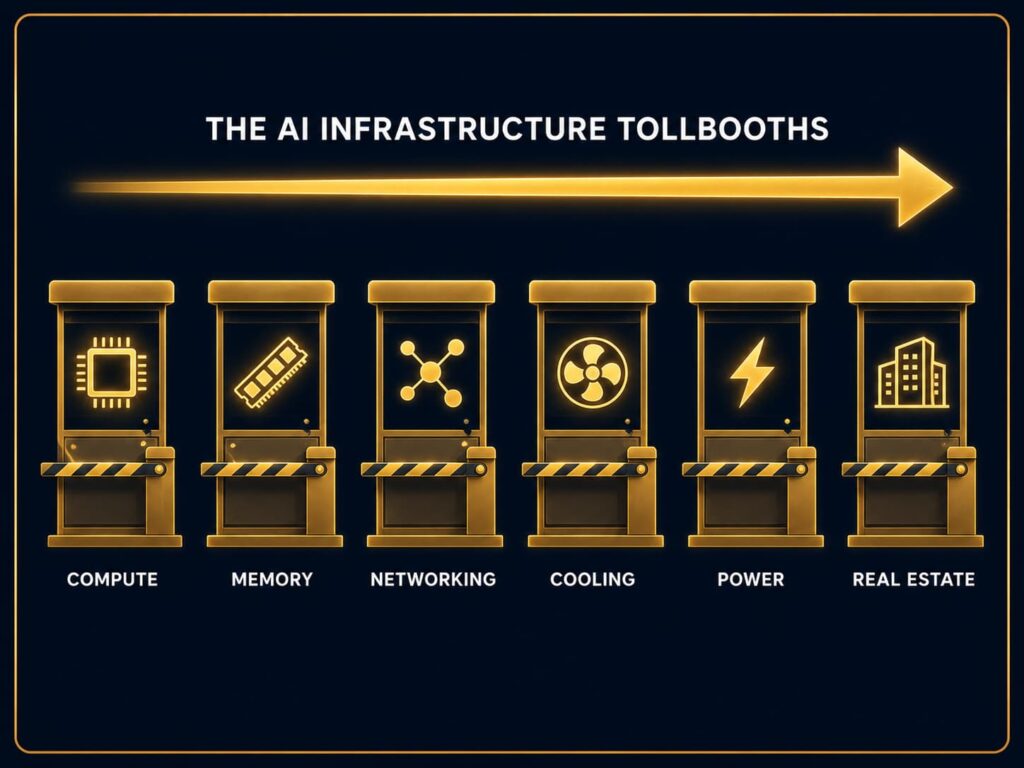
Think of the AI economy as a superhighway. Every agent task has to pass through six tollbooths, and someone is collecting at each one.
| Tollbooth | What It Does | Who Collects |
|---|---|---|
| Compute | The chips that actually run the models | Nvidia, AMD, Intel |
| Memory | Agents need context to remember what they are doing | Micron, Samsung, SK Hynix |
| Networking | Agents talk to databases, APIs, and each other constantly | Broadcom, Arista, Cisco |
| Thermal Management | Dense AI racks generate insane heat | Vertiv, Schneider Electric |
| Power | Agents run 24/7, so you need reliable electricity | Utility companies, NextEra |
| Real Estate | All this stuff has to live somewhere | Data center REITs: Equinix, Digital Realty |
A chatbot taps all six. An agent pounds them. The ai banking sector will be one of the largest consumers of this infrastructure.
The numbers do not lie. Google is processing 16 billion tokens per minute – up 60% last quarter. Nvidia’s CEO says inference compute demand is already 100 times higher than expected. Hyperscalers are spending like crazy on AI infrastructure. Memory demand is surging. Cooling backlogs are expanding.
The tollbooth companies are not hoping this demand shows up. They are reporting it every quarter.
Morgan Stanley’s AI Agent Bet
Morgan Stanley will soon open a key wealth management funnel to artificial intelligence agents from thousands of corporations, CNBC has learned exclusively. It is one of the earliest instances of a major Wall Street bank opening its platforms to external AI tools. This move signals that ai banking is moving from theoretical discussion to practical deployment.
The move will allow clients’ autonomous agents to pull data and insights directly from the firm’s stock administration platforms, ShareWorks and Equity Edge, bypassing the traditional software interfaces built for human users, according to Mark Mitchell, chief product officer of Morgan Stanley at Work. This is a defining moment for ai banking because it transforms how corporate clients interact with financial platforms.
The bank has already granted a handful of clients early agentic access and plans to open it up to the firm’s 3,400 administration clients by next year. The scale of this rollout is a clear signal that ai banking is not a pilot program. It is a strategic priority.
“The way we see it, in a future state, our corporate clients will not be logging into ShareWorks or Equity Edge,” Mitchell said. Instead, they will be “using agentic AI-powered tools on their desktops within the four walls of their companies, interacting with our platforms in a purely agentic way.” This vision of ai banking replaces software interfaces with intelligent agents that work on behalf of clients.
In April, Morgan Stanley executives attributed $1.2 trillion in assets gathered to its workplace strategy. The firm acquired Solium Capital in 2019 and E-Trade in 2020, creating a business that it says caters to almost half of the companies in the S&P 500 and eight of the 10 biggest unicorn startups. That scale gives Morgan Stanley a unique position in the ai banking race.
The bank’s AI pitch to corporate clients is straightforward. Fast-growing technology and biotech companies want to administer increasingly complex stock plans without adding headcount in support roles like human resources. AI agents can handle aspects of the job without adding human employees. For Morgan Stanley, ai banking is about scaling services without scaling headcount.
For the CNBC exclusive , Morgan Stanley’s move signals that ai banking is moving from experimentation to deployment across the entire wealth management industry.
The Model Context Protocol
For this change, Morgan Stanley is leaning on something called the Model Context Protocol, an open-source standard that allows AI models to plug into data sources.
In a pre-AI world, companies would have frowned upon allowing clients to bypass the online front door to their services. For decades, companies fought to hook users on proprietary platforms.
Morgan Stanley, which began partnering with OpenAI in 2022, believes that matters less in a world where AI agents become the primary interface. Software is “at an inflection point, clearly,” Mitchell said.
“The companies that are going to survive in the future are the ones who have proprietary data and business logic, which is the foundation of our offering,” Mitchell said. “The fact that they won’t be logging into the websites doesn’t scare us at all.”
This is the new logic of ai banking. The platform is the data, not the interface.
Why This Matters: The Efficiency Ratio
Fully embracing AI could drive a 15-percentage-point improvement in your bank’s efficiency ratio.
Artificial intelligence is redefining the future of banking. It is a profound technological advancement catalyzing structural transformation across the industry. As AI, including generative AI, scales from experimentation to implementation to enterprise-wide reinvention, it is creating dual tailwinds directly impacting bank efficiency ratios.
| Driver | Impact on Efficiency Ratio |
|---|---|
| Revenue growth | Up to 3 percentage points improvement |
| Cost transformation | Up to 14 percentage points improvement |
| AI investments | Temporary 2 percentage point drag |
| Net total | Up to 15 percentage points improvement |
For banking and capital markets executives, this marks a profound change where the efficiency ratio is no longer a backward-looking performance metric. It is becoming the most telling forward-looking indicator of your bank’s ability to leverage AI innovation to compete, grow and endure.
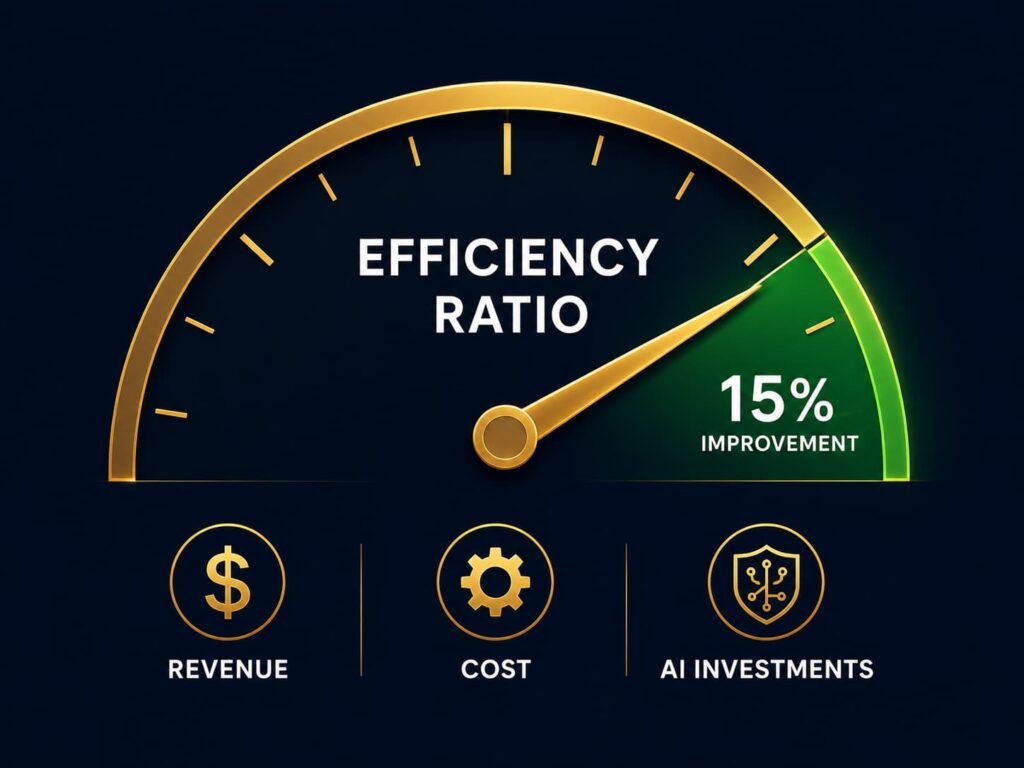
Banks that embrace AI could drive up to a 15-percentage-point improvement in their efficiency ratio, according to PwC Strategy& analysis . The efficiency ratio is poised to evolve into a barometer of AI maturity. Banks using AI can more effectively capture “money in motion” and anticipate customer needs at scale to grow revenue without proportional cost increases.
For more on [risk management in financial infrastructure], this guide covers how ai banking transforms operational risk.
Revenue Driver: Client Impact and Growth
AI tools are improving how teams identify high-intent prospects and enhance the precision of marketing and advisory efforts. When embedded in the banking lifecycle, these tools can boost satisfaction and retention and redefine how and where clients interact with their bank. This is the revenue side of ai banking.
Customization at scale
Today’s customer and client service is undergoing a fundamental shift as AI becomes embedded in day-to-day customer interactions. In the consumer finance space, AI chatbots sift through internal knowledge bases, customer account data, and service tickets to deliver instant, accurate and personalized customer support. This is ai banking at its most visible level.
In asset and wealth management, several banks are already using GenAI to deliver real-time insights and build portfolios tailored to each client’s risk appetite, spending habits, and long-term goals. Clients receiving the personalization they are seeking can make a measurable impact on a bank’s levels of client satisfaction, engagement and retention. The revenue potential of ai banking lies in this hyper-personalization at scale.
Proactive financial decision-making
AI is already moving beyond suggestions to taking action, with the goal to autonomously execute tasks within human-defined guardrails. This is the next frontier of ai banking.
A customer’s personal CFO interface, for example, would unify budgeting, borrowing, investing and insurance in one seamless conversation. The personal CFO then crafts a tailored portfolio or submits a micro loan application after the customer taps to approve. In ai banking, the customer does not need to navigate multiple apps or websites. The agent does it for them.
As a client searches flights to Italy, the same digital agent automatically completes a travel rewards credit card application and issues a digital card immediately, calibrated to the client’s expected spending. In the background, autonomous AI agents can watch the stock and bond markets and draft orders, waiting for customer confirmation to execute trades. This proactive capability is what separates ai banking from traditional digital banking.
These capabilities remain in limited pilots today, but they paint a picture of banking becoming personal again, prompting interactions that feel proactive, deeply personal and almost invisible. Together, they can turn money management from a task into an intelligent service that benefits financial wellbeing. That is the promise of ai banking.
Cost Driver: Intelligent Automation
AI is streamlining processes, automating routine work and eliminating inefficiencies, freeing teams to focus on higher value activities. We are seeing firsthand how this transformation is establishing a new frontier in ways of working and industry performance.
One institution, for example, cited a 40% decrease in costs to verify commercial banking clients thanks to AI-driven onboarding and verification tools. We expect this cost optimization trend to continue, with banks adopting AI-driven operations experiencing up to a 14 percentage point drop in their efficiency ratio.
AI can power cost reduction through next-generation efficiency and “melting” the middle office, collapsing traditional silos between front and back office to create more integrated, agile and scalable operations.
Achieving these gains will inevitably require continued investments into a company’s AI “backbone.” While our analysis suggests that these efforts may raise steady-state costs and temporarily increase efficiency ratios by around 2 percentage points, they are critical for long-term data advantage, stronger transparency and a meaningful edge in a new race for trust and authenticity.
The Governance Challenge
The more responsibility AI agents receive, the more important governance becomes.
Financial institutions will need to answer questions that barely existed a few years ago. What information can an agent access? What actions can it take? How are those actions monitored? What happens if an agent receives manipulated instructions?
Chandler Fang, founder of t54, put it this way:
“Morgan Stanley’s approach makes sense. Agentic AI gives financial institutions a way to scale customer support, plan administration, and the broader wealth management funnel without needing to add thousands of employees. The value proposition is clear, especially in areas like treasury management, trading, equity research, analysis, and operational automation. However, the real challenge is governance. Banks need robust data privacy controls to ensure agents can’t access or misuse confidential client information. They also need safeguards against prompt injection and other emerging AI security risks. An underwriting agent should operate under very different permissions, controls, and risk parameters than a wealth management agent. That is where the next layer of infrastructure will be built.”
The banks that figure out how to combine automation with security, compliance, and client trust could end up with a meaningful advantage over the next decade.
The Human-AI Collaboration
This new model of banking goes beyond simple automation. It leverages AI agents as adaptive performance engines: automating routine work, orchestrating complex processes, and positioning people where they create the most value. Together, this human–AI collaboration enables banks to compete more effectively in an AI-driven economy.
Internally, there is a similar logic. Morgan Stanley sees agentic AI allowing it to scale its own services, customer support, plan administration, the wealth management funnel, without adding “thousands and thousands” of employees, Mitchell said.
Rivals including JPMorgan Chase and Goldman Sachs are using AI agents internally for things like writing code, but have yet to publicly announce steps to allow external agents to connect directly to their firms’ systems. Morgan Stanley is leading the way in external ai banking integration.
The Real AI Story
Here is the beautiful part. It does not matter which AI model wins. OpenAI could dominate. Google could. Some startup nobody has heard of yet. Does not matter.
Whoever wins still needs compute. Still needs memory. Still needs networking. Still needs cooling. Still needs power. And in ai banking, whoever wins still needs the platforms that administer trillions in assets.
The infrastructure companies get paid regardless of who crosses the finish line first. Morgan Stanley is positioning itself to be the infrastructure for ai banking wealth management.
The tollbooth companies are not hoping this demand shows up. They are reporting it every quarter. That is the difference between this gold rush and the last one. The demand is real. It is already here.
The Competitive Landscape – Who Is Leading the AI Banking Race?
The ai banking race is not a single sprint. It is a multi-lane marathon with different leaders in different segments.
Morgan Stanley is leading in wealth management integration. By opening its ShareWorks and Equity Edge platforms to external AI agents, it has staked a claim to the future of employee stock plan administration. The $1.2 trillion in assets attributed to its workplace strategy is a number that competitors cannot ignore. Morgan Stanley is betting that ai banking will make wealth management more scalable, not less personal.
JPMorgan Chase is leading in internal AI deployment. The bank has been using AI agents internally for code generation, research analysis, and operational automation. While it has not yet announced external agent access, its internal scale is unmatched. JPMorgan is betting that ai banking will make its operations more efficient before it touches client-facing systems.
Goldman Sachs is leading in AI-driven research and trading. The bank has deployed AI tools to assist with equity research, macroeconomic analysis, and trade execution. It is also exploring agentic AI for client onboarding and compliance. Goldman is betting that ai banking will give it an edge in speed and insight.
Citigroup is leading in AI-powered risk management. The bank has deployed AI tools to monitor credit risk, market risk, and operational risk in real time. It is also exploring agentic AI for regulatory reporting and compliance monitoring. Citi is betting that ai banking will make risk management more proactive and less reactive.
The ai banking leaders are not all moving in the same direction. Each bank is placing its bet on where ai banking will create the most value. Morgan Stanley is betting on wealth management and client acquisition. JPMorgan is betting on internal efficiency. Goldman is betting on research and trading. Citi is betting on risk and compliance.
The banks that figure out how to combine automation with security, compliance, and client trust will have a meaningful advantage over the next decade. But the first mover advantage in ai banking is real. Morgan Stanley’s move to open its platforms to external AI agents is a signal that ai banking is moving from experimentation to deployment.
Bottom Line
AI banking is real. Morgan Stanley’s move to open its wealth platform to external AI agents is not a pilot. It is a signal.
The efficiency ratio is no longer a backward-looking metric. It is becoming the most telling forward-looking indicator of which banks are winning the AI race. PwC’s analysis shows that banks that fully embrace AI could drive up to a 15-percentage-point improvement in their efficiency ratio.
That is not incremental. That is transformational.
The banks that figure out how to combine automation with security, compliance, and client trust will have a meaningful advantage over the next decade. The infrastructure companies that power the tollbooths will get paid regardless of which model wins.
Most investors are still watching the wrong race. The AI story is not about the models. It is about the infrastructure. And in banking, it is about who builds the platforms that AI agents will rely on.
The race is on. Morgan Stanley just made its move.
Disclaimer
This article is for educational and informational purposes only. It does not constitute financial advice, trading recommendations, or an offer to buy or sell any asset. Trading and investing carries significant risk. Past performance does not guarantee future results. Always do your own research. Consult a licensed financial advisor if you need professional investment advice.