


The regulatory landscape for crypto Etps in the United States underwent one of the most significant shifts in years on September 2, 2026. In a joint staff statement, the Securities and Exchange Commission (SEC) and the Commodity Futures Trading Commission (CFTC) clarified that current U.S. law does not prohibit registered exchanges from facilitating the trading of certain spot crypto-asset products. This wasn’t a new law, and it wasn’t a new rule. It was something arguably more impactful: a coordinated statement that removed the regulatory ambiguity that had kept many spot crypto products off major U.S. exchanges for years.
The announcement came during individual keynotes by the two chairmen followed by a fireside chat at the ninth annual DC Blockchain Summit, hosted by the Chamber of Digital Commerce. SEC Chairman Paul S. Atkins described the interpretation as a key step toward greater certainty. “After more than a decade of uncertainty, this interpretation will provide market participants with a clear understanding of how the Commission treats crypto assets under federal securities laws. This is what regulatory agencies are supposed to do: draw clear lines in clear terms,” Atkins said.
The CFTC joined the SEC in the interpretation to align guidance under the Commodity Exchange Act. CFTC Chairman Michael S. Selig stated, “For far too long, American builders, innovators, and entrepreneurs have awaited clear guidance on the status of crypto assets under the federal securities laws and Commodity Exchange Act. With today’s interpretation, the wait is over.”
This article breaks down everything you need to know about the SEC-CFTC joint interpretation, the five-bucket taxonomy, what it means for crypto ETPs, and how traders can position themselves for the coming wave of institutional capital. The crypto ETPs pipeline is now more visible than ever.
For more on crypto trading strategies, see our guide on crypto trading strategies.
Key Takeaways: 7 Things Every Trader Must Know About Crypto ETPs
- The SEC-CFTC joint interpretation classifies most crypto assets as “digital commodities” – not securities – providing long-sought regulatory clarity.
- The 5-bucket taxonomy separates digital assets into commodities, collectibles, tools, stablecoins, and securities.
- Staking, mining, airdrops, and wrapped tokens are explicitly classified as non-securities transactions.
- Three regulatory shifts – Generic Listing Standards (2025), the March 2026 interpretive release, and the pending CLARITY Act – unlocked the ETP pipeline.
- Already approved: Spot ETFs for Bitcoin, Ethereum, Solana, and XRP are trading with over $100 billion in combined AUM.
- The pipeline: Over 90 ETF applications covering 24 tokens remain under SEC review, with Bitwise projecting 100+ new crypto ETFs launching in 2026.
- The CLARITY Act would codify the commodity-vs-security taxonomy into federal statute, making the current regulatory framework permanent.
The SEC-CFTC Joint Interpretation: A Regulatory Green Light
The joint statement, released by the SEC’s Division of Trading and Markets and the CFTC’s Division of Market Oversight and Division of Clearing and Risk, expressed the view that SEC-registered national securities exchanges (NSEs) and CFTC-registered designated contract markets (DCMs) are not prohibited from facilitating the trading of certain spot crypto-asset products. This seemingly technical clarification carried profound implications for crypto ETPs.
“Today’s joint staff statement represents a significant step forward in bringing innovation in the crypto asset markets back to America,” said SEC Chairman Paul Atkins. “Market participants should have the freedom to choose where they trade spot crypto assets.”
CFTC Acting Chairman Caroline D. Pham added: “Under the prior administration, our agencies sent mixed signals about regulation and compliance in digital asset markets, but the message was clear: innovation was not welcome. That chapter is over.”
The joint effort is part of the SEC’s Project Crypto and the CFTC’s Crypto Sprint, building on the recommendations of the President’s Working Group on Digital Asset Markets report on “Strengthening American Leadership in Digital Financial Technology.” The crypto ETPs framework is now clearer than ever.
According to the SEC – Joint Statement on Crypto ETPs, this clarification removes the regulatory ambiguity that had kept many spot crypto products off major U.S. exchanges for years.
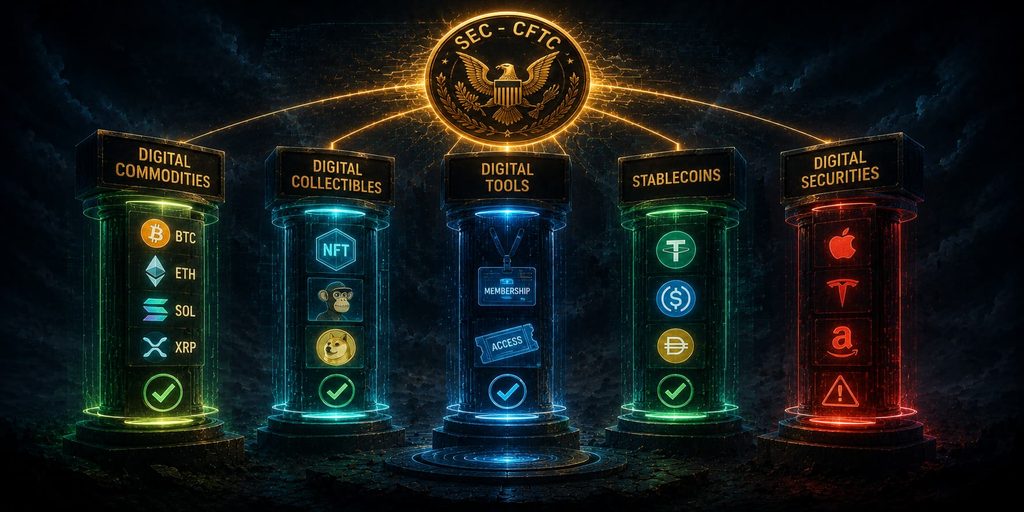
The 5-Bucket Taxonomy: How Crypto Assets Are Now Classified
The guidance separates digital assets into 5 distinct categories based on their characteristics, uses, and functions—4 of which are not treated as securities. This taxonomy is essential for understanding which crypto ETPs can move forward.
For the full breakdown, visit the CFTC – Digital Asset Guidance page.
1. Digital Commodities
A crypto asset that’s linked to and derives value from the operation of a crypto system, rather than the expectation of profits. The guidance specifically mentions Bitcoin (BTC), Ethereum (ETH), Solana (SOL), XRP, Cardano (ADA), Chainlink (LINK), Avalanche (AVAX), Polkadot (DOT), and 15 other cryptocurrencies. Digital commodities are not treated as securities.
2. Digital Collectibles
Crypto assets that are designed to be collected, and may represent or convey rights to artwork, music, videos, trading cards, in-game items, memes, characters, or cultural content. NFTs and memecoins may fall under this category. Digital collectibles are not treated as securities.
3. Digital Tools
Crypto assets that perform a practical function, like representing proof of a membership, ticket, credential, and other similar use cases. Digital tools are not treated as securities.
4. Stablecoins
Crypto assets designed to maintain a stable value equivalent to its pegged asset. Payment stablecoins under the GENIUS Act are not securities. By statute, a “payment stablecoin” issued by a permitted issuer under the GENIUS Act will be excluded from the securities definition when the Act becomes effective.
5. Digital Securities
Digital assets issued as investment contracts with promises of future profits. Includes tokenized securities (i.e., traditional financial instruments that are traded on a blockchain, including tokenized stocks and bonds). Unsurprisingly, digital securities are treated as securities.
When a Non-Security Crypto Asset Becomes a Security via Howey
The guidance establishes how a legal standard called the Howey Test—which defines whether a transaction qualifies as an investment contract, and therefore a security—applies to digital assets. It makes clear that a digital asset can start out as a security and “graduate” from that status if there is no longer a reliance on the efforts of the issuer to derive value for the asset. This is crucial for crypto ETPs.
Creation of an Investment Contract
A non-security crypto asset becomes subject to an investment contract when an issuer induces an investment of money in a common enterprise by making representations or promises to undertake essential managerial efforts from which purchasers would reasonably expect profits.
What matters: the source, content, timing, and channel of issuer communications. Explicit, detailed promises (e.g., milestones, resourcing, timelines, how profits may arise) conveyed through formal channels are more likely to create reasonable profit expectations. Vague statements or post-sale promises do not.
Secondary Market Implications and “Separation”
The asset does not transform into a security. But the associated investment contract can “travel” with the asset in secondary trades if purchasers would reasonably expect the issuer’s promised essential managerial efforts to remain connected. The connection can cease—separating the asset from the investment contract—when:
- Fulfillment: The issuer completes the promised essential efforts (e.g., achieves stated functionality, decentralization, or open-sources code), and publicly discloses completion.
- Abandonment/failure: The issuer clearly and publicly announces it will no longer perform the promised essential efforts, or sufficient time has passed without performance and investors would no longer reasonably expect those efforts.
Airdrops: When No “Investment of Money”
Covered airdrops are disseminations of non-security crypto assets where recipients provide no money, goods, services, or other consideration in exchange for the airdropped assets. Examples include:
- Unannounced airdrops to holders of a specified asset.
- Post-facto airdrops to users of a testing environment for a prior period, with no prior announcement or conditioning.
- Unannounced, free airdrops to users based solely on prior use of a related application.
If recipients must provide consideration (e.g., purchases, services, tasks) in exchange for the airdropped asset, the interpretation does not apply. Even if an airdropped asset is not subject to an investment contract at dissemination, later transactions could create an investment contract.
Three Regulatory Shifts That Unlocked the Crypto ETPs Pipeline
The September 2026 joint statement was the culmination of three sequential regulatory developments that transformed the approval landscape for crypto exchange-traded products. Understanding these shifts is essential for any trader following crypto ETPs.
1. Generic Listing Standards (September 2025)
The SEC approved new generic exchange listing standards for commodity-based trust shares, including digital assets—the most structurally important regulatory change since the Bitcoin ETF approval in January 2024.
Before GLS, every new crypto ETF required a bespoke 19b-4 rule-change filing reviewed by the full SEC commission—a process taking approximately 240 days on average with no guarantee of approval. Under GLS, if a digital asset meets predefined criteria, an exchange can list the ETF within 75 days without an SEC vote.
The criteria: the underlying asset must be traded as a futures product on a CFTC-regulated exchange for at least six months, have a 12-month average liquidity of $700M+, and participate in the Intermarket Surveillance Group (ISG) fraud monitoring program. GLS compressed approval timelines by 68% and created a predictable, mechanistic path for eligible assets. This accelerated the crypto ETPs pipeline dramatically.
2. The Joint SEC-CFTC Interpretive Release (March 17, 2026)
On March 17, 2026, the SEC and CFTC jointly published a landmark 68-page interpretive release that classified 16 cryptocurrencies as “digital commodities”—not securities. The 16 assets include Bitcoin (BTC), Ethereum (ETH), Solana (SOL), XRP, Cardano (ADA), Chainlink (LINK), Avalanche (AVAX), Polkadot (DOT), and others. This classification resolved the commodity-vs-security question that had blocked institutional capital for years.
Key consequences of this ruling for crypto ETPs:
- Any spot ETF for the 16 named assets can proceed through the GLS approval process with the commodity-vs-security question resolved.
- Institutional compliance departments that blocked altcoin exposure on securities grounds must now update their frameworks.
- Exchange listings for all 16 assets are cleared of SEC enforcement risk.
- Staking yield is explicitly classified as a non-securities transaction—validating staking ETF products.
- The ruling is an interpretive rule (binding but not statutory); the CLARITY Act would make it permanent.
3. The CLARITY Act (Pending)
The Digital Asset Market Clarity Act, passed by the House 294-134 in July 2025, would codify the commodity-vs-security taxonomy into federal statute—making the March 17 ruling permanent and impossible to reverse without Congressional action. The CLARITY Act transfers jurisdiction over most crypto spot markets to the CFTC and establishes a framework for digital asset regulation.
What This Means for Crypto ETPs
The Immediate Impact
The September 2026 joint statement, combined with the earlier regulatory shifts, creates a clear path to market for a wide range of crypto ETPs. As one industry observer noted, U.S. regulators have taken a coordinated step toward making spot crypto products market ready. The crypto ETPs pipeline is now wide open.
Approved Products Already Trading
As of 2026, spot ETFs are already live for four asset classes:
- Bitcoin: 11 spot ETFs approved January 2024, including BlackRock’s IBIT (roughly 50.8% market share)
- Ethereum: Spot ETFs approved May 2024, began trading July 2024
- Solana: Spot ETFs approved September 2025
- XRP: Spot ETFs approved November 2025
Total AUM across Bitcoin and Ethereum spot ETFs alone exceeded $100 billion at peak. Bitcoin ETFs absorbed $47.2 billion in 2025 inflows and now hold approximately 7% of global BTC supply. This demonstrates the massive appetite for crypto ETPs.
The Pipeline: What’s Coming Next
The crypto ETPs pipeline is substantial. According to industry analysis:
- Approximately 91 ETF applications covering 24 tokens remain under SEC review, including Dogecoin, Cardano, Avalanche, and Polkadot filings.
- At least 126 crypto ETF filings are pending.
- Bitwise projects 100+ new crypto ETFs launching in 2026.
- Galaxy Research projects $50B+ in 2026 ETF net inflows.
- DOGE, ADA, AVAX, LINK, DOT, and more are next in the queue.
Institutional Capital Floodgates
The combined effect of these regulatory shifts is expected to be transformative. Analysts predict the new framework could flood the crypto markets with over $3 trillion in institutional capital by 2030.
The taxonomy shift is the final green light for Solana and XRP Spot ETFs. Institutional demand for diversified crypto products is expected to skyrocket now that the underlying assets are legally defined. Crypto ETPs are the vehicle for this institutional adoption.

What’s Still Being Debated
The regulatory clarity is not complete. Industry groups are still clashing with the SEC over how to regulate a new generation of exchange-traded products spanning crypto, private assets, event contracts, and leveraged strategies. This affects the future of crypto ETPs.
The Crypto Council for Innovation has asked the SEC to extend some of the regulatory efficiencies available to ETFs registered under the Investment Company Act of 1940 to other exchange-traded products. Many spot crypto products currently use commodity-trust structures instead of registering as investment companies.
Grayscale, Andreessen Horowitz, the Solana Policy Institute, and others have filed competing letters with the SEC on issues including:
- Whether novel ETFs need one common regulatory framework or separate rules based on their structures and risks
- Whether event contracts should remain eligible for registered funds
- Whether confidential consultations should be permitted before public filings
The SEC must now decide these questions, which will shape the regulatory framework for the next generation of crypto ETPs.
Why This Matters for Traders
For traders, the regulatory clarity has several practical implications that will shape crypto ETPs trading.
1. More Products, More Liquidity
The crypto ETPs pipeline will bring a flood of new products to market, increasing liquidity and providing more ways to gain crypto exposure through traditional brokerage accounts.
2. Institutional Validation
The classification of major cryptocurrencies as commodities rather than securities provides the legal certainty that institutional investors required. This is expected to drive significant institutional capital into the space through crypto ETPs.
3. Reduced Regulatory Risk
With the commodity-vs-security question resolved for the 16 named assets, exchange listings for these assets are cleared of SEC enforcement risk.
4. The CLARITY Act Wildcard
The pending CLARITY Act would codify the taxonomy into federal statute, making the current regulatory framework permanent and impossible to reverse without Congressional action. Its passage would cement the current regulatory environment for crypto ETPs.
For more on risk management in crypto, see our guide on risk management in crypto.
Conclusion: A New Era for Crypto ETPs
The SEC and CFTC have jointly cleared the path for crypto ETPs. The joint interpretation, combined with the Generic Listing Standards and the pending CLARITY Act, has created a clear regulatory framework for crypto exchange-traded products. The crypto ETPs pipeline is now more visible than ever.
The 5-bucket taxonomy provides the clarity that the industry has been seeking for over a decade. Digital commodities, collectibles, tools, and stablecoins are not securities. Staking, mining, airdrops, and wrapped tokens are explicitly classified as non-securities transactions. This is a fundamental shift in how the U.S. government views crypto assets.
For traders, the implications are clear: more products, more liquidity, more institutional capital, and reduced regulatory risk. The crypto ETPs market is about to expand significantly. The next few years will see a flood of new crypto ETPs hitting the market, providing traders with more ways to gain exposure to digital assets through traditional brokerage accounts.
The regulatory landscape for crypto assets in the United States has changed. The path is now clear for crypto ETPs. The question is not whether the institutional capital will come, but how fast.
Disclaimer
This article is for educational and informational purposes only. It does not constitute financial advice, trading recommendations, or an offer to buy or sell any asset. Trading cryptocurrencies carries significant risk and may not be suitable for all investors. You can lose more than your initial deposit. Past performance does not guarantee future results. Always read full terms, contract specifications, and risk disclosures before trading. Do your own research. Consult a licensed financial advisor if you need professional investment advice.