


Financial markets have spent decades proving an uncomfortable truth: the investor’s greatest enemy is not volatility, fees, or even choosing the wrong fund. It’s the investor himself. The way your brain processes information, manages fear, and makes decisions under uncertainty can cost you more profitability than any other factor. Confirmation bias is the silent killer of portfolios.
So says the data. According to the “Mind the Gap 2024” report by Morningstar, the average investor earns roughly one percentage point less per year than the very funds they invest in. Not because the funds perform poorly, but because investors buy and sell at the wrong moments. Confirmation bias plays a major role in this underperformance.
What drives this problem? The answer lies in cognitive biases: mental shortcuts the brain uses to make quick decisions which, when applied to investing, tend to produce systematically poor outcomes. The Spanish National Securities and Exchange Commission (CNMV) itself includes them in its “Economic Psychology Guide for Investors” and warns of their impact on the financial decisions of savers. Confirmation bias is one of the most dangerous of these biases.
For more on why traders struggle with discipline, see our guide on why most traders quit.
Key Takeaways: Understanding Confirmation Bias
- Confirmation bias leads individuals to favor information that aligns with their pre-existing beliefs, potentially resulting in skewed decision-making.
- It originates in cognitive psychology and is crucial in understanding investor behavior in markets.
- Investors should recognize their confirmation bias tendencies to improve decision-making and avoid investment pitfalls like bubbles.
- Actively seeking diverse perspectives and challenging assumptions can mitigate the effects of confirmation bias.
- The stock market’s bubble phenomena can be attributed to herd behavior, where individuals follow popular trends without independent analysis.
For more on how to prepare for high-impact data, see our guide on how to prepare for high-impact data.
What Is Confirmation Bias?
Confirmation bias is a cognitive process where individuals favor information that reinforces their existing beliefs or theories. It originates from cognitive psychology and plays a significant role in behavioral finance. According to Investopedia, confirmation bias is one of the most common cognitive biases affecting investors, leading them to seek out information that confirms their existing opinions while ignoring contradictory data.
This bias influences decisions by reinforcing preconceived notions, potentially leading to poor financial outcomes. Investors may skew the value of their decisions based on their own cognitive biases because they seek out information that confirms their existing opinions. They ignore facts or data that refutes them. Recognizing confirmation bias is crucial for investors to make rational decisions and avoid financial pitfalls.
The confirmation bias meaning is straightforward: when you believe something to be true, your brain automatically seeks out evidence that supports that belief while filtering out anything that contradicts it. This is not a conscious choice. It is a deeply ingrained neurological shortcut that has been with us since the dawn of human cognition. Confirmation bias is the brain’s way of protecting us from the discomfort of being wrong.
When it comes to investing, data and analysis play an important role but human behaviour often influences decisions just as strongly. One of the most common behavioural tendencies investors experience is confirmation bias—the habit of favouring information that supports what we already believe while ignoring facts that challenge those views. In the context of mutual funds this bias can subtly affect choices such as which schemes to invest in, how long to stay invested and whether to diversify.
How Confirmation Bias Works
Confirmation bias affects perceptions and decision-making in all aspects of life, but it can create particular problems for investors. When researching an investment, they might inadvertently look for or favor information that supports their preconceived notions about the asset or strategy and fail to register or to under-weigh any data that presents different or contradictory ideas. The result is a one-sided view and a self-reinforcing loop. Confirmation bias can thus cause investors to make poor decisions, whether it’s in their choice of investments or their timing of trades.
Confirmation bias can be doubly problematic when it is paired with implicit bias, which stereotypes people and groups. Confirmation bias helps explain why investors do not always behave rationally and perhaps supports arguments that the market behaves inefficiently. The syndrome is a source of investor overconfidence and helps explain why the bulls tend to remain bullish, and the bears tend to remain bearish regardless of what is happening in the market.
Psychologists call the discomfort we feel when faced with conflicting information cognitive dissonance. To avoid this discomfort many investors subconsciously dismiss or reject such information. Confirmation bias is the brain’s way of protecting us from the mental distress of cognitive dissonance.
For instance if an investor strongly believes that a particular stock or fund is the best choice, they might focus only on positive news about it and overlook warning signals. Similarly investors who get personally involved in researching their portfolio holdings may become emotionally attached to them giving importance only to favourable information. Confirmation bias in investing is a powerful and often invisible force.
Types of Confirmation Bias
Confirmation bias can be broken down into several sub-categories. Here are some of the most common.
Confirmation Bias in Research
This sort of confirmation bias relates to making a decision or adopting a view and then seeking information that supports it. This can happen unconsciously: Even in the way a person searches for evidence or phrases a question can reflect the preference and so yield the proof they want. Confirmation bias in research is pervasive.
How Confirmation Bias Affects Interpretation
This variety of confirmation bias relates to how people process and evaluate data. Typically, evidence that conflicts with preconceptions causes discomfort and so is ignored or given little consideration—while confirming evidence is accepted uncritically or at least more readily. This disparity in interpreting info explains why research so often fails to change people’s opinions on issues. Confirmation bias interpretation is a major barrier to objective analysis.
The Impact of Confirmation Bias on Memory
This type of confirmation bias relates to memory. Past experiences and events influence current thinking and behavior, of course. But people remember things in selective ways, and often that selectivity serves to back up current beliefs—as opposed to the current beliefs being shaped by the memories. In other words, we recall the past in a way that reinforces the present. Confirmation bias memory is a powerful force that shapes our perception of reality.
Why Confirmation Bias Happens
What causes confirmation bias, and why do humans have it? Although it can cause problems, it seems to make life easier too. Below are a few reasons why.
Efficiency of Confirmation Bias
It’s an information jungle out there, and it keeps getting thicker all the time in our digital media era. We don’t have the time or the energy to evaluate everything equally to form unbiased decisions. By encouraging us to look for or accept certain types of info, confirmation bias frankly helps cut through the clutter. It’s an efficient, if limited, way to edit evidence and process data. Confirmation bias efficiency is a survival mechanism.
Boosting Self-Esteem Through Bias
People like to feel good about themselves—that they’re intelligent, decent, and right. Discovering that they’re incorrect makes people feel bad about themselves. Therefore, people will seek information that supports their existing opinions, decisions, and desires. In other words, confirmation bias is a confidence booster. It’s no surprise that, while anyone can be prone to it, confirmation bias often can be found in anxious individuals with low self-esteem.
Stress Reduction via Confirmation Bias
“The test of a first-rate intelligence is the ability to hold two opposed ideas in the mind at the same time, and still retain the ability to function,” F. Scott Fitzgerald wrote in “The Crack-Up,” a 1936 essay. Ah, but for most people, maintaining a pair of contradictory beliefs causes cognitive dissonance—a state of mental distress and unease that often impedes functioning. To minimize this dissonance, confirmation bias kicks in. By reinforcing one set of facts—what we want to see, hear, or believe—it alleviates the paralyzing conflict. Confirmation bias stress reduction is a psychological defense mechanism.
How Confirmation Bias Influences Investment Decisions
Confirmation bias can be particularly dangerous for investors. Reflecting the direct influence of desire on beliefs as it does, it causes irrational behavior—and investing is one area where emotion emphatically has no place. Confirmation bias in investing is one of the most costly cognitive errors.
While countless ways exist for confirmation bias to (adversely) affect investment decisions, here are three common effects.
Missed Opportunities Due to Bias
Confirmation bias encourages investors to remain preoccupied with their own prejudices and stay in their comfort zones. As a result, they might easily miss out on new (to them) strategies, products, and investment opportunities. They might cling to notions like “never dig into principal” or “never go into debt,” even when their individual circumstances dictate that doing the opposite makes more financial sense. Confirmation bias missed opportunities are a real cost.
Ignoring Diversification and Its Risks
Diversification is a technique that allocates investments across various financial instruments, industries, and asset classes that would each react differently to the same event. Although it mainly aims to reduce risk, it can maximize returns (by avoiding losses) as well. Confirmation bias can encourage investors to become obsessed with a few companies or a few investment types. This causes them to ignore diversification and concentrate their holdings in a single stock or asset class, thus exposing themselves to greater risk.
The Role of Confirmation Bias in Market Bubbles
Bubbles occur when prices for a particular asset or investment rise far above its real value in increasingly speculative trading. Since bubbles are all about investors buying “because everyone’s doing it,” people with confirmation bias are prone to invest more in asset bubbles, swayed by the consensus view—and ignoring any contrarian voices warning that the uptick is getting out of hand, that the elevated prices aren’t justifiable or sustainable. So they’re likely to incur a lot of financial damage when the bubble pops, as it inevitably does. Confirmation bias market bubbles have destroyed countless portfolios.
Consequences of Confirmation Bias in Investing
If not addressed confirmation bias can significantly influence investment decisions. Some of the common effects include:
- Holding on to investments for too long – Investors may ignore warning signals and focus only on favourable updates, delaying timely action. Confirmation bias makes you hold losers too long.
- Relying on selective information – Instead of reviewing all available facts they may look for data that only supports their preset belief.
- Lack of diversification – Overconfidence in a few ideas can result in portfolios that are concentrated and exposed to higher risk.
- Excessive exposure to employer stock – Some investors put a large share of their money into their company’s stock assuming they have an advantage which can increase risk.
Confirmation bias can cause investors to make poor decisions, whether it’s in their choice of investments or their timing of trades.
For more on overcoming cognitive biases, see our guide on overcoming cognitive biases.
A Real-World Example of Confirmation Bias
Suppose an investor hears a rumor that a company is on the verge of declaring bankruptcy. Based on this information, the investor considers selling the stock. When they go online to read the latest news about the company, they read only the articles that repeat the likely bankruptcy scenario and miss a story about a promising new product the company has just launched that is expected to increase sales. Instead of holding the stock, the investor sells it at a substantial loss—just before it turns around and climbs to an all-time high.
This is confirmation bias in action. The investor sought out information that confirmed their fear and ignored information that contradicted it. The result was a costly mistake. Confirmation bias examples like this are everywhere in the markets.
Other Dangerous Cognitive Biases
Confirmation bias is not the only cognitive bias that threatens your portfolio. Here are other dangerous biases to watch for.
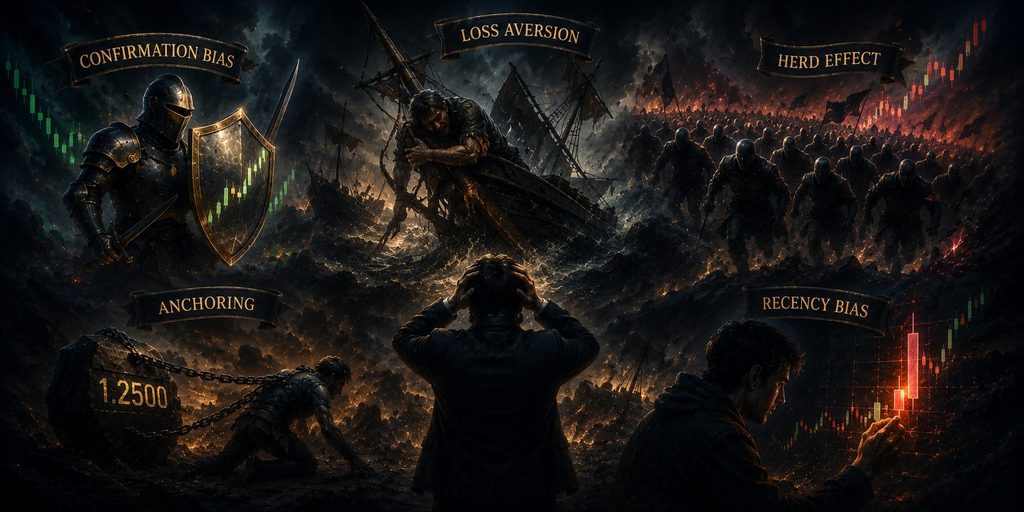
Loss Aversion: The Costliest Bias
The fear of losing is real—so real that it often outweighs the possibility of gaining something of equal value. “When investing, it may happen that, in order to avoid realizing losses, an investor holds onto an investment with little chance of recovery and ultimately loses the entire investment,” explain experts at the CNMV.
Applied to investing, it produces a devastating outcome: investors sell during market downturns (out of fear of further losses) and remain out of the market just as the recovery begins. In many cases, investors do not fail because they chose the wrong funds, but because they exit at the worst possible moments and re-enter too late during the good ones. Loss aversion works hand in hand with confirmation bias.
Over the long term, this bias can intensify and evolve into what is known as the “myopic loss aversion” effect. It consists of obsessing over reviewing the portfolio daily and overreacting to news and events that occur in the short term. Myopia causes investors to lose their perspective on their investment, since the more frequently they look, the more likely they are to see a loss and act on it.
Herd Effect: Doing What Everyone Else Does
Let’s be honest: at some point in our lives we have all been influenced by the opinion of the group. When we were children, we sometimes went along with mischief we weren’t fully convinced about, simply because our friends were. Later in life, we may have done the same with trends that didn’t really suit us. Well, investing is no exception to this “peer pressure” effect.
When markets fall and everyone is selling, the pressure to do the same can feel almost irresistible. And when everyone is buying a particular asset class, staying on the sidelines can feel like a mistake. The herd effect (or herd behavior) leads investors to act against their own analysis simply because others are doing the same.
The fear of missing out on a historic opportunity pushes individual investors to enter the market just when prices already reflect everyone else’s optimism. The problem is that, without a personal strategy, there is no clear basis for knowing when to exit. And when enthusiasm fades and a correction arrives, those who entered on impulse are often the last to leave—and the ones who lose the most. Confirmation bias and the herd effect reinforce each other.
Anchoring Bias: “I Won’t Sell Until I Recover What I Paid”
It is one of the most repeated phrases among investors and one of the costliest. Anchoring bias makes us fixate on a reference point—such as the purchase price or a stock’s all-time high—and make decisions based on that figure instead of evaluating the current market reality. Confirmation bias often reinforces anchoring.
Overconfidence: Believing You Know More Than You Do
Believing you know more than you actually do is one of the most common and silent biases. The overconfident investor doesn’t realize they are taking on more risk than they think; they are convinced their analysis is correct, their instincts are reliable, and that things will unfold as expected. The result is a more concentrated portfolio, more frequent trading, and a perception of risk that does not match reality. Confirmation bias fuels overconfidence.
Recency Bias: Overweighting Recent Events
After a sharp stock market drop, the investor overestimates the likelihood of another and flees. Likewise, after an exceptional year in some asset class, they assume it will continue to rise and concentrate their portfolio there. In other words, the brain gives more weight to what has just happened than to long-term historical evidence, leading us to assume that recent market behavior will persist in the future. As a result, decisions are often made at the worst possible time: buying high and selling low. Recency bias works hand in hand with confirmation bias.
Strategies to Overcome Confirmation Bias
The encouraging part is that confirmation bias can be minimized with conscious effort and discipline. A few strategies include:
Seek Contrary Advice
The first step to overcoming confirmation bias is to have an awareness that it exists. Once an investor has gathered information that supports their opinions and beliefs about a particular investment, they should seek alternative ideas that challenge their point of view. It is good practice to make a list of the investment’s pros and cons and reassess it with an open mind. This is the most direct way to counter confirmation bias.
Avoid Affirmative Questions
Investors should not ask questions that confirm their conclusions about an investment. For example, an investor who wants to buy a stock because it has a low price-earnings (P/E) ratio would be affirming their findings if they only asked their financial advisor about the company’s valuation. A better approach would be to ask the broker for more information about the stock, which can be pieced together to form an unbiased conclusion.
Explore Different Perspectives
If you usually depend on one research approach, balance it with other viewpoints to get a wider picture. Confirmation bias thrives in echo chambers. Seek out opinions that challenge your assumptions.
Give Equal Weight to All Data
Consider both positive and negative information before making a decision. Confirmation bias leads us to overweight confirming evidence. Consciously force yourself to evaluate contradictory data.
Build a Diversified Portfolio
Allocating money across multiple asset classes reduces the risk of overconfidence in a single investment. Diversification is one of the most effective defenses against confirmation bias.
Seek Professional Support
Financial advisors and fund managers rely on structured analysis and risk management which helps bring objectivity to investment decisions. An external perspective can help counter confirmation bias.

How to Protect Your Portfolio from Confirmation Bias
Knowing about biases is not enough to avoid them: awareness alone does not switch off emotional decision-making mechanisms. But it does help create safeguards. Confirmation bias can be managed with the right safeguards.
Some practical measures include:
- Set up automatic periodic contributions instead of deciding each time when and how much to invest. This removes the emotional decision-making that confirmation bias feeds on.
- Review your portfolio periodically rather than daily. Frequent checking increases the likelihood of falling prey to recency bias and confirmation bias.
- Write down in advance your rules for how you will act during market declines, before emotions take over. Having a written plan helps counter confirmation bias.
- Use stop-loss orders to remove the emotional element from exit decisions.
- Keep a trading journal where you record your reasoning for each trade, including alternative perspectives you considered.
However, one of the most effective safeguards is having a financial advisor who acts as a behavioral counterweight, helping prevent impulsive decisions.
How Confirmation Bias Affects Mutual Fund Investors
When it comes to mutual fund investing, confirmation bias can show up in several ways:
- Overlooking negative information – An investor may continue holding a fund by focusing only on its past achievements, while ignoring recent periods of underperformance.
- Overconfidence in a single asset class – Some investors assume that equity funds always provide higher returns and ignore the relative stability offered by debt or hybrid funds.
- Depending only on familiar sources – Many rely mainly on friends, family or social media for advice while avoiding professional guidance that might challenge their existing views.
- Equity vs Debt Funds – An investor convinced that equities are too risky may stick only to debt funds. While safer, this approach might limit long term growth potential.
- Sticking to Familiar Funds – Choosing the same category of funds every time, instead of exploring options like hybrid funds, index funds, or thematic funds.
- Ignoring Diversification – Believing that one SIP is enough, while overlooking the importance of spreading investments across asset classes.
Such patterns highlight how psychology can interfere with logical investing.
Why Investors Need to Be Aware of Behavioural Bias
Behavioural tendencies like confirmation bias don’t just shape everyday decisions they can also have a lasting impact on investment outcomes.
- Emotions over logic – Investors may hold on to underperforming investments or miss potential opportunities because of emotional attachment.
- Portfolio imbalance – Favouring one asset class too much due to personal belief, while overlooking others that could add stability.
- Avoiding necessary changes – Some investors hesitate to review or rebalance their portfolio if it challenges their existing views.
Confirmation bias is a natural human tendency but when it comes to investing it can lead to decisions that may not align with long term financial goals.
Conclusion: Breaking Free from Confirmation Bias
Confirmation bias is one of the most dangerous cognitive traps in investing. It causes us to seek out information that confirms what we already believe, ignore contradictory evidence, and make decisions based on emotion rather than logic. Confirmation bias has destroyed countless portfolios.
But confirmation bias can be overcome. By recognizing the bias, seeking contrary advice, diversifying your portfolio, and building a disciplined process, you can see the market as it truly is—not as you wish it to be. Confirmation bias is a choice to overcome.
The stock market is not a reflection of your beliefs. It does not care what you think. The market is a complex, dynamic system that rewards those who see reality clearly and punishes those who see only what they want to see. Confirmation bias is the enemy of clear sight.
Every day you have a choice: you can continue to seek out information that makes you feel right, or you can seek out the truth. One path leads to comfort. The other leads to profitability. Confirmation bias is the fork in the road.
Break free from confirmation bias. See the market as it is. Your portfolio will thank you.
Disclaimer
This article is for educational and informational purposes only. It does not constitute financial advice, trading recommendations, or an offer to buy or sell any asset. Trading forex, commodities, indices, cryptocurrencies, and futures carries significant risk and may not be suitable for all investors. You can lose more than your initial deposit. Past performance does not guarantee future results. Always read full terms, contract specifications, and risk disclosures before trading. Do your own research. Consult a licensed financial advisor if you need professional investment advice.