


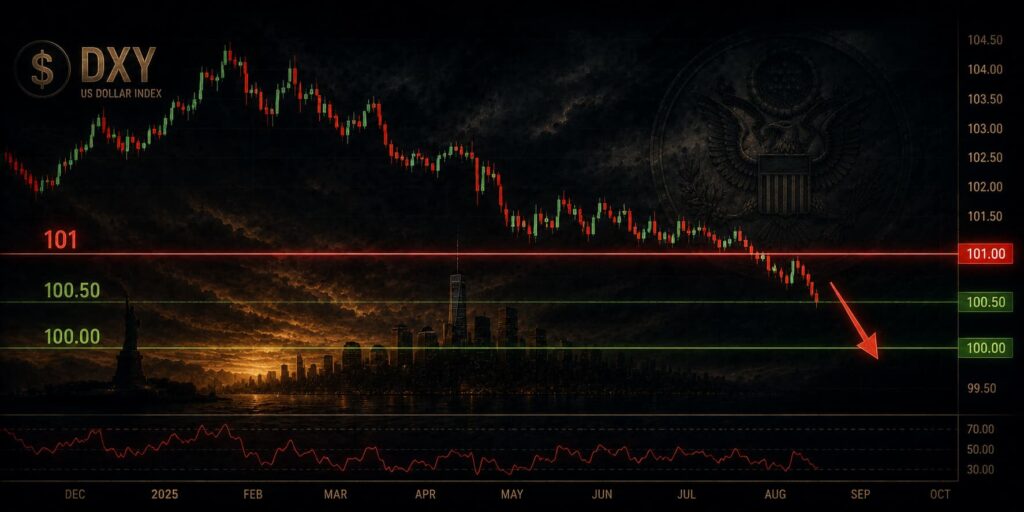
The dollar cracked. Not dramatically, but decisively. DXY closed the New York session at 100.935 (Yahoo Finance, 20:47 GMT), down 0.34% on the day, with every major cross bid against the greenback and gold ripping 1.51% higher into the CPI print. The setup everyone was watching for—weak dollar, firm risk, gold catching a real-yield bid—that setup landed on schedule. This session wrap breaks down exactly what happened and what it means for tomorrow.
This session wrap covers everything that moved in the New York session and what it means for tomorrow’s CPI print. For more on how the dollar moves gold, see our guide on how the dollar moves gold.
Dollar Index: The 101 Handle Fails
Start with the number that matters in this session wrap. DXY printed 100.935 into the NY close, down 0.34% on the day. That is the second consecutive session the index has failed to hold the 101 round handle, and it is now sitting inside a range that we have been watching since the July FOMC minutes landed. The tape did not scream. It leaked. That distinction matters in this session wrap.
What we watched intraday was the classic pre-CPI positioning bleed. We have seen this dozens of times: the market drags the dollar lower into a print it expects to be either in line or a shade soft, so the risk trade gets pre-loaded. If CPI lands where consensus wants it (headline -0.1% m/m, core 0.2% m/m), the dollar has already done the work and the reaction is muted. If it prints hot, the dollar snaps back violently because the positioning is offside. That is the setup into 12:30 GMT tomorrow. This session wrap highlights that dynamic.
The intraday behaviour tells the same story. DXY refused to bid through the 101.50 shelf in the London morning, faded steadily through the NY open, and closed on the lows. VIX dropped 3.85% to 16.5, which is a low-vol regime print. When the dollar fades and vol compresses together, that is the market saying it is comfortable with the CPI risk. Comfortable is not the same as correct, and we have watched comfortable markets get their teeth kicked in on hot CPI prints twice this year already. The session wrap captures this tension.
EUR/USD: The Rate-Differential Bid Returns
EUR/USD closed at 1.1425, up 0.36% on the session. That is a full big-figure above the pre-FOMC range low and it puts the pair back in territory it has not held since the ECB’s June refi cut. The move is not about Europe. It never is when the DXY is the driver. The move is about the US side of the rate differential compressing. This session wrap highlights that dynamic.
Here is the mechanism. When the market prices a softer CPI print, it prices lower terminal Fed rate expectations, which compresses the front end of the US curve. The front end drives the dollar. So the euro catches a bid not because Frankfurt did anything, but because the differential narrowed from the US side.
The pair is now sitting between two named levels we have been tracking. The 1.14 round handle is the first structural anchor below, having been defended twice in the past week. The 1.15 round handle is the next structural test above, and it sits directly at the June ECB day’s high. Between those two levels there is nothing structural, just algo territory. This session wrap tracks these levels.
Key levels for EUR/USD: Support at 1.1400 and 1.1350. Resistance at 1.1500 and 1.1550. The pair is currently trading in the middle of this range, with the 1.1425 level acting as a pivot point for the session. A break above 1.1500 would open the door to 1.1550, while a break below 1.1400 would target 1.1350. The session wrap monitors these levels closely.
GBP/USD: Sterling Quietly Gains
Sterling closed at 1.3392, up 0.33% on the day. The pair has been the quiet beneficiary of the dollar fade because it has the least idiosyncratic risk of the majors this week, at least until 20:00 GMT tomorrow when BoE Governor Bailey speaks. That is the local catalyst. This session wrap covers the Bailey risk.
Our read on Bailey is straightforward. The MPC is caught between a labour market that is still tight and a services CPI that is still uncomfortably high, and the market is pricing the next cut cautiously. If Bailey leans dovish, sterling gives back some of today’s gains against the dollar but likely holds the 1.33 round. If he leans hawkish, GBP/USD extends into the 1.34 zone which was the weekly high from the second week of June. Either way, the pair is a rate-differential vehicle first and a growth story second.
What is worth noting is that GBP/USD did not lead the G10 today. AUD and NZD did. Sterling was mid-pack, which suggests the market is respecting the Bailey risk into tomorrow’s session and refusing to load up either way. That is disciplined tape behaviour and it is what you want to see going into a dual-catalyst day.
For more on breaking the revenge trading cycle, see our guide on revenge trading rules.
USD/JPY: 162 Refuses to Break Clean
USD/JPY closed at 162.255, down just 0.11% on the day. The yen underperformed. Every other major caught a proper bid against the dollar. The yen barely moved. Why? This session wrap explains the yen’s underperformance.
Two reasons. First, the BoJ remains the most reluctant hiker in the G10, and every dovish tick out of Tokyo (or every hint that the yield-curve control unwind is being managed rather than accelerated) caps the yen’s ability to appreciate. Second, the 162 round handle has become a genuine intervention watchpoint. The MoF verbal jawboning has been consistent above 160, and the market knows it. So even on a dollar-weak day, USD/JPY does not sell off the way it “should” based on the rate-differential move, because dip-buyers are willing to defend anywhere near the 162 shelf.
Our read is that USD/JPY is now a two-catalyst pair. It needs either a hot US CPI (which drags it back to 163+ and puts the intervention line right in the spotlight) or an explicit MoF/BoJ signal (which is the only thing that reliably breaks the pair lower). Absent either, it grinds sideways in the 161.50 to 162.50 range, which is exactly what happened today. This session wrap tracks the intervention watchpoint.
Key levels for USD/JPY: Support at 161.50 and 160.00. Resistance at 162.50 and 163.00. The pair is currently testing the 162.25 level, with the 162 handle acting as a psychological barrier. A break above 162.50 would target 163.00, while a break below 161.50 would target 160.00. The session wrap monitors these levels closely.
USD/CHF: The Swiss Franc Bid
Here is the interesting one. USD/CHF closed at 0.8093, down 0.67%. That is the biggest move in the G10 dollar crosses today, and the franc did it on a risk-on tape. Normally CHF strength shows up in risk-off. Today’s move is different. This session wrap highlights this structural shift.
The read is that the franc caught a bid because of the geopolitical tape (see the Qeshm Island headline below), because the SNB has quietly become less dovish at the margin, and because gold ripped and CHF still correlates loosely with gold as a real-asset hedge. The 0.81 round has now been lost, and the pair is sitting inside range last seen before the SNB’s March cut. That is a structural shift, not a noise move.
For context, the CHF move alongside gold’s 1.51% rally to $4,057.2 is the tell. The market is quietly bidding real-asset hedges even while it prices a soft CPI and buys equities. That is not a contradiction. That is what a market does when it is worried about a tail risk (geopolitics, or a sneaky hot CPI) without committing to the risk-off regime. Cross-asset like this is what makes the session read interesting rather than mechanical. This session wrap captures the cross-asset dynamics.
Key levels for USD/CHF: Support at 0.8000 and 0.7900. Resistance at 0.8150 and 0.8200. The pair is currently trading at 0.8093, having broken below the 0.81 round handle. A break below 0.8000 would target 0.7900, while a break above 0.8150 would target 0.8200. The session wrap tracks these levels closely.
The Commodity Bloc: AUD, NZD, CAD Lead
The commodity-linked currencies led the G10 today. AUD/USD closed at 0.6977, up 0.85%. NZD/USD at 0.5813, up 0.86%. USD/CAD at 1.4059, down 0.64% (meaning CAD strengthened). The commodity bloc catches a bid when three things happen simultaneously: dollar weakness, commodity price strength, and risk-on tape. All three landed today. This session wrap tracks the commodity bloc rotation.
WTI closed at $79.95, up 2.32%. Brent at $85.54, up 2.69%. Crude ripped through the London afternoon on the Qeshm Island headline and never gave it back.
The CAD move is the cleanest of the three because it is the most directly commodity-driven. USD/CAD lost the 1.41 round handle and closed on the lows. The AUD story is more mixed because it also depends on China Q2 GDP tomorrow morning, which is a Wednesday risk that Sydney traders are already pricing. NZD tends to follow AUD in these regimes and it did today.
Key levels for AUD/USD: Support at 0.6900 and 0.6850. Resistance at 0.7000 and 0.7050. The pair is currently testing the 0.6977 level, with the 0.7000 round handle acting as a psychological barrier. A break above 0.7000 would target 0.7050, while a break below 0.6900 would target 0.6850. The session wrap monitors these levels closely.
For more on why most traders quit too early, see our guide on why most traders quit.
Gold: Real Yields, Not Fear
Spot gold settled at $4,060.40, up 1.59% on the New York session. That is a clean +$63.5 print on the day, and it happened while the S&P 500 was also green (+0.38%), the Nasdaq 100 was pushing +1.10%, and the VIX was cracking down through 16.5 (-3.85%). This session wrap breaks down the gold move.
Read that sequence carefully. Gold going bid alongside equities, in a low-volatility tape, with the dollar softer, is not the classic fear pattern. In a fear tape you get gold up, equities down, VIX up, Treasuries bid. Today you got gold up, equities up, VIX down, and Treasuries bid as well. Consequently, the correct read is not “haven bid”. The correct read is “real-yields easing”. This session wrap explains the real-yield dynamic.
The other tell is silver. XAGUSD closed $59.07, +2.48%. Silver led gold by 89bps on the day. That is the industrial-metal-with-monetary-torque behaviour. When the metals complex is being bought purely on hedge demand, gold outperforms. When it is being bought on the reflation-plus-easing-real-yields trade, silver leads. Silver led. This session wrap captures the silver-gold ratio read.
Key levels for Gold: Support at $4,020 and $4,000. Resistance at $4,100 and $4,150. The pair is currently trading at $4,060, having broken above the $4,050 level. A break above $4,100 would target $4,150, while a break below $4,020 would target $4,000. The session wrap monitors these levels closely.

The Macro Read: CPI, Warsh, Bailey and the Shape of Tomorrow
Now the fundamentals. This is what the session was actually pricing. This session wrap lays out the macro picture.
US CPI, 12:30 GMT tomorrow. Consensus is headline -0.1% m/m (previous +0.5%) and 3.8% y/y (previous 4.2%). Core 0.2% m/m (previous 0.2%) and 2.8% y/y (previous 2.9%). The headline number will be dragged lower by energy base effects, so the number that matters for the Fed reaction function is core. Core at 0.2% m/m annualises to 2.4%, which is inside the Fed’s tolerance. Core at 0.3% or higher and the whole complex has to reprice.
Fed Chair Warsh testimony, 14:00 GMT. This is a live catalyst because Warsh has been more measured than the market expected since taking the chair. His testimony lands 90 minutes after CPI, which means the market will already have a CPI reaction to layer his tone on top of. If CPI is soft and Warsh is cautious about declaring victory, the dollar gives back more of the 101 handle. If CPI is hot and Warsh leans hawkish, the dollar snaps back through 101.50 and the entire risk-on tape unwinds. This session wrap tracks the Warsh risk.
BoE Governor Bailey, 20:00 GMT. Sterling-specific catalyst as covered above. The reason it matters for the broader dollar read is that if Bailey surprises hawkish, sterling extends, and the DXY basket weighting means GBP strength drags the dollar index lower even if the euro is flat.
The cross-asset sentiment engine scored risk composite at 39.4 (risk-on), USD bias at -7 (mild dollar sell), gold bias at +17 (bullish), and vol regime at low. That is the profile of a market that has already priced the friendly outcome. Which brings us back to the setup: the dollar has done the work. Now the print has to deliver. This session wrap highlights the sentiment profile. According to CME FedWatch, the market is pricing a 43% chance of a hike by September, down from 57% before the NFP miss.
Geopolitics: The Qeshm Island Headline
Two geopolitical headlines crossed the wire in the final hour of the NY session. First, at 20:51 GMT, Mehr News reported that a US projectile hit Qeshm Island. Six minutes later, at 20:52 GMT, Fars News stated that rumours regarding explosions in cities of Khuzestan province were false. Both crossed via Financial Juice. This session wrap covers the geopolitical risk.
Our approach on these headlines is discipline. We do not speculate beyond what the briefing supplies. What we observe is that crude jumped, CHF caught a bid, gold ripped and equities held their gains. That is the classic cross-asset signature of a market pricing tail geopolitical risk without committing to full risk-off. If further headlines confirm or contradict the projectile report tomorrow, the reaction is likely to be sharp, particularly in crude and CHF. Until then, the read is: the market is watching, positioning is asymmetric toward hedges, and the base case remains the CPI print as the primary driver.
The Dollar Crack: What It Means for Tomorrow
The dollar cracked. Not dramatically, but decisively. DXY closed the New York session at 100.935, down 0.34% on the day, with every major cross bid against the greenback and gold ripping 1.51% higher into the CPI print. This session wrap frames the scenarios.
When the dollar fades and vol compresses together, that is the market saying it is comfortable with the CPI risk. Comfortable is not the same as correct, and we have watched comfortable markets get their teeth kicked in on hot CPI prints twice this year already.
The three scenarios for tomorrow:
1. Soft CPI (Core 0.2% or below): The dollar has already done the work. The reaction is muted. Gold holds gains, equities extend, and DXY drifts toward 100.50. This is the market’s base case.
2. In-line CPI (Core 0.2%): The market has already priced this. The dollar stays heavy, gold consolidates, and the focus shifts to Warsh’s testimony at 14:00 GMT. This is the most likely outcome.
3. Hot CPI (Core 0.3% or above): The dollar snaps back violently because the positioning is offside. DXY reclaims 101.50, gold fades hard, and the entire risk-on tape unwinds. This is the risk scenario.
Key Levels Summary
| Instrument | Support | Resistance | Current |
|---|---|---|---|
| DXY | 100.50, 100.00 | 101.50, 102.00 | 100.935 |
| Gold | $4,020, $4,000 | $4,100, $4,150 | $4,060 |
| EUR/USD | 1.1400, 1.1350 | 1.1500, 1.1550 | 1.1425 |
| GBP/USD | 1.3350, 1.3300 | 1.3450, 1.3500 | 1.3392 |
| USD/JPY | 161.50, 160.00 | 162.50, 163.00 | 162.255 |
| USD/CHF | 0.8000, 0.7900 | 0.8150, 0.8200 | 0.8093 |
| WTI | $78.00, $75.00 | $82.00, $85.00 | $79.95 |
Conclusion: The Setup Is Complete
The dollar cracked. Not dramatically, but decisively. DXY closed the New York session at 100.935, down 0.34% on the day, with every major cross bid against the greenback and gold ripping 1.51% higher into the CPI print. The setup everyone was watching for landed on schedule. This session wrap has prepared you for what comes next.
Now the print has to deliver.
If CPI lands where consensus wants it, the dollar has already done the work and the reaction is muted. If it prints hot, the dollar snaps back violently because the positioning is offside. If it prints soft, the dollar breaks lower and gold runs higher.
The cross-asset sentiment engine scored risk composite at 39.4 (risk-on), USD bias at -7 (mild dollar sell), gold bias at +17 (bullish), and vol regime at low. That is the profile of a market that has already priced the friendly outcome.
The session wrap shows a market that is positioned for soft CPI. The question tomorrow is whether the market gets what it expects—or whether it gets a surprise.
This session wrap has prepared you for both scenarios. Now it is up to you to execute.
Disclaimer
This article is for educational and informational purposes only. It does not constitute financial advice, trading recommendations, or an offer to buy or sell any asset. Trading forex, commodities, indices, cryptocurrencies, and futures carries significant risk and may not be suitable for all investors. You can lose more than your initial deposit. Past performance does not guarantee future results. Always read full terms, contract specifications, and risk disclosures before trading. Do your own research. Consult a licensed financial advisor if you need professional investment advice.