


This weekly wrap covers everything you need to know from the past five trading sessions. Gold is on course for its best week since January, up about 7% on the week and closing at $4,341.3 after touching $4,370, its highest level in seven weeks . The genuinely interesting part is that the reason it was rising changed overnight and it kept rising anyway. That is the story of this weekly wrap.
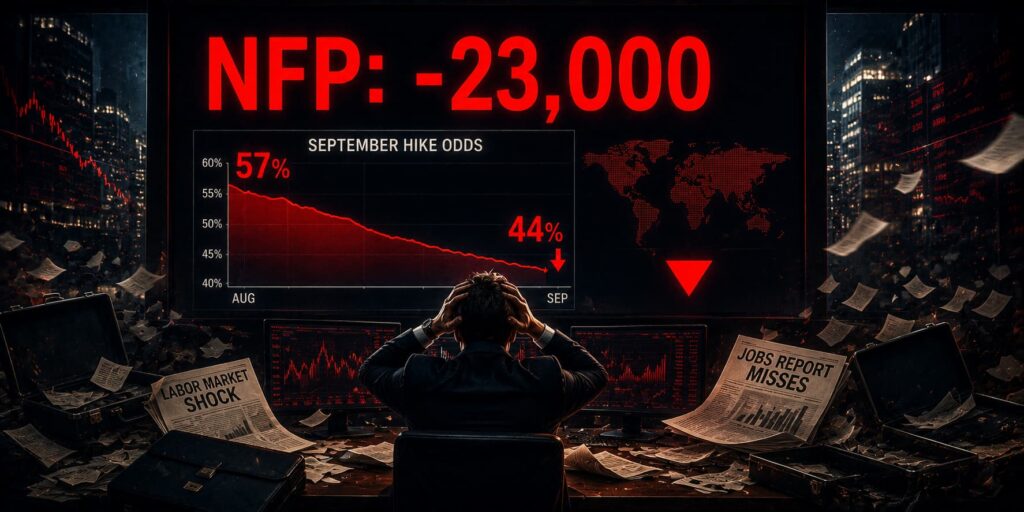
Our weekly wrap begins with Thursday, when gold was trading around $4,260, supported by hopes of peace in the Middle East and falling oil prices . Friday’s US non-farm payrolls report then landed, and the entire picture shifted. The US economy shed 23,000 jobs in July, a massive miss against the 80,000 gain economists had expected . Prior months were revised down another 103,000 . This weekly wrap will break down exactly what that means for your trading.
The weaker-than-expected jobs data presents a scenario where the Fed may not raise interest rates at its next meeting. Further, declining energy prices, coupled with the potentially reduced likelihood of a US interest rate hike, point to a weaker dollar and stronger gold prices. This is the key takeaway from this weekly wrap.
Be careful with exact gold quotes this morning: sources vary slightly. Spot gold closed around $4,336 to $4,341 per ounce, with COMEX December futures at $4,399.7 . Everything above $4,300 is materially the same story and every feed agrees on the 7% week. Structurally, the 4,100 to 4,112 cap, the 4,200 pocket and the 4,220 trendline origin are all now beneath price. Above here, the chart remains in open air and 4,300 is a round number rather than a drawn level. This weekly wrap will guide you through all the key levels.
For more on how market news drives price action, see our guide on [news trading].
Weekly Wrap: The NFP Shock That Changed Everything
The US economy unexpectedly lost 23,000 jobs in July, according to the Labor Department’s Bureau of Labor Statistics. Economists polled by Reuters – Markets had expected payrolls to rise by 80,000. It was the first negative print since early 2024.
Previously reported job gains for May and June were also revised sharply lower, combining to slash 103,000 from prior estimates . The unemployment rate fell to 4.1% from 4.2% in June, but this was driven by workers leaving the labor force as participation dropped to 61.4%, the lowest in five and a half years . Every weekly wrap should highlight such significant shifts.
“I think no one really predicted that nonfarm payrolls would decrease, nor that the June figures would be revised down so sharply,” said Thierry Wizman, global FX and rates strategist at Macquarie Group .
The market’s reaction was swift and decisive. September hike odds collapsed from roughly 55-58% before the report to about 44% immediately after . According to LSEG data, the probability of a September hike dropped to 43.9%, down from 57% before the jobs report was released . This weekly wrap tracks these shifts in real-time.
Richmond Fed President Thomas Barkin said that “jobs data was very consistent with a sector in weak balance,” describing the labor market as being in a “low hire, low fire” scenario .
For more on preparing for high-impact data like NFP, see our guide on [how to prepare for high-impact data].
Weekly Wrap: Gold’s 7% Surge and the Engine Swap
Gold surged more than 2.3% on Friday alone, gaining over $100 to close at $4,341.3 after touching $4,370 during the session . The yellow metal posted its biggest weekly gain since January 19, with prices climbing more than 7% over the week . This weekly wrap examines the drivers behind this move.
What changed. The input reversed and the output did not. From Monday to Thursday, the driver was the collapse in oil: hopes of peace in the Middle East pushed crude down roughly 10% on the week, cheaper energy cut expected inflation, which cut expected Federal Reserve tightening, which cut Treasury yields and the dollar, and lower real yields is the single most reliable input into a higher gold price. That was the rate leg.
On Friday, the NFP miss handed gold an entirely different engine. A weak jobs report suggests the Fed is less likely to raise rates at its next meeting . The dollar index dropped to 99.54, down 0.42% . US Treasury yields fell, with the 10-year down to 4.649% . This weekly wrap captures how gold swapped engines mid-move.
Gold is the one asset that gets paid by both sides of a weak payrolls print: lower rates, weaker dollar, and safe-haven flows all converged at once . Underneath all of it, central bank demand has remained a key support. According to the World Gold Council, central banks purchased 288.9 tonnes of gold in the second quarter, a 62% increase from a year earlier . South Korea returned to the gold market after 13 years, reinforcing the trend of sustained official-sector demand.
“Weaker-than-expected jobs data suggests the Fed is less likely to raise interest rates at its next meeting,” said David Meger, director of metals trading at High Ridge Futures .
What we are watching. The retest. A break with no level above it is defined entirely by what happens on the way back down. If this move is real, 4,220 and then the 4,100 to 4,112 cap should now act as support rather than resistance . This weekly wrap keeps you focused on what matters.
Weekly Wrap: Dollar Index Presses Key Support
The dollar spent this week being sold on a peace deal, and then the NFP miss delivered the knockout. The index closed at 99.54, down 0.42% on the session . Earlier in the week, DXY had traded as high as 100.02 on Thursday before reversing . This weekly wrap breaks down the dollar’s decline.
What changed. The July payrolls report was a genuine shock: -23,000 jobs against +80,000 expected, with prior months revised down another 103,000 . Market expectations for a rate hike from the Fed at its next meeting dropped to about 44%, according to CME FedWatch, down from 55% in the prior session and 67% a week ago.
On the geopolitical front, Iran de-escalation hopes that had carried the week hit a wall. Two explosions were reported on Iran’s Qeshm Island at around 21:40 local time on Thursday, described by the semi-official Tasnim news agency as Iranian armed forces confronting hostile enemy targets at the entrance to the Strait of Hormuz . The terms of the Iran and Oman shipping text became public and are considerably harder than the tape had assumed.
Energy is the transmission belt between Iran and the Federal Reserve. WTI closed at $77.08, down 1.33%, and Brent at $82.21, down 1.25% . But the NFP miss overwhelmed the oil story. A weak labor market means the Fed has less cover to hike, regardless of what oil does. This weekly wrap explains the interplay between these forces.
What we are watching. Whether 99.45 to 99.55 holds as support. The index is now pressing that band, and a break below it opens the 99.00 shelf . Above, 100.45 to 100.60 has still not been approached.
Weekly Wrap: EUR/USD Holds the Break
Wednesday the euro broke the band, Thursday it held above it, and Friday it surged. EUR/USD closed at 1.1568, up 0.39% on the session, up 0.41% on the week . This weekly wrap covers the euro’s resilience.
What changed. The dollar leg gave way, and the NFP miss was the catalyst. A weak jobs report means the Fed is less likely to hike, which is the single most bullish input for the euro. Beyond the dollar, the euro side is still doing real work of its own. Eurozone Q2 GDP grew 0.4%, double the forecast pace and the strongest since early 2025, and July annual inflation ran at 2.9% with both core and services accelerating.
Traders now fully price one further European Central Bank increase by year end and put roughly 40% odds on a second. Set that against a Federal Reserve whose September path has been thrown into doubt, and you still have a two-sided rate story rather than a dollar move the euro is borrowing. This weekly wrap highlights the divergence.
What we are watching. Whether the 1.1508 to 1.1520 band holds from above. Price cleared it on Wednesday, held above it through Thursday, and is now comfortably above it, which is the sequence that confirms a break.
Weekly Wrap: Cable Resolves Lower
Cable resolved downwards. GBP/USD is 1.3493, up 0.3% on the session, but the structure remains bearish . This weekly wrap examines sterling’s struggle.
What changed. Almost all of it was the dollar, and the dollar turned because the payrolls miss capped the downside. Sterling is a risk currency before it is anything else, so deteriorating risk sentiment is precisely what turned it away from the band a third time.
Sterling does not have a rate advantage over the dollar. Bank Rate is 3.75% and Fed funds is 3.50 to 3.75%, roughly flat. What cable actually has is a Bank of England that is more hawkish than the Fed: the BOE held on a 6 to 3 vote with Greene, Mann and Pill all voting for 4.00% . That is a narrowing split that the market continues to underestimate. This weekly wrap explains the BOE dynamic.
What we are watching. The 1.3332 to 1.3343 band beneath, because that lower band is what defines the higher low and therefore whether this was a range or a top.
Weekly Wrap: USD/JPY and the Intervention Shadow
USD/JPY closed at 157.56, down 0.57% on the session . The pair remains under the shadow of official intervention. This weekly wrap tracks the yen’s dynamics.
The confirmed leg is official. Japan and the United States have announced a joint yen-buying operation, stated out loud by both sides . That is a policy bid that can be repeated. The unconfirmed leg is the Iran de-escalation, which is real on the strikes and unsettled on the substance.
What changed. The NFP miss weakened the dollar across the board, pushing USD/JPY lower. The pair has given back much of the recent gains as the intervention threat remains real and the US Treasury is actively participating.
What we are watching. 164.00 is now the intervention line, and Tokyo has drawn it with Washington co-signing. Rallies into the low 160s are where the MOF gets interested again.
Weekly Wrap: S&P 500 Hits Record High
US stocks advanced on Friday, with the S&P 500 closing at a record high to cap off a strong week of gains . The S&P 500 gained 47.68 points, or 0.62%, to 7,757.64. The Nasdaq Composite gained 342.26 points, or 1.30%, to 26,690.62. The Dow rose 0.28% to 54,036.93 . This weekly wrap covers the equity rally.
For the week, the S&P 500 gained 3.58%, the Nasdaq rose 5.19%, and the Dow climbed 2.96% . A weak jobs report eased expectations that the Federal Reserve would raise interest rates at its September meeting . A significant deceleration in the US job market propelled stock prices upward while bond yields decreased, fueled by speculation that the Fed will not be compelled to increase interest rates in the near future.
Earnings season has been strong. Of the 436 companies in the S&P 500 that have reported results, 85.1% have topped analyst expectations, well above the 68% average since 1994 . This weekly wrap highlights the earnings strength.
Weekly Wrap: What the NFP Surprise Means for September
The Fed decision on 15-16 September is now the most consequential meeting of the year. The NFP miss has fundamentally reshaped the debate. This weekly wrap analyzes the Fed path.
Before Friday, the market was pricing roughly a 55-67% chance of a September hike . After the report, that probability fell to about 44% . According to some estimates, the odds stand at just 30% for a hike, with a 70% chance the Fed will hold.
The two-way risk:
- Soft CPI on Wednesday: September hike odds collapse further, dollar falls, gold and equities rally. This is the market’s base case.
- Hot CPI on Wednesday: The inflation problem reasserts itself. The Fed’s hand is forced. September hike odds rebound. Dollar rallies, gold fades.
Wednesday’s CPI report is the first inflation data that fully captures the 24% move in crude from July. If inflation remains sticky despite the energy unwind, the Fed’s credibility problem resurfaces. If inflation cools, the case for a pause becomes overwhelming. This weekly wrap prepares you for both scenarios.
Our view: The NFP miss has tilted the scales toward a pause, but CPI is the final arbiter. Chair Kevin Warsh has said “there is no soft inflation target.” If inflation data remains elevated, he will have to act.
Weekly Wrap: Iran and the Geopolitical Wildcard
The geopolitical track continues to run in parallel with the data. Two explosions were reported on Iran’s Qeshm Island at around 21:40 local time on Thursday, described by the semi-official Tasnim news agency as Iranian armed forces confronting hostile enemy targets at the entrance to the Strait of Hormuz . This weekly wrap tracks the geopolitical risks.
The terms of the Iran and Oman shipping text now before Iran’s parliament became public: a ban on vessels linked to the United States, Israel and other countries deemed hostile until Tehran is compensated for war damage, tolls of up to 7% of cargo value on other commercial ships, and fines of 20% of cargo value for violations . A United States official rejected the terms outright.
Crude turned on it, with WTI at $77.08 and Brent at $82.21 after trading lower earlier in the week . The Iran track has been worth several percent a day on crude, feeding gold through the inflation channel and the risk channel at the same time.
Key Levels Summary
| Instrument | Support | Resistance | Current |
|---|---|---|---|
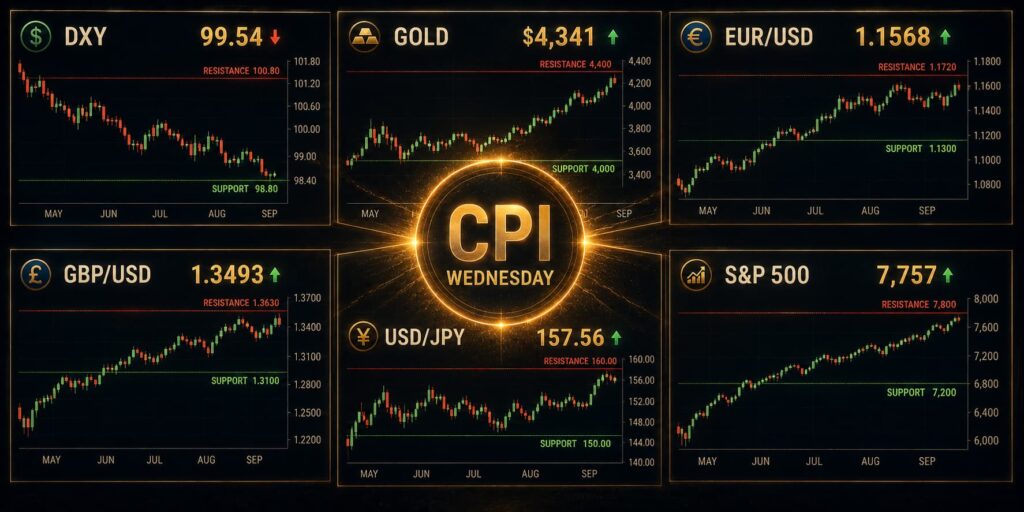
| DXY | 99.45-99.55, 99.00 | 100.45-100.60, 101.50 | 99.54 |
| Gold | 4,220, 4,100-4,112 | 4,370, 4,390 | 4,341 |
| EUR/USD | 1.1508-1.1520, 1.1458-1.1470 | 1.1579-1.1585, 1.1600 | 1.1568 |
| GBP/USD | 1.3332-1.3343, 1.3167-1.3192 | 1.3457-1.3468, 1.3575-1.3585 | 1.3493 |
| USD/JPY | 157.58, 155.00 | 160.00, 164.00 | 157.56 |
| S&P 500 | 7,500, 7,400 | 7,800, 7,900 | 7,757 |
Weekly Wrap: Looking Ahead to CPI
US CPI for July lands on Wednesday 12 August at 08:30 New York and is the next major test . Economists expect inflation to decrease slightly from 3.5% to 3.4% year-over-year, with Core CPI also dipping from 2.6% to 2.5% . This weekly wrap sets up the week ahead.
The FOMC is 15 to 16 September. Friday’s payrolls and Wednesday’s CPI are effectively the entire dataset the Committee gets before it decides. Every print between now and 16 September has to do work that the Chair declined to do at the July meeting.
The desk will be watching CPI closely. A soft print confirms the NFP narrative and pushes September hike odds lower. A hot print reopens the debate and puts the Fed back in a difficult position. This weekly wrap has prepared you for both outcomes.
Disclaimer
This article is for educational and informational purposes only. It does not constitute financial advice, trading recommendations, or an offer to buy or sell any asset. Trading forex, commodities, indices, cryptocurrencies, and futures carries significant risk and may not be suitable for all investors. You can lose more than your initial deposit. Past performance does not guarantee future results. Always read full terms, contract specifications, and risk disclosures before trading. Do your own research. Consult a licensed financial advisor if you need professional investment advice.