


Turn on any financial news channel, open any trading app, or scroll through market updates, and you’ll see the same narrative repeated endlessly:
“Bitcoin Hits Record High on U.S. Regulatory Clarity.”
The story seems simple: regulatory clarity happened, Bitcoin soared. Cause and effect, right?
But here’s where it gets interesting.
Just three months earlier, the same outlets were telling us a completely different story:
“Bitcoin Price Plunges Despite Pro-Crypto U.S. Government.”
Wait… what?
The same fundamental factor, supportive U.S. crypto policy, was credited with driving a price surge in one headline, while in another, prices collapsed despite this very same positive policy environment. This is one of the most confusing aspects of trading market news.
This isn’t an isolated incident. It’s the norm. And it’s exactly why trading market news is so difficult.
Our research compiled over 20 recent examples across major markets, Gold, Oil, Bitcoin, S&P 500, EUR/USD, and more. In every single case, we found contradictory headlines within weeks or months of each other.
| Asset | Contradictory Claims |
|---|---|
| Gold | “Holds steady as Fed flags inflation risks” vs. “Glow fades as inflation cools” |
| Oil | “Prices up 3% on geopolitical tensions” vs. “Slides 2% on same tensions fueling recession fears” |
| Copper | “Rises amid US-China trade truce” vs. “Drops sharply after trade deal bounce” |
The pattern is clear: The same fundamental factors are credited with driving prices up in one context, while prices mysteriously fall despite those very same positive factors in another. Understanding market news requires looking beyond the headline.
This guide breaks down why this happens, what actually moves price, and how to trade market news with clarity instead of confusion.
For more on the mental discipline required in trading, see our guide on [trading psychology and discipline].
Do Technical Indicators Move Price?
No. Technical indicators do not move price. They are mathematical descriptions of what price has already done. Price moves on information, expectations, and capital flows. The chart shows the result of those forces, not the cause. This is crucial for anyone trading market news.
This is the biggest misconception in retail trading. Most traders open a chart, stack a few indicators, and try to predict the next move from patterns alone. They are studying the footprint and ignoring the runner.
A perfect double bottom collapses on a hot inflation print. A textbook trendline snaps when a central bank shifts tone. The pattern was real. The context underneath it just changed.
This is why two traders can stare at the same chart and reach opposite conclusions. The chart is incomplete on its own. To read the market, you have to read what is driving it, which is why market news is essential.
Why Does Price Move on News?
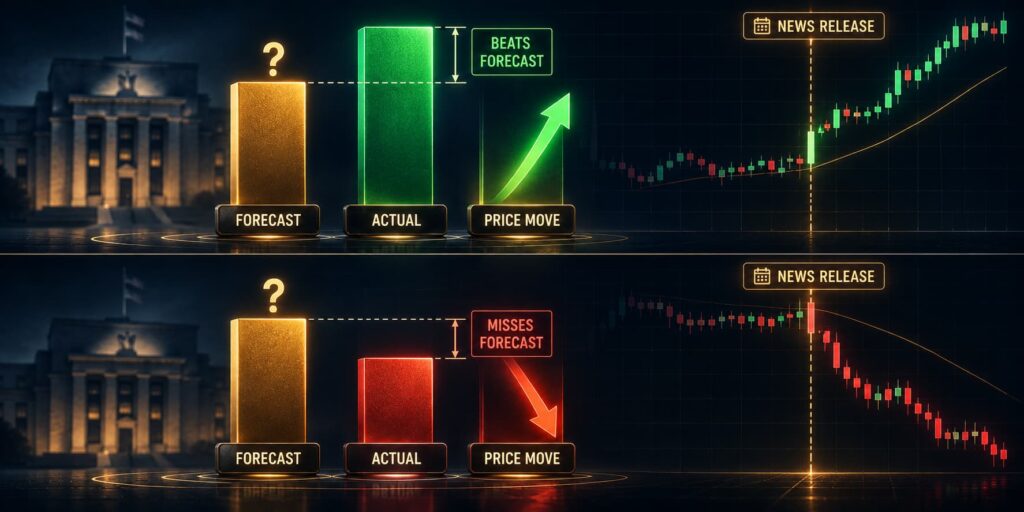
Price moves on news because traders reprice an asset the moment new information changes their expectations about the future. The news itself is not the cause. The cause is the difference between what was already expected and what was actually revealed. This is the foundation of market news trading.
Markets are forward looking. Before any major release, the current price already reflects the consensus forecast. Everyone has positioned for the expected outcome. So when the data lands, only the surprise matters.
If reality matches the forecast, price barely moves. If reality misses the forecast, capital floods in one direction to correct the mistake. That correction happens in seconds. And it happens because of three forces working together: information, expectations, and capital flows.
This is where market news becomes a powerful tool. The trader who understands the surprise versus the forecast can position accordingly.
For more on preparing for high-impact market news, see our guide on [how to prepare for high-impact data].
What Actually Causes the Move: Expectation vs Reality
Every tradable event has two numbers that matter more than the headline: the forecast and the actual.
- Forecast. What the market expected before the release. This is already baked into the price.
- Actual. What was really reported.
The move comes from the gap between them. A bigger surprise means a bigger move. A small surprise means a quiet release, even if the headline sounds dramatic.
This is why a strong jobs number can still tank a currency. If the forecast was already strong and the actual just matched it, there is no surprise to trade. The information was already in the price. Market news traders understand this distinction.
In the ABS-CBN example, the stock opened at p6, bypassing any intermediate prices, because the market instantly repriced the stock to reflect the new information. The move happened in the gap between the previous closing price and the new expectation.
What Does “Priced In” Mean?
“Priced in” means the market has already adjusted the price to reflect an expected outcome before it happens. When something is priced in, the actual event produces little reaction because traders positioned for it in advance. This is a key concept in market news trading.
This is the trap that catches most retail traders. They see good news and expect price to rise. But if the good news was anticipated, the move already happened days earlier. By the time the headline drops, the smart money is taking profit, not buying.
It also explains the classic market saying: buy the rumor, sell the news. Traders buy in anticipation of an event, then sell once it confirms, because there is no new information left to push price further.
In the Bitcoin example, the SEC approved the spot Bitcoin ETF on January 11, 2024. CoinDesk published 51 articles that day while Bitcoin dropped 7.67% the next day and was down 10% by day three. The news was already priced in.
Why the Same News Moves Price Differently Each Time
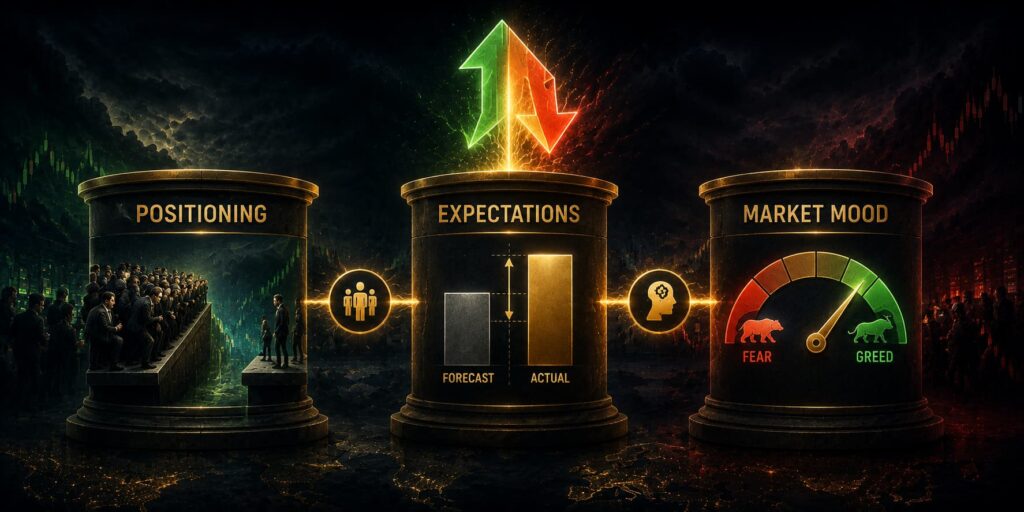
The same news moves price differently because the context around it changes. Price reaction depends on positioning, what was already priced in, and the broader market mood at that moment. This is the most important lesson in market news trading.
Three factors decide the reaction:
1. Positioning. If most traders are already long, even good news can trigger selling as they take profit. The crowd has nowhere left to push it.
2. Expectations. A number is only bullish or bearish relative to the forecast, not in absolute terms. Context decides everything.
3. Market mood. In a risk-off environment, traders ignore good news and sell anything risky. In risk-on, they shrug off bad news and keep buying.
This is why two identical CPI prints can produce opposite reactions months apart. The number is the same. The setup around it is not.
Real-World Example: Bitcoin and News Volume
A study of 63,926 headlines matched to daily Bitcoin closing prices found that the correlation between daily changes in article volume and daily Bitcoin returns was 0.019, which means only 0.04% of daily price action was explained. For practical purposes, this is effectively zero.
The study also found that in the three days before a major coverage spike, Bitcoin’s price was already elevated, around 1% above the event-day baseline. Then after the spike, price drifted down by roughly 0.8% by day three.
That is not a “news moves markets” narrative. It’s a “markets move, then news catches up” story. Market news traders need to understand this dynamic.
How Risk-On and Risk-Off Spread One Event Across Markets
A single piece of news rarely affects just one asset. It shifts the overall appetite for risk, and that appetite ripples across every market at once.
- Risk-on. Traders feel confident. Capital flows into riskier assets like equities, indices, and higher-yield currencies. Safe havens get sold.
- Risk-off. Traders get defensive. Capital flees to safe havens like gold, the dollar, and bonds. Risk assets get dumped.
This is why a surprise interest rate decision can move stocks, currencies, and commodities in the same instant. It did not change one asset. It changed how much risk the whole market wanted to hold. This is a critical insight for market news trading.
Reading the direction of capital flow tells you far more than any single chart.
Does Price Only Move on News?
No. News is the most visible trigger, but price moves continuously on fundamentals, capital flows, and positioning, even when there is no headline on the screen. Market news is just one piece of the puzzle.
Think of a scheduled release as the loud version of something that happens all day long. The market is a constant repricing machine. The same three forces that drive a news spike, information, expectations, and capital flows, are running between every event too. They just move slower and quieter.
These are the drivers working underneath the headlines:
- Fundamentals. Growth, inflation, and earnings expectations shift gradually, not just at release time.
- Central bank policy paths. Traders constantly adjust their bets on where rates are heading.
- Capital flows. Money rotates between assets, sectors, and safe havens based on where the opportunity and the risk sit.
- Institutional positioning. What the biggest players are doing builds over weeks.
- Liquidity and geopolitics. Thin liquidity exaggerates moves. Geopolitical shifts reprice risk in real time.
So news is not the cause of every move. It is the moment all of these forces reprice at once, fast and visible. Understanding market news means understanding what lies beneath it.
Real Event Mechanics: How Market News Plays Out
The theory is simple. The execution is where traders get caught. Here is the cause and effect chain on the events that move markets most.
CPI (inflation). Hotter than forecast inflation signals more aggressive central bank policy. That repricing of rate expectations hits currencies, gold, and indices within seconds. The surprise versus forecast is everything. A high number that matches expectations is a non-event. Market news traders watch for the surprise.
NFP (jobs). A strong labor market shifts expectations for the economy and rates. But the reaction depends on what the market already assumed. A blowout number into a market braced for weakness creates the biggest moves.
FOMC (rate decisions). The rate decision itself is often priced in. The real volatility comes from the tone of the statement and the press conference, because that reshapes expectations for future decisions. Traders are not trading today’s rate. They are trading the path of the next six months.
In every case, the pattern is the same. New information lands, expectations break, capital reprices, and the move is over before most retail traders understand what happened.
Why Retail Traders Get Caught Out
Retail traders get caught out for two reasons: they see the news too late, and they read it without context. By the time a move shows up on the chart, the cause has already passed. This is the biggest challenge in market news trading.
Institutions do not have better instincts. They have better information and they get it faster. They see the headline the instant it hits the wire. They know the forecast, the positioning, and the risk environment going in. So when the surprise lands, they already understand what it means and they move first.
The retail trader sees the candle, not the cause. They watch price spike, panic, and chase the move after it is done. They are trading the effect with no view of the cause.
This is the information gap. And for decades it was the reason retail traders felt like the market moved against them on every news event.
For more on risk management during market events, see our guide on risk management strategies.
How to Actually Read Market News as a Trader
To read market news correctly, stop watching price and start watching the cause. Track the surprise versus the forecast, the direction of capital flow, and the overall risk mood before you ever place a trade.
The framework is simple:
- Know the forecast before the event. You cannot judge a surprise without a baseline.
- Catch the headline in real time. A reaction you see ten minutes late is a reaction you missed.
- Read the risk environment. Is capital flowing risk-on or risk-off? That sets the direction.
- Match cause to effect. Tie the exact headline to the exact move so you learn the patterns.
- Prepare, don’t predict. Smart traders plan their response to each scenario before the number drops.
The problem is that doing all of this manually means juggling a news terminal, an economic calendar, a sentiment read, and a positioning report at the same time, in the seconds when it matters most.
Remember: Only the early bird gets the worm. Faster, more skilled, and better-armed institutional investors had already been buying for days before the news you saw hit the wire.
A Practical Framework for Trading Market News
Now that we understand why market news moves prices differently each time, let’s build a practical framework you can use starting today.
Step 1: Identify the Event Type
Not all market news is equal. Categorize events into three types:
- Scheduled Data Releases. CPI, NFP, FOMC, GDP. These are predictable. You can prepare.
- Unexpected Geopolitical Events. Wars, elections, natural disasters. These are unpredictable. You react.
- Central Bank Communications. Speeches, minutes, press conferences. These are tone-driven. You interpret.
Step 2: Check the Consensus Forecast
Before any scheduled release, know what the market expects. This is your baseline. Without it, you cannot judge the surprise. Most economic calendars provide this data.
Step 3: Assess Current Positioning
Is the market already long or short? This is harder to gauge, but you can look at:
- COT reports for futures positioning
- Sentiment indicators (fear/greed)
- Recent price action leading into the event
Step 4: Read the Risk Environment
Is the market in risk-on or risk-off mode? This sets the direction. A good number in risk-on can lift risk assets. A good number in risk-off might be ignored or sold into.
Step 5: Plan Multiple Scenarios
Before the event, plan for:
- A beat (actual > forecast)
- A miss (actual < forecast)
- An in-line (actual = forecast)
Decide your response for each scenario. This removes emotion from the equation.
Step 6: Watch the Immediate Reaction
Price moves within seconds. The first 5-15 minutes often tell you the true direction. Wait for the initial spike to settle before making decisions.
Step 7: Compare to Historical Patterns
How has price reacted to similar market news in the past? Use historical data to inform your read. This is where backtesting fundamentals becomes valuable.
Step 8: Manage Risk
No matter how confident you are, always use a stop-loss. Market news can create unpredictable moves. Protecting your capital is non-negotiable.
According to Investopedia – News Trading , successful news trading requires discipline, preparation, and a clear understanding of market expectations. Without these, trading market news is simply gambling.
Key Takeaways
- Technical indicators do not move price. They describe what price has already done. Charts answer where and when. Fundamentals, flows, and market news answer why.
- Price moves on the gap between expectation and reality, not on the market news itself. According to Reuters Markets, the surprise versus forecast is what drives the move.
- If an outcome is priced in, the actual event produces little reaction.
- The same market news moves price differently because positioning, expectations, and market mood change.
- One event shifts overall risk appetite, which ripples across every market at once.
- Market news is not the only driver. Price moves continuously on fundamentals, capital flows, and positioning, even with no headline.
- Retail traders lose because they see market news late and read it without context.
- The edge is not prediction. It is reading the cause in real time and preparing before the move.
- Stop trading the candle. Start reading the cause. The cause is market news.
Disclaimer
This article is for educational and informational purposes only. It does not constitute financial advice, trading recommendations, or an offer to buy or sell any asset. Trading forex, commodities, indices, cryptocurrencies, and futures carries significant risk and may not be suitable for all investors. You can lose more than your initial deposit. Past performance does not guarantee future results. Always read full terms, contract specifications, and risk disclosures before trading. Do your own research. Consult a licensed financial advisor if you need professional investment advice.