


One of the most confusing things about trading is this:
Two traders can use the exact same strategy, look at the same chart, enter the same trade and still end up with completely different results.
One trader grows their account slowly and consistently.
The other keeps losing money and starts blaming the market.
I used to think the difference was intelligence or experience. But after spending more time around traders and watching how people actually behave in the market, I realized something important:
The strategy is usually not the real problem.
The person using it is.
This is the foundation of trading consistency. Without it, no strategy will ever work.
The Strategy Isn’t Magic
Most beginners spend months searching for the “perfect” strategy.
They jump from one indicator to another, buy courses, copy signals, and keep changing setups every few weeks. The assumption is simple:
“If I find the right strategy, I’ll finally become profitable.”
But the truth is, many profitable traders are using very basic systems.
Simple support and resistance.
Trend-following.
Breakouts.
Moving averages.
Nothing revolutionary.
The real difference is how consistently they follow their system. Trading consistency is what separates those who succeed from those who don’t.
A trader with a basic strategy and strong discipline will almost always outperform a trader with a complex strategy and weak discipline. That is the reality of trading consistency.
For more on [trading psychology and discipline], our guide covers the mental discipline required for trading consistency.
Small Decisions Change Everything
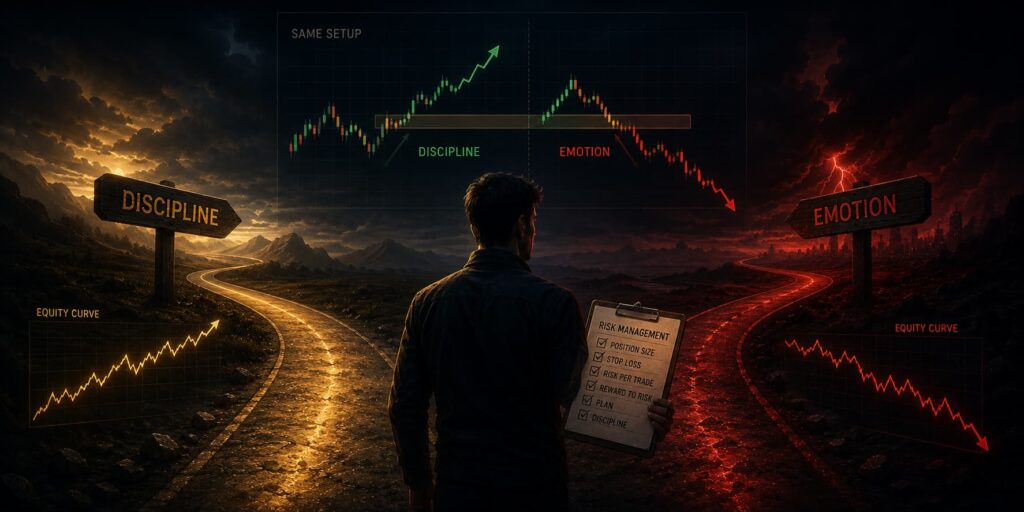
Imagine two traders using the same breakout strategy.
Both see the same setup.
Trader A enters the trade with proper risk management. They risk only a small percentage of their account. They already know where they will exit if the trade fails.
Trader B enters with a larger position because they feel “confident” this trade will work. When the market moves against them, they refuse to exit. They hold and hope.
Now both traders are no longer using the same strategy.
One is trading with discipline.
The other is trading with emotion.
That single difference changes the result completely.
This is trading consistency in action. The trader who follows the rules consistently will outperform the one who bends them based on emotion. Trading consistency is not about being perfect; it is about being disciplined.
Emotions Destroy Good Setups
Most trading losses don’t happen because the strategy is bad.
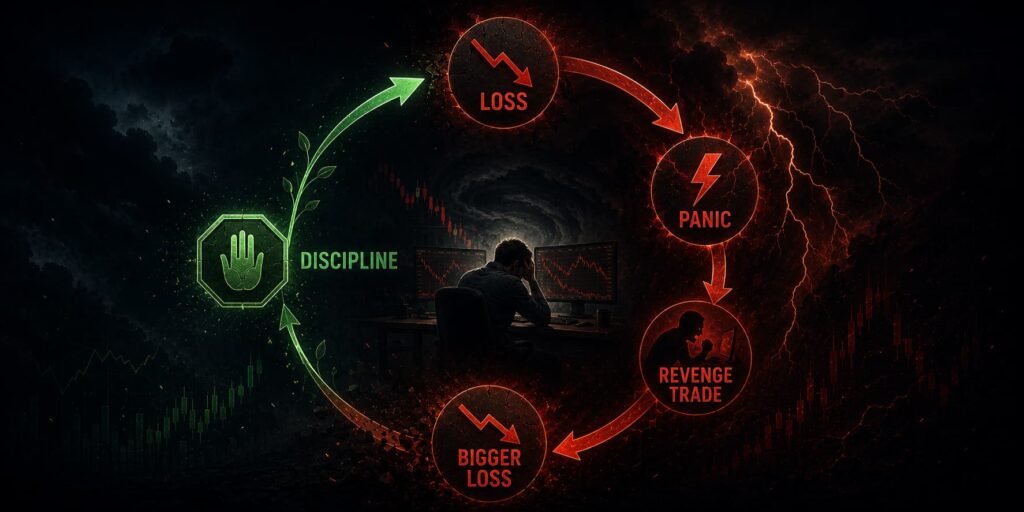
They happen because people panic, overtrade, or abandon their rules after a few losses.
A trader may have a system with a real edge, but emotions slowly ruin the execution.
They:
- Exit winning trades too early
- Hold losing trades too long
- Revenge trade after losses
- Increase position size emotionally
- Take random trades out of boredom
Over time, these small mistakes destroy consistency. Trading consistency requires emotional control.
The dangerous part is that many traders don’t even realize they’re doing it. They blame the market, the broker, or the strategy instead of looking at their own execution.
Risk Management Matters More Than Most People Think
This is probably the most underrated part of trading.
A profitable trader understands that losses are normal.
They don’t try to win every trade.
Instead, they focus on protecting capital so they can survive long enough for the strategy to work over time. This is the essence of trading consistency.
Losing traders often do the opposite.
They risk too much on one trade because they want fast results. A few bad trades then wipe out weeks or months of progress.
The market punishes impatience very quickly.
Trading consistency requires that you stay in the game long enough for your edge to play out. If you blow up your account, your trading consistency ends permanently.
Patience Is a Real Trading Skill
A lot of people think trading is about taking more trades.
In reality, experienced traders often do less.
They wait.
They skip weak setups.
They avoid emotional entries.
Beginners usually feel pressure to always be in the market. They open trades simply because they don’t want to “miss opportunities.”
But sometimes the best trade is no trade at all.
That took me a long time to understand.
Trading consistency is not about frequency; it is about quality. A trader with patience will wait for the right setups and execute them well. That is trading consistency.
The Hard Truth About Trading
At some point, every trader realizes this:
Trading is less about finding a secret strategy and more about controlling yourself.
Discipline.
Patience.
Risk management.
Trading consistency.
Those things sound boring compared to indicators and “100% winning setups,” but they are usually what separates profitable traders from struggling ones.
Two people can absolutely use the same strategy and get opposite results.
Because in trading, execution matters more than information.
And that’s what makes trading difficult for most people. Trading consistency is the bridge between knowledge and results.
This is why [why most traders quit] – they lose patience before consistency kicks in.
Over-Committed Position
It is my belief that the more money a trader risks on a trade relative to their overall net worth, the more emotionally invested in that trade they will be. It seems like commonsense perhaps, but the implications of this are quite profound.
When you become over-committed to a trade or to an investment, you are far more likely to make a mistake. For this reason, two traders can literally be in the exact same trade, but if one has risked a much higher percentage of their net worth, they are most likely going to see the chart much differently and react to it much differently, than the trader who has risked a “safer” amount.
The take-away point of this is that the more money you have at risk, the more emotionally-charged you will be at every up and down tick of that chart. When you are very emotional about a position, usually due to being over-committed money-wise, you are more likely to see a short-term reversal in that position as an impending market correction that may go well past your entry point, causing you to lose money.
So, what do you do? Inevitably, when faced with this powerful emotion of fear, you will exit that trade for probably either a very small gain relative to what you had since you are exiting as the market is coming back towards your entry, or you will exit near breakeven. Granted, this is still much better than a loss, but it can be very painful and mess with your trading mindset, leading to more mistakes.
To the trader who wasn’t over-committed, that same correction may have been viewed differently; as a simple market correction. That trader may have held the trade and now is well into the money as the chart turned around just as the previous trader bailed.
This is really just one of many examples of how risking too much or being over-committed to a position can cause you to panic and self-sabotage your trades.
To reiterate the point: two traders, one has risked way too much, the other has risked a much smaller amount, the one who risks too much will almost always panic and mess up the trade, the one who didn’t risk too much is more likely to have a favorable trading result. Trading consistency is built on proper position sizing.
Bias of No Position or Position
Simply by being in a position, by having “skin in the game” so to speak, you may view the chart differently than a trader who has not taken a position in that market. Even if you are staying within your per-trade risk parameters and following your trading plan to the T, you are going to be at least slightly influenced by the fact that you have your hard-earned money on the line and could potentially lose it. This is essentially why trading is not easy and it’s not for the weak minded or easily shaken personality.
It’s a curious fact that when you are demo-trading with paper-money, you are probably going to get better results than when you trade live. The reason is, it’s paper-money, not real money. The key to trading consistency truly is trying to forget about the money and trading the markets as if it’s all a game and the money is just a way of keeping score, a tally of points, so to speak.
The only way to effectively do this is to not be over-committed. You have to basically try to see the chart as if you have no position in the market, even if you do. Trading consistency requires emotional detachment.
According to Investopedia – Trading Psychology , this is one of the most common behavioral biases that affects traders. The presence of real money changes decision-making, which is why trading consistency is so difficult to achieve.
Recency Bias Based on Trade Outcomes
Two traders, trading the same setup on the same chart may see that chart differently due to something called recency bias. Recency bias means you have a bias or an opinion or feeling about something due to an experience you had recently with that same or similar thing.
So, trader A may have seen this “same” scenario before and had a trade on and lost money, whereas trader B may have made money on market conditions similar to what they’re seeing now.
As stated in an article in USnews & World Report titled “7 Behavioral Biases that May Hurt Your Investments”:
“It’s no secret that retail investors tend to chase investment performance, often piling into an asset class just as it is peaking and about to reverse lower. Because the investment has been climbing higher recently, investors believe that will remain the case.”
As humans, we are all influenced by recent events more heavily than past ones, it’s just part of being human. This can be good and bad in trading. Market conditions that are trending strongly lend to recency bias being beneficial because if you keep getting in the trend on pullbacks you’ll likely keep making money. However, when the trend changes and the market starts moving sideways, you are likely going to get chopped up if you don’t quickly read the price action and figure out the conditions are changing.
Interestingly, there are many different personality biases that can affect how any individual sees the market. Trading consistency requires recognizing these biases and overcoming them.
Too Attached to the Market or to the Initial View
People can become emotionally attached to charts, certain markets, or just to their initial view on a chart for a variety of reasons, not only from being over-committed financially.
Take a trader who has researched a certain market extensively and studied the chart a lot, they are probably going to become very attached to a view once they take one. They will feel their time spent studying XYZ market has to have been worth something and they can’t bear to think the market isn’t doing what they want. This causes them to look for news articles and web stories that support their view on the chart, after all, you can find any opinion on anything online.
This is essentially letting arrogance and ego dictate your trading behavior. You can become over-attached to a chart simply because you don’t want to believe you are wrong or that all your research has been for naught.
This is essentially what is called the over-confidence bias. This is caused by spending too much time studying a market and “convincing” yourself you are right about what will happen next. Traders also get over-confident after a winning trade because they tend to become overly-optimistic about their recent decision and attribute too much of the win to something they did rather than just a statistical occurrence of their edge playing out.
Another trader who maybe doesn’t have this mental hurdle because they haven’t done the research and the study is arguably at an advantage to the trader above. When you spend less time on something you are naturally more neutral and less committed to it. This gives a fresh perspective and more importantly, a more objective one. Trading consistency requires objectivity.
In trading, objectivity is key. Trading consistency is built on the ability to see the market as it is, not as you want it to be.
Brett Steenbarger – Trading Psychology writes extensively about how over-confidence bias destroys traders. Trading consistency requires humility and self-awareness.
Indicators vs. Clean Charts
One obvious reason two traders will view the same chart differently is indicators. Some traders like to plaster their charts in technical analysis indicators that literally make the charts look like a piece of modern abstract art.
The trader who uses clean, simple price action charts without indicators plastered all over them, will inevitably have a different perspective on the same market; a clearer and more accurate one. Trading consistency is easier to achieve with clarity.
Trend Follower vs Contrarian
Similar to the above point, there is truth that two traders who have historically made money trading the markets different ways, are going to see the same chart differently.
Trader A may see a chart going up, but because he is a natural contrarian, wanting to trade opposite to near-term momentum, he wants to short into the strength, ideally at a key level, because he has made money doing this before, recency bias. He hates trading with the herd.
Trader B may see that same chart going up and he is looking to go long. Because he too has made money doing this. He has traded trends and made good money. He can’t ever seem to go against the herd.
Neither approach is necessarily right or wrong; there are multiple ways to skin a fish, so to speak. Whilst it is more dangerous to trade against near-term trends, some traders just have a knack at fading the market, or picking the places the market will reverse, contrarians. However, for most traders, sticking with the trend is the best bet.
The point is that each person is going to see the exact same chart, setup or pattern in the market a little bit differently and for a variety of reasons discussed above, react differently to the same market movement. Trading consistency requires knowing your style and sticking to it.
Conclusion
Two traders can indeed see the same chart differently and more often than not they will get different results from the exact same trading setup on the exact same chart. The common unifier in trading is the price action on the chart, it really is the great equalizer. The price action takes into account all variables affecting a market and that have affected it in the past and displays it to you in a relatively easy to read clue-packed “portrait.” Learning to read the price action is how you can eliminate or greatly reduce most of the variables in the markets that confuse and complicate the trading process for most.
Most of the reason two traders see the same chart differently is due to lack of discipline and trading consistency. Some traders chronically risk too much per trade, which obviously greatly influences their perception of what a market is doing and what it might do next.
Whilst I can teach you the importance of discipline and explain to you why you need it, I cannot force you to actually get and stay disciplined in your day-to-day trading routine. I can show you the door to trading success, but I cannot make the journey for you, that is up to you. Trading consistency is a choice you make every single day.
So, what you have to decide next is how are you going to view the same charts everyone else is looking at? Will you view them through emotionally-charged eyes and indicator-riddled screens, or will you view them through calm, collected eyes with smooth, clean charts? That is also up to you.
Trading consistency is the difference between those who succeed and those who don’t. The strategy is not the problem. The person using it is. Trading consistency is the bridge between knowing and doing.
Disclaimer
This article is for educational and informational purposes only. It does not constitute financial advice, trading recommendations, or an offer to buy or sell any asset. Trading forex, commodities, indices, cryptocurrencies, and futures carries significant risk and may not be suitable for all investors. You can lose more than your initial deposit. Past performance does not guarantee future results. Always read full terms, contract specifications, and risk disclosures before trading. Do your own research. Consult a licensed financial advisor if you need professional investment advice.