


This weekly summary covers everything you need to know from the week of September 1-5, 2026. The week was defined by a dramatic return of geopolitical risk that upended the benign macro narrative that had been building through August. The Middle East conflict escalated sharply, sending oil prices surging and reigniting inflation fears, just as markets were preparing for the critical September FOMC meeting. This weekly summary breaks down all the key moves and what they mean for the weeks ahead.
The week unfolded in three distinct acts: geopolitical escalation, central bank crosscurrents, and a stunning nonfarm payrolls shock. Each act built on the last, creating one of the most volatile trading environments since the July FOMC meeting. This weekly summary tracks each phase in detail.
This weekly summary is designed to give you a complete picture of the week’s events and how to position for the week ahead.
For more on how geopolitical risk moves oil, see our guide on how geopolitical risk moves oil.
Key Takeaways from This Weekly Summary
- Geopolitical escalation sent oil surging – US-Iran strikes pushed Brent above $96 and WTI above $91, with markets pricing significant supply disruption risk. This weekly summary highlights oil as the week’s biggest mover.
- BOJ hawkish pivot triggered yen surge – Governor Ueda signaled a September rate hike with odds surging above 90%, triggering a massive carry trade unwind. This weekly summary considers this the most important central bank development.
- NFP shocked markets with 162,000 jobs added – Nearly triple the 56,000 consensus, pushing September Fed hike odds to ~60%. This weekly summary flags the NFP as the week’s defining data point.
- Fed rate hike probability jumped – CME FedWatch showed 60.3% odds of a September hike following the strong jobs data. This weekly summary tracks the repricing.
- USD/JPY collapsed toward 155 – The yen surged nearly 300 pips on intervention fears and BOJ hawkish signals. This weekly summary considers this the most dramatic FX move of the week.
Act I: Geopolitical Escalation (September 1-2)
The week began with a dramatic escalation in the Middle East. On September 1, the United States launched a new round of precision strikes against Iranian Islamic Revolutionary Guard Corps (IRGC) military targets, including the first-ever strikes on Iranian coastal oil facilities. Tehran retaliated immediately, firing missiles at U.S. military bases in Jordan. This weekly summary tracks the escalation sequence.
The escalation sent shockwaves through energy markets. Brent crude futures surged over $96 a barrel, while WTI pushed past $90. According to Reuters, oil prices hit fresh six-week highs as the latest U.S. strikes on Iran and renewed Israeli threats against Tehran revived concerns about disruptions to Middle East supplies. The Strait of Hormuz—the world’s most critical energy chokepoint—once again became the focal point of global supply fears. This weekly summary considers the oil spike the most important market development.
By September 3, Brent crude futures settled at $95.20 a barrel, while WTI traded at $90.77. Analysts warned that if strikes continued, oil could breach $100 per barrel. President Trump indicated that the new military campaign against Iran “would not last that long,” but the uncertainty alone was enough to keep markets on edge. This weekly summary highlights the uncertainty as a key risk factor.
This weekly summary emphasizes that geopolitical risk is now the dominant market driver.

For more on how to prepare for high-impact data, see our guide on how to prepare for high-impact data.
Act II: Central Bank Crosscurrents (September 2-4)
Against this volatile backdrop, the world’s major central banks delivered a series of signals that pulled markets in different directions. This weekly summary tracks all three central banks.
Bank of Japan: The Hawkish Surprise
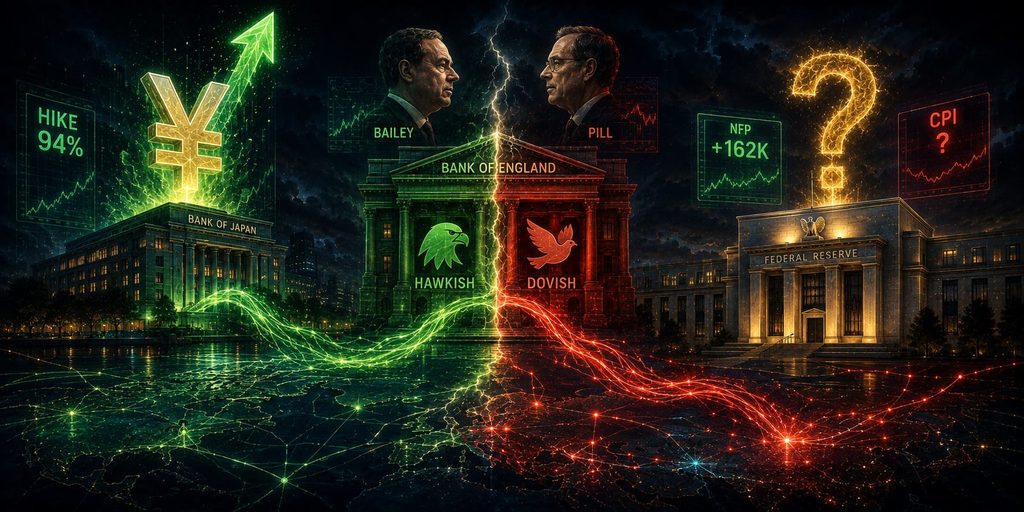
The Bank of Japan delivered the most significant surprise of the week. Governor Kazuo Ueda explicitly signaled that a September rate hike is on the table. According to Bloomberg, hawkish comments from Ueda and board member Hajime Takata raised the possibility of an outsized rate increase at the central bank’s Sept. 18 meeting. This weekly summary flags the BOJ as the week’s biggest central bank story.
Ueda stated that with underlying inflation approaching the 2% target, the BOJ must pay greater attention to upside risks in policy implementation. Treasury Secretary Scott Bessent suggested he was supporting such a move after a meeting with Ueda. This weekly summary considers the US-Japan coordination a significant development.
Overnight index swaps surged to price a 94-97% probability of a 25bp hike to 1.25% at the September 17-18 meeting. Reports indicated the BOJ has already “basically finalized” the decision to raise rates. This weekly summary tracks the repricing.
The yen responded immediately, triggering a massive carry trade unwind. A rush to unwind yen-funded carry trades helped send the currency to a one-month high against the dollar. The shrinking advantage of overseas rates will also act to unwind the carry trade, where investors borrow cheap yen to invest elsewhere. This weekly summary considers the carry trade unwind a structural shift.
Bank of England: A Split Decision
Governor Andrew Bailey pushed back aggressively against market expectations of a September rate hike, calling for “flexibility” in monetary policy and cooling hopes of tightening. However, BOE Chief Economist Huw Pill struck a more hawkish note, reiterating the need to raise the bank rate to 4%. This split within the BOE created confusion for sterling markets. This weekly summary highlights the BOE confusion.
Federal Reserve: Waller’s Dovish Interlude
Governor Christopher Waller delivered remarks that temporarily eased September rate hike fears ahead of the crucial nonfarm payroll report. According to CME FedWatch data, following the ADP data release, the probability of the Fed maintaining interest rates in September was 37.8%, with a 62.2% probability of a 25 basis point hike. But the broader picture remained hawkish. This weekly summary tracks the Fed’s shifting odds.
Act III: The Nonfarm Payrolls Shock (September 4)
The week’s main event arrived on Friday, September 4, with the August Nonfarm Payrolls report. The result was a stunning beat: 162,000 jobs added versus a consensus expectation of just 53,000-56,000—nearly three times what economists had forecast. The unemployment rate held steady at 4.1%. This weekly summary considers the NFP the most important data point of the week.
This was not a modest surprise. It was a complete repudiation of the “cooling labor market” narrative that had been building through July and early August. The ADP “small nonfarm” print earlier in the week had shown only 38,000 jobs added, creating expectations for a weak number. The actual NFP print blew those expectations out of the water. This weekly summary highlights the surprise magnitude.
The market reaction was swift and decisive. According to CME’s FedWatch tool, the probability of a 25 basis point Fed rate hike by September rose to 60.3%, up from 58.2% immediately after the data. The probability that the Fed will hold rates steady through September fell to 39.7%. This weekly summary tracks the repricing.
Market Reaction to the NFP Shock
| Asset | Reaction | Significance |
|---|---|---|
| U.S. Treasury yields | Sharp selloff across all maturities | Rate hike expectations surged |
| Fed rate hike odds | Jumped to ~60% for September | Market now pricing meaningful tightening |
| USD | Strengthened broadly | Safe haven + rate support |
| S&P 500 | Mixed – sold off initially, held firm | Good news = bad news (higher rates) |
| Gold | Pressured | Higher rates = headwind |
Foreign Exchange: The Great Divergence
USD/JPY: The Carry Trade Unwind
This was the most dramatic move of the week in this weekly summary. USD/JPY started the week testing the 160 level, driven by persistent dollar strength. By week’s end, it had collapsed toward 155, a weekly decline of approximately 2.35%. USD/JPY slid toward 155.00 as intervention and Fed hike doubts collided. This weekly summary tracks the yen’s surge.
The catalyst was a powerful one-two punch:
- BOJ hawkish signals: Ueda’s explicit of a September hike triggered a massive repricing of yen expectations. The probability of a September hike surged above 90%. This weekly summary flags the BOJ as the key driver.
- Intervention fears: With USD/JPY trading near the critical 160 level—the zone that triggered joint US-Japan intervention in August—markets became increasingly nervous about another coordinated intervention. This weekly summary highlights the intervention watchpoint.
The combination forced a violent unwind of the yen carry trade, which had been one of the most crowded positions in global markets. A rush to unwind yen-funded carry trades helped send the currency to a one-month high against the dollar. This weekly summary considers the carry trade unwind a major theme. According to Bloomberg, the carry trade exodus is accelerating ahead of the BOJ rate decision .
The DXY fell below 99.0, driven primarily by yen strength rather than any fundamental dollar weakness. The dollar’s early-week rally stalled, leaving the index in the mid-99s. This weekly summary tracks the DXY’s decline.
Technical levels for USD/JPY:
| Level | Significance |
|---|---|
| 155.00 | Psychological support; break below could accelerate toward 153 |
| 156.50 | Immediate resistance; sellers active here |
| 158.00 | Former support now resistance |
| 160.00 | Critical resistance; intervention watchpoint |
EUR/USD: Range-Bound Consolidation
EUR/USD traded in a tight range around 1.1600-1.1650 throughout the week, closing the week with a modest +0.31% gain at 1.1612. This weekly summary tracks the euro’s consolidation.
The pair lacked independent direction, caught between conflicting forces:
| Force | Impact on EUR/USD |
|---|---|
| Geopolitical escalation | Safe-haven USD demand (bearish EUR) |
| Oil price surge | Eurozone energy import concerns (bearish EUR) |
| ECB hike expectations | September 10 hike priced (bullish EUR) |
| DXY weakness from JPY | Indirect EUR support |
The 200-day moving average at approximately 1.1600 continued to act as a magnet, with the pair struggling to break decisively in either direction. This weekly summary considers 1.1600 the key level.
Technical levels for EUR/USD:
| Level | Significance |
|---|---|
| 1.1600 | 200-day MA; critical support |
| 1.1550 | Next support if 1.1600 breaks |
| 1.1650 | Immediate resistance |
| 1.1700 | Key resistance; breakout level |
GBP/USD: BOE Confusion Caps Upside
GBP/USD closed the week slightly lower at 1.3514, a decline of about 0.15%. Sterling underperformed the euro, reflecting the confused signals from the BOE:
- Bailey poured cold water on September hike expectations
- Pill maintained that rates need to rise to 4%
The mixed signals created uncertainty, preventing sterling from capitalizing on dollar weakness. This weekly summary highlights the BOE confusion.
Technical levels for GBP/USD:
| Level | Significance |
|---|---|
| 1.3500 | Psychological support |
| 1.3450 | Next support if 1.3500 breaks |
| 1.3600 | Immediate resistance |
| 1.3650 | Key resistance |
Energy Markets: The Geopolitical Premium Returns
Oil was the standout performer this week, with both Brent and WTI posting their largest weekly gains since July. This weekly summary considers oil the week’s biggest mover.
| Benchmark | Weekly Move | Key Drivers |
|---|---|---|
| Brent | ~+7% to $95+ | US-Iran strikes, supply disruption fears |
| WTI | ~+5-6% to $90+ | Same, plus inventory tightness |
Brent crude settled at $95.52 on Wednesday, down 11 cents, while WTI rose 29 cents to $91.30, with both contracts touching six-week highs during the session. Oil prices rose for a fourth straight day on Thursday, taking Brent crude futures over $96 a barrel. This weekly summary tracks the oil surge.
The market is pricing a significant risk premium for potential Strait of Hormuz disruption. Global crude markets are already facing a supply deficit of 2-3 million barrels per day, with inventories continuing to decline. Any further escalation could push oil toward $100 or higher. This weekly summary flags the oil risk.
European natural gas futures also spiked to over three-year highs as the conflict raised concerns about energy security.
The US-Iran Conflict Sequence
The US-Iran conflict escalated dramatically during the week. This weekly summary tracks the sequence:
September 1: The United States launched precision strikes against Iranian IRGC military targets, including coastal oil facilities. This was the first time the US targeted Iranian oil infrastructure directly.
September 2: Tehran retaliated with missile fire at U.S. military bases in Jordan. The escalation pushed oil markets into panic mode, with Brent breaking above $95 and WTI pushing past $90.
September 3: Oil prices settled at six-week highs. Brent crude settled at $95.52, down 11 cents, while WTI rose 29 cents to $91.30. Both contracts touched six-week highs during the session.
September 4: Oil rose for a fourth straight day, taking Brent futures over $96 a barrel. President Trump indicated that the new military campaign against Iran “would not last that long,” but the uncertainty persisted.
U.S. Treasury Market: The Yield Story
The Treasury market was a battlefield this week, with competing forces driving yields in different directions. This weekly summary tracks the yield moves.
Early week: Yields spiked sharply. The 10-year Treasury yield hit 4.80%, its highest level since early 2025. The 2-year yield jumped 14bp in a single session as markets repriced rate hike expectations.
Mid-week: Governor Waller’s dovish comments temporarily eased pressure, with the 2-year yield falling to 4.34% and the curve steepening.
Friday (Post-NFP): The strong jobs report sparked a broad selloff in Treasuries, pushing yields higher across the curve. The 2-year yield climbed back toward 4.36%, the 10-year held near 4.77%, and the 30-year remained above 5.25%.
The yield curve flattened materially, reflecting the market’s repricing of near-term rate hike risk relative to long-term growth concerns. This weekly summary considers the flattening a key signal.
The Week Ahead: September 7-13
The Main Event: ECB Rate Decision (September 10)
The European Central Bank meets on Thursday, September 10, in Berlin. This is a significant meeting—it’s the ECB’s annual “away day” outside Frankfurt, hosted this year by Germany. This weekly summary flags the ECB meeting as the key event.
| Expectation | Detail |
|---|---|
| Rate decision | 25bp hike to 2.50% (deposit rate) |
| Market pricing | ~99% certainty |
| Lagarde press conference | Key focus—forward guidance |
| Key risk | No clear guidance could limit market reaction |
The ECB’s decision is widely expected to be the second and final rate hike in the current tightening cycle. With a hike fully priced, the focus is entirely on forward guidance. If Lagarde leaves the door open for further hikes, the euro could strengthen. If she signals a pause, the euro may weaken. This weekly summary considers guidance the key variable.
Market scenarios for the ECB:
| Scenario | ECB Signal | Market Reaction |
|---|---|---|
| Hawkish | Door left open for further hikes | EUR strengthens, yields rise |
| Dovish | Clear signal of pause | EUR weakens, yields fall |
| Neutral | No clear guidance | Limited reaction; focus shifts to CPI |
U.S. Data: The CPI Pivot (September 11)
Friday’s NFP was the “appetizer.” Next week’s August CPI report (September 11) is the “main course.” This weekly summary flags CPI as the most important data point of the month.
| Metric | What to Watch |
|---|---|
| Headline CPI | Energy pass-through from oil spike |
| Core CPI | Sticky inflation signals |
| Market reaction | This will likely determine September Fed hike probability |
The August Consumer Price Index lands September 11, four days before the FOMC convenes. Economists expect core CPI to rise +0.24% m/m in August, nudging the year-over-year pace down to 2.4%. Annual headline inflation is expected to ease from 3.5% to 3.4%. This weekly summary tracks the forecasts.
The critical tension: The strong NFP print has already pushed September hike odds to ~60%. If CPI comes in hotter than expected, odds could approach 80-90%. If CPI surprises to the downside, the Fed may still have room to hold. This weekly summary flags this as the key debate.
| CPI Outcome | Fed Response | Market Reaction |
|---|---|---|
| Hot (Core >0.3%) | September hike likely (80-90% odds) | USD rallies, gold falls, yields spike |
| In-line (Core 0.2-0.25%) | Uncertainty remains (60% odds) | Volatility, range-bound |
| Soft (Core <0.2%) | Hold likely (70% odds) | USD falls, gold rallies, yields drop |
BOJ: The September Meeting
The BOJ’s September 17-18 meeting is now the most important in years. With odds of a hike above 90%, the market is pricing in a 25bp move to 1.25%. This weekly summary considers this the second-most important event of the month.
What to watch:
- The size of the hike: 25bp priced in; any surprise would be a 50bp move
- Forward guidance: Will the BOJ signal more hikes into 2027?
- The carry trade reaction: A hike will accelerate the unwind
Key Levels to Watch
| Asset | Level | Significance |
|---|---|---|
| USD/JPY | 155.21 | Key support; break below could accelerate |
| EUR/USD | 1.1600 | 200-day MA; breakout direction sets tone |
| 10-year yield | 4.80% | Resistance; break above signals hawkish repricing |
| WTI Oil | $90-95 | Ceiling; break above $100 = stagflation fears |
Conclusion: The Bottom Line
This weekly summary covers a week that was a masterclass in how geopolitics can override everything. The US-Iran escalation, the BOJ’s hawkish pivot, and the stunning NFP beat have completely reset the macro landscape. This weekly summary has tracked all the key moves.
Three things to internalize from this weekly summary:
- The Fed is trapped. Strong jobs data + rising oil prices + sticky inflation = no room to cut, and mounting pressure to hike. The September 15-16 meeting is now genuinely “live” for a rate hike.
- The BOJ is a game-changer. The yen is no longer just an intervention story. It’s a rate hike story. With 90%+ probability of a September hike and more expected into 2027, the carry trade unwind has legs.
- Geopolitics is back. The Middle East conflict has re-escalated, oil is surging, and inflation fears are returning. This is the wildcard that could upend all central bank projections.
What to watch next week:
- ECB Thursday: Hike is priced. Guidance is everything.
- CPI Friday: This will decide whether the Fed hikes in September or holds.
- Oil prices: If WTI breaks $95, markets will start pricing $100+ oil and stagflation risks.
- USD/JPY: The carry trade unwind is accelerating. Watch 155 support.
This weekly summary has prepared you for all the key scenarios. Now it’s up to you to execute.
Disclaimer
This article is for educational and informational purposes only. It does not constitute financial advice, trading recommendations, or an offer to buy or sell any asset. Trading forex, commodities, indices, cryptocurrencies, and futures carries significant risk and may not be suitable for all investors. You can lose more than your initial deposit. Past performance does not guarantee future results. Always read full terms, contract specifications, and risk disclosures before trading. Do your own research. Consult a licensed financial advisor if you need professional investment advice.