


This session wrap covers June 26, 2026. The dollar refused to bid into a live war headline. That is the story of the day. With Fox News and Axios both confirming active US military strikes in the area of the Strait of Hormuz, the textbook reaction is a DXY squeeze. The textbook did not show up.
In one sentence: this session wrap reads as a soft DXY at 101.345 despite live Strait of Hormuz strikes, with gold absorbing the safe-haven bid, oil dumping on a counterintuitive risk-fade, and the FX majors barely flinching because the rate-differential anchor never moved.
This session wrap covers the internal rotation, the S&P Global sovereign debt headline, and the cross-asset tells that made this session unique.
For a deeper look at [how the Fed shapes the dollar], this session wrap recommends understanding the rate spine that held the dollar back.
The DXY Tape and What the Dollar Refused to Do
The dollar index closed at 101.345, down 0.08% on the day. On any normal session wrap, that print is unremarkable. On a session where two named wires confirmed US military strikes around the Strait of Hormuz, with a third headline reporting an explosion in the Sirik region, that DXY print is the entire story.
The textbook live-fire response is mechanical. Dollar bid, gold bid, oil bid, yen bid, equities soft. We got two out of five today. Gold went, equities went soft on the Nasdaq leg, and the dollar did not show up. Neither did the yen. Neither did oil, which actually dumped 2.73%. That dislocation is the read worth keeping in this session wrap.
The reason is in the rate spine. The dollar trades against rate differentials and risk-flow demand. With US 10Y yields unchanged on the day and the MarketWatch wire flagging that “bond yields are falling as inflation pops, the Fed’s tough talk under Warsh is helping,” the front-end of the dollar story did not get the catalyst it needed. A war headline does not move FOMC pricing if the policy path is already framed by the new chair’s hawkish positioning. This session wrap has seen this exact setup play out before: macro pricing trumps geopolitical noise when the differential is the dominant variable.
This session wrap treats the rate spine as the anchor for the entire session.
The Hormuz Headline and the Cross-Asset Reaction
Let us anchor the headline flow with the timestamps, because sequence matters. At 20:43 GMT, Iranian media flagged that warning shots were fired toward violating vessels in the Strait of Hormuz. At 20:45 GMT, IRIB reported an explosion heard in the Sirik region of Iran. At 20:58 GMT, Fox News reported ongoing US strikes on Iranian targets, Axios confirmed strikes in the area of the Strait of Hormuz, and the US military issued a statement framing the action as a response to yesterday’s attack on a commercial ship transiting the Strait.
That sequence matters because the market did not price escalation as escalation. It priced it as a contained tactical response. Three signals back that read, and this session wrap tracks all of them.
One, oil sold off hard. WTI at 69.96 (-2.73%) and Brent at 73.3 (-2.60%) is not the tape of a market pricing a closure of the Strait. It is the tape of a market that had a war-premium already baked in and is now fading it. Roughly 20% of global oil and a third of seaborne LNG transits Hormuz. A genuine closure scenario would have crude bid five to ten percent, not down two and a half. The crude desk read this as a targeted, response-limited action.
Two, the VIX bled lower to 18.41 (-2.54%). Equity vol does not collapse into a real escalation, it expands. The vol market voted “contained.” This session wrap reads the VIX as confirmation of the contained-headline read.
Three, the dollar did not catch a flight-to-quality bid. When the dollar misses the haven flow, the haven flow is usually being absorbed elsewhere, namely gold. And that is precisely where it went.
Major-Pair Walkthrough Against the Dollar
Walk the majors with that frame in mind: the dollar is soft because the rate spine is soft, not because the haven trade is failing. This session wrap covers each major pair in detail.
EUR/USD: 1.1387 (+0.22%)
The euro was the cleanest gainer in the G10 against the dollar, closing at 1.1387. With no tier-1 European data on the tape in this window, the move is mechanical: dollar weakness mapped one-for-one into the euro because the ECB-Fed differential narrative did not get a fresh shove either direction. The pair is now perched at the 1.1400 round resistance, the round number nobody has clean-broken in this cycle. That round is the level the desk is watching into the next session.
GBP/USD: 1.3198 (+0.08%)
Cable closed at 1.3198, up 0.08%, the laggard of the dollar-weakness G10 trade. Sterling did not get the same lift as the euro because the BoE-Fed differential is tighter and the UK risk-on bid was missing with the FTSE down 0.39% on the day. The 1.3200 round is exactly where price is hovering, which is precisely the kind of magnetic round the FX market loves to chop at into a US data void.
USD/JPY: 161.745 (-0.04%)
This is the pair that should have moved and did not. Yen-as-haven was a 2022 trade. It is barely a trade in 2026. The Bank of Japan path is still glacially behind every other G10 central bank, the carry math still favours dollar-yen longs structurally, and a live military headline in the Middle East no longer flips that arithmetic in the way it used to. USD/JPY closed at 161.745, essentially unchanged, sitting just below the 162.00 round resistance. The yen failed to perform the haven role, which is itself a tell about how the market is processing this headline.
USD/CHF: 0.8094 (-0.14%)
The Swiss franc, by contrast, did its haven job. USD/CHF down 0.14% to 0.8094 means the franc caught a modest bid, the cleanest haven response in FX outside of gold itself. The 0.8000 round below is the structural level that has acted as a magnet for franc-strength episodes through this cycle.
AUD/USD and NZD/USD: 0.6896 and 0.5640
The Antipodeans were soft against the dollar despite the broad dollar weakness, which tells you the risk-off lean in commodity FX won out over the dollar-down trade. AUD at 0.6896 (-0.07%) and NZD at 0.5640 (-0.06%) both held just below psychological rounds.
USD/CAD: 1.4192 (-0.06%)
The loonie barely moved against the dollar despite WTI dumping 2.73%, which is itself a tell. A 2.7% drop in crude on any other day takes USD/CAD twenty pips higher minimum. Today it took it nowhere. The dollar-down lean cancelled the oil-down lean. USD/CAD closed at 1.4192, sitting in the middle of its recent range with no clear structural pull.
For more on [trading major currency pairs], this session wrap recommends understanding how each pair responds to risk regimes.
Yields, Warsh, and the Rate Spine Behind the Dollar
This is where the day’s macro read crystallises. The MarketWatch headline at 20:38 GMT framed the entire rate complex: “Bond yields are falling as inflation pops. The Fed’s tough talk under Warsh is helping.” That single line is the rate spine for the whole session and explains the dollar tape. This session wrap treats it as the key macro driver.
Read it carefully. Inflation is popping. In a normal regime, that lifts the front end of the curve and lifts the dollar. Today, the curve is flattening because the new Fed leadership under Warsh has been credible enough on the policy path that the market is pricing the inflation pop as containable, not extending. The long end is rallying (yields down) because the inflation expectation is anchored. That is the textbook hawkish-credibility trade.
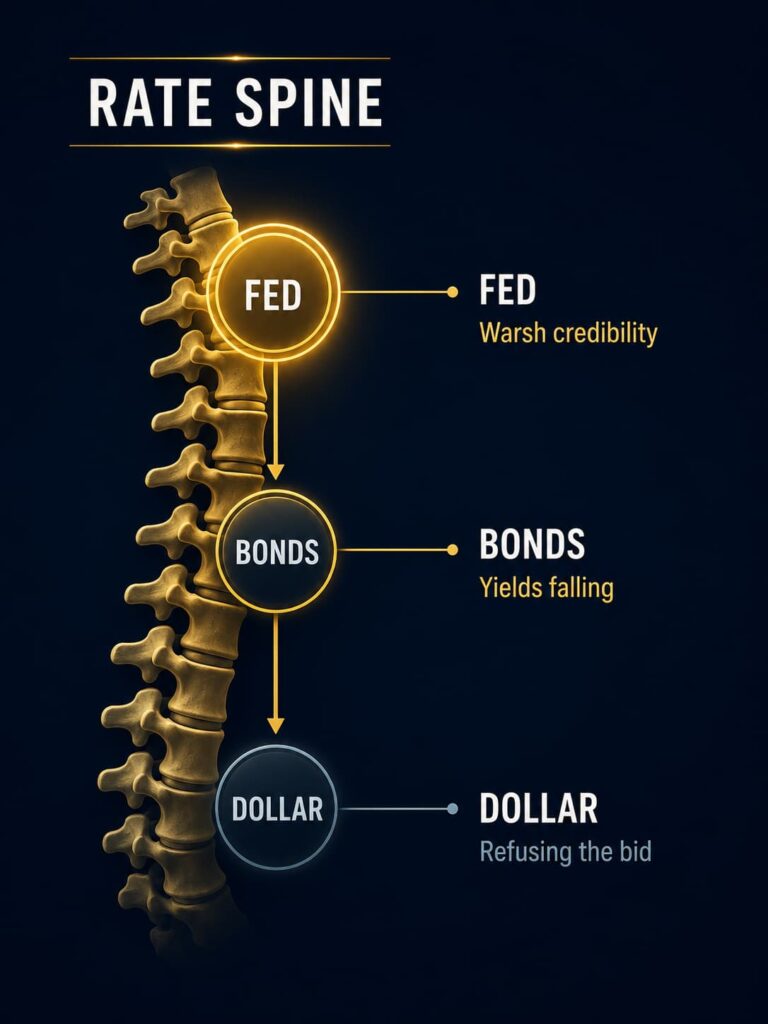
For the dollar, this is double-edged. Hawkish credibility usually supports the dollar by anchoring real yields higher. But if it comes through curve-flattening rather than front-end repricing, the dollar gets less of the bid. That is what we saw today. This session wrap reads the new Fed chair’s communication regime as doing the work the dot plot used to do, with a price tag the dollar is not yet capturing.
For the official source, the Federal Reserve publishes the monetary policy framework that shapes this rate spine.
Gold Up, Oil Down: Reconciling the Safe-Haven Split
Gold closed at 4087.9, up 1.42% on the day. Silver tracked it at 59.07, up 1.24%. Those are the cleanest haven responses on the tape, and they explain why the dollar did not catch the haven bid: the haven flow went into metals, not into dollars.
This is a meaningful regime tell. In the 2022 to 2024 window, the dollar was the dominant haven destination. Gold caught some, but the dollar caught most. In 2026, the haven flow is going to gold, and the dollar is being treated as a rate-differential asset, not a haven asset. The reason is structural: central-bank gold buying through 2024 and 2025 has anchored the metal as the de facto haven, and the dollar has lost some of that premium because of the policy uncertainty premium baked into a new Fed chair and a US administration explicitly comfortable with a weaker dollar.
Oil down is the harder read at first glance. WTI at 69.96 (-2.73%) and Brent at 73.3 (-2.60%) on a day with live US strikes around the Strait of Hormuz seems contradictory. It is not. The crude market had a war-premium baked in across the prior two weeks of tit-for-tat headlines. Today’s strikes, framed by the US military as a targeted response to a commercial ship attack, were read as a containment action, not an escalation. The war-premium is being faded, not extended.
For more on [gold trading strategies], this session wrap covers how real yields and the dollar drive the metal.
The S&P Global Sovereign Debt Headline
The single most important macro print of the day did not come from BLS or the Fed. It came from S&P Global Ratings. This session wrap treats it as the hidden catalyst of the session.
Two wires landed in the same minute. The first: “S&P: US ‘AA+/A-1+’ sovereign ratings affirmed: outlook remains Stable.” That is the headline that protects the bid in Treasuries on the surface. The second is the one the market actually traded: “S&P on US: Expect net general government debt to approach 100% of GDP, given structurally rising nondiscretionary interest & aging-related expenditure.”
That second sentence is a sovereign-credit agency telling the market that the United States debt path is structural, not cyclical, and that the interest bill itself is feeding the trajectory. It is the kind of line that does three things at once. It puts a floor under gold by reframing the long-run real-yield narrative. It puts pressure on the long end of the dollar by amplifying the supply-and-debt-service concern. And it gives equity strategists an excuse to mark down the multiple ceiling on the highest-duration parts of the index, which is exactly where the Nasdaq 100 lives.
For the official source, S&P Global Ratings publishes the sovereign debt analysis that drove this session.
The Nasdaq 100 and the Dow: A Tale of Two Indices
The Nasdaq 100 at 29118.24, off 1.09%, was the loudest line in the cross-asset table. Two threads tied together to make it the worst sector of the session. This session wrap breaks down the rotation.
First, the duration thread. When a sovereign-credit agency tells you the debt trajectory is approaching 100% of GDP, the term-premium bid in long Treasuries can stay sticky even if the front end is anchored. That keeps the long-duration discount rate from falling, which mechanically caps the multiple expansion on long-duration equities. The Nasdaq 100, dominated by mega-cap technology and AI infrastructure names, is the purest expression of long-duration equity in the market. It bleeds first when the long-end story tightens.
Second, the AI-capex thread. Research on the agentic AI market growing from roughly $8bn today to nearly $300bn annually by 2035 reads bullish on the surface. Underneath, the market has been increasingly suspicious of the gap between hyperscaler capex commitments and near-term monetisation. That frames the prize as enormous but distant, triggering profit-taking in the names that have run hardest.
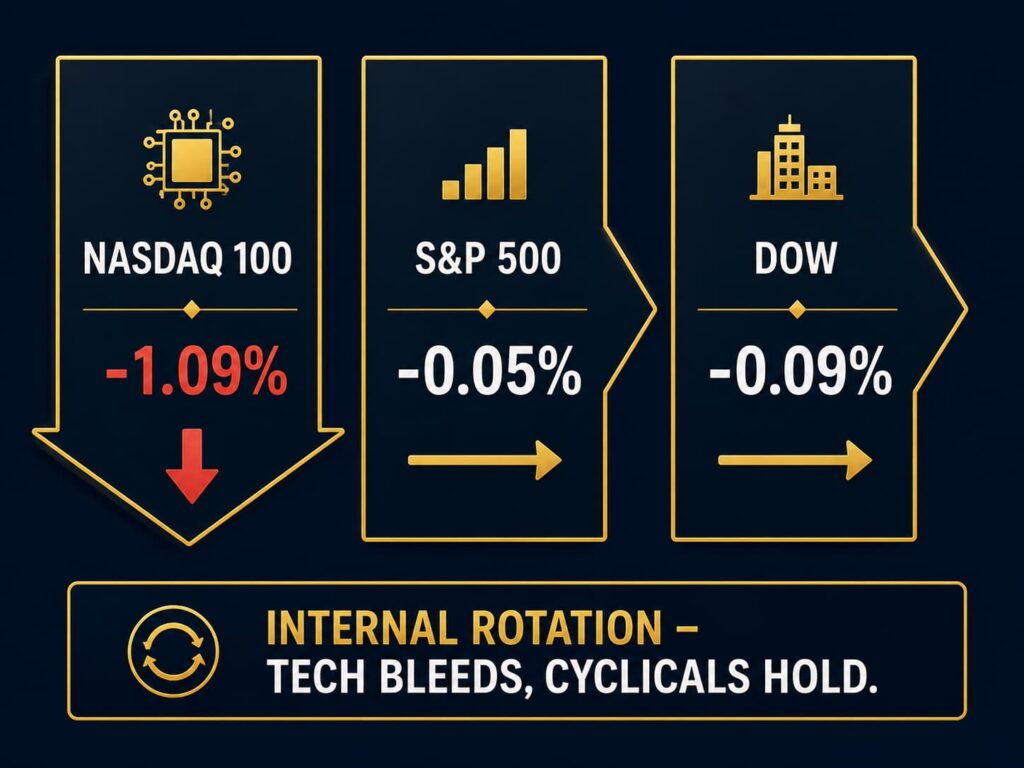
The Dow Jones Industrial Average at 51876.11, down 0.09%, did exactly what you would expect a price-weighted index of mostly industrial, financial, healthcare and consumer-staples names to do on a duration-rotation day. It absorbed the flow. The Dow has a structurally lower duration profile than the Nasdaq 100, so when the long end tightens, the Dow’s relative valuation looks better.
The MOC Imbalance Read
The market-on-close imbalance print carried real information: -$4.5bn on the S&P 500, -$3.3bn on the Nasdaq 100, -$88.7m on the Dow, with a notable +$807.4m on Mag 7.
That last number deserves attention. A negative imbalance on the headline indices alongside a positive imbalance on the Mag 7 basket tells you that the institutional flow at the close was selling the broad index complex while accumulating the mega-cap tech leadership names. On a session when the Nasdaq sold off 1.09%, that is the textbook signature of dip-accumulation by larger systematic and discretionary books that view the AI leadership cohort as a long-term core holding.
This session wrap reads the MOC imbalance as confirmation that the rotation was institutional, not retail panic.
The VIX Softening
VIX softened to 18.35, down 2.86%, which tells you the vol market is not pricing this rotation as a regime break. Yet. Realised vol on the tech side will have run hotter than that index level suggests, but cross-asset hedges did not come on aggressively. That is the difference between rotation and panic.
This session wrap treats the VIX as the confirmation that the market read the headline as contained.
Asset-by-Asset Positioning Read
| Asset | What’s Priced | Direction |
|---|---|---|
| DXY (101.345) | Rate-spine soft, haven flow leaking to gold | Soft |
| XAU/USD (4087.9) | Active geopolitical bid + structural CB demand floor | Bid |
| Brent (73.3) / WTI (69.96) | War-premium fade, contained headline read | Heavy |
| EUR/USD (1.1387) | Mirror image of soft DXY, no fresh ECB catalyst | Bid |
| USD/JPY (161.745) | Yen-as-haven is broken, carry math dominant | Range |
| NDX (29118) | Long-positioning trim, mega-cap rotation | Heavy |
Key Levels Worth Watching
| Asset | Level | Significance |
|---|---|---|
| DXY | 101.00 | Round support, rate-spine-soft extension |
| DXY | 102.00 | Round resistance, haven-bid trigger |
| EUR/USD | 1.1400 | Round resistance, the level the pair is sitting under |
| USD/JPY | 162.00 | Round resistance, yen-as-haven break point |
| Gold | 4080 / 4100 | Support / next overhead round |
| WTI | 70.00 | The level that defines the war-premium fade |
| VIX | 20.00 | The line between contained-vol and expanding-vol regime |
Final Takeaway
The dollar did not bid because the rate spine did not move and the haven flow went to gold instead. That sentence is the entire session wrap. Every other observation in this piece is a corollary.
The market read the Hormuz strikes as a contained response, not an escalation, and routed haven flow into metals while leaving the dollar to be priced purely on the rate differential. The Warsh-credibility read kept the long end anchored and the front end from spiking, which is why the dollar ended soft despite a live war headline. That is the regime tell worth keeping for the next session.
“When the dollar refuses the haven bid on a live war headline, the market is telling you the dollar is no longer the haven. That is a regime tell worth keeping.”
Disclaimer
This article is for educational and informational purposes only. It does not constitute financial advice, trading recommendations, or an offer to buy or sell any asset. Trading forex, commodities, indices, cryptocurrencies, and futures carries significant risk and may not be suitable for all investors. You can lose more than your initial deposit. Past performance does not guarantee future results. Always read full terms, contract specifications, and risk disclosures before trading. Do your own research. Consult a licensed financial advisor if you need professional investment advice.