


Sunday night. Quick one, because Wednesday just got a lot more interesting.
Start with the good news. After thirteen nights of it, the US paused. Saturday, nothing. Sunday, nothing. Tehran has said it holds as long as Washington holds.
On its own that de-escalates the whole thing. Oil comes softer, the pressure comes off, and Warsh gets the room to hold rates and simply talk tough.
Then Saturday morning happened.
The Houthis put missiles and drones into two Aramco sites on the Red Sea coast. Jizan took a hit and burned. The ones aimed at Yanbu were intercepted. First direct strike on Saudi oil infrastructure in four years, and it came as retaliation for Saudi hitting Hodeidah.
So you have de-escalation on one front and fresh escalation on another. At the same time. Three days before a Fed decision.
Here is the part most people will miss. That refinery went up on Saturday, with the market shut. Brent spent the back end of last week either side of 100 and closed just under it. None of the weekend is in the price yet. Monday’s open is the first time anyone actually votes on it.
Which means Wednesday’s Fed decision comes down to two things.
Does the pause hold. And does the Red Sea calm down, or catch fire.
The pause holds and the Red Sea settles. Oil fades back, the pressure comes off, and Warsh holds while talking tough. The market breathes. The Fed decision becomes a straightforward hold with hawkish rhetoric.
Either way I am ready for it, because I am not trading the headlines. I am watching the things that actually decide the outcome. That is the difference, and it is the only part of this worth copying.
Where the Board Sits Before the Fed Decision
Levels below are our last read into Friday’s close and are refreshed before this goes out. Treat them as the map, not the trade.
| Market | Last Read | On the Week | Our Stance |
|---|---|---|---|
| WTI Crude | ~$82 a barrel | up ~14% | Bid on the supply premium |
| Brent Crude | ~$86, one-month high | up sharply | Bid |
| Gold, XAU/USD | ~$4,017, lost $4,000 | down ~3% | Heavy while yields and the dollar hold |
| Dollar, DXY | ~100.7 | slightly softer | Firm, two-way into the Fed decision |
| FOMC, 29 Jul | hold ~87% priced | hike odds fell | Higher for longer is the risk |
Read this row honestly. The hike odds fell this week, they did not rise. A soft US inflation print took the July increase largely off the table. What keeps the higher-for-longer thesis alive is not this week’s data, it is the oil shock now building on top of it. And that oil shock is exactly what could make Wednesday’s Fed decision more interesting than the market expects.
The One Thing That Matters for This Fed Decision
We have said this since the first quarter and we will say it plainly again. The path of least resistance is the inflation trade, and geopolitics is the accelerant. The renewed fighting between the United States and Iran is not a headline the market can price once and move on from. It sits directly on the supply side of oil, and oil sits directly on the inflation the central banks are trying to bring down. This is the context for every Fed decision going forward.
The chain is simple and we keep it simple. A supply-risk premium lifts oil. Higher oil feeds headline inflation and, over time, expectations. Sticky inflation keeps real yields supported and the dollar firm. A firm dollar and higher real yields are heavy for gold. And a market that has to keep pricing inflation risk cannot commit to the cuts it wanted, so the curve leans back towards higher for longer. That is the environment into an FOMC that is now inside ten days. That is the environment that will determine Wednesday’s Fed decision.
For more on [how geopolitical risk moves oil], our framework for reading war premiums through the energy channel.
The Dollar Breakout Before the Fed Decision
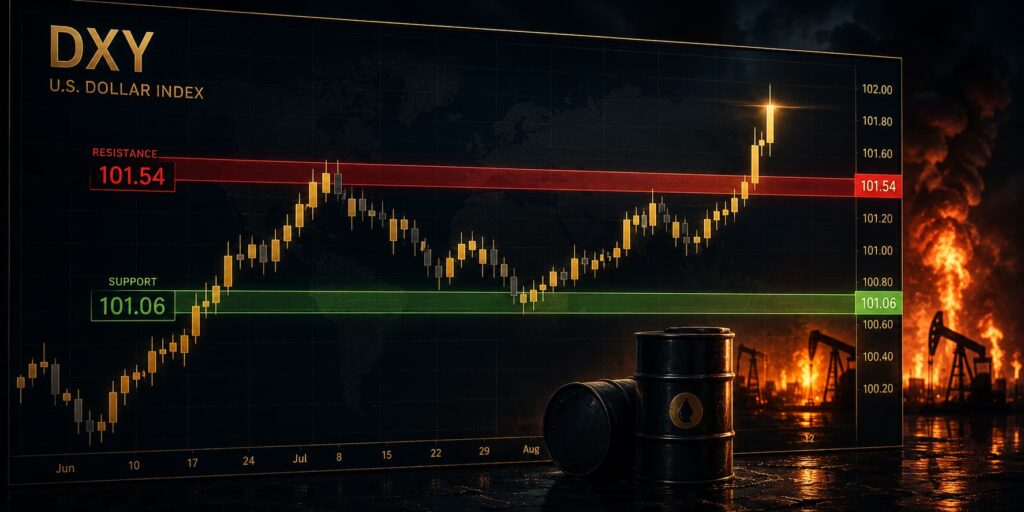
The dollar broke, and we are going to say so plainly. DXY closed 101.43 yesterday with a 101.54 high, the best print of the month, and this morning it sits at 101.38 after a shallow dip to 101.36. That dip is the tell. Every attempt to sell this dollar since the middle of July has been absorbed inside a single session, and the reason is no longer a mystery. This is an inflation dollar, bid because the Federal Reserve has been pinned by an oil shock it cannot cut into, and the futures market has finally stopped arguing about it. All of this sets up a critical Fed decision.
What changed. Cuts have been priced out of the curve completely. According to Reuters – Oil & Markets , the crude rally has been the primary driver of the hawkish repricing across the front end of the US curve. CME FedWatch, read live this morning, shows a 0.0 percent chance of an ease at every meeting listed, with a hike priced at 33.7 percent for 29 July, 80.8 percent by 16 September, 86.7 percent by 28 October and 92.2 percent by 9 December. A week ago the July number sat nearer 10 percent. This repricing has completely changed the landscape for Wednesday’s Fed decision.
What we are watching. Whether 101.54 goes on a closing basis, because that is what turns a range break into a trend, with 101.80 as the six month ceiling above it. Underneath the market, the 101.06 shelf carries the whole argument, since the five day volume point of control, yesterday’s low and the round number all sit in the same place. Flash PMIs across Europe and the US are the only scheduled risk before the FOMC window opens next week. The Fed decision will be the main event
Data and event risk. Flash manufacturing and services PMIs out of France, Germany, the euro area, the UK and the US through the morning and early afternoon. FOMC on 28 to 29 July, decision at 19:00 BST on the Wednesday, with no fresh projections at this meeting. Bank of England decision and Monetary Policy Report on 30 July at 12:00 BST. The Fed decision is the main event.
For more on [how to prepare for high-impact data], our process for framing FOMC risk.
Sterling’s Signal Ahead of the Fed Decision
Sterling gave the cleanest signal of the morning and almost nobody will notice it. UK retail sales beat on every single line at 07:00, and GBP/USD did essentially nothing, holding 1.3323 against a 1.3318 open. When a currency cannot rally on a number like that, the message is that it is not being priced on domestic data at all. The structure agrees, with lower highs and lower lows since 1.3541 on 15 July, and we stay on the sell side of strength. The looming Fed decision is overwhelming everything else.
What changed. June retail sales rose 1.0 percent on the month against expectations of a 0.3 percent fall, 4.2 percent on the year against 2.4 percent expected, and the core measure rose 1.1 percent against a 0.5 percent fall expected. That is a large beat on every line, and it hands the Bank of England hawks another argument six days before they meet. Sterling’s response was a handful of pips. On the other side of the pair, the dollar closed at its best level of the month and the Fed curve now carries a 92.2 percent chance of a hike by 9 December, with no ease priced at any meeting on the board. The Fed decision has completely overshadowed UK data.
Main driver. A dollar the market has not been able to fade, running straight over a domestic story that would normally matter a great deal. Bank Rate was held at 3.75 percent in June on a 7 to 2 vote, with Greene and Pill already voting for 4 percent, and this morning’s data strengthens their hand considerably. In an ordinary week that is a sterling positive worth several figures. This week it is a footnote, because the other side of the pair is repricing faster. That is precisely what makes the structure trustworthy here: it is surviving news that should have broken it. The Fed decision is the dominant force.
What we are watching. 1.3301, which is the round number, Wednesday’s low and last week’s low all in the same place, and the last real shelf on this chart. Below it the levels thin out quickly toward 1.3263, then 1.3226, then the six month low at 1.3143. That thinness is the point, and it is why we treat a close under 1.3301 differently from a wick through it. The Bank of England on 30 July is the scheduled event with the power to change the character of this, and UK flash PMIs land this morning. But the Fed decision on Wednesday is the bigger risk.
Gold’s Failure Ahead of the Fed Decision
Gold failed the test it set for itself. We published 4,075 as the level that decides, and gold closed 4,046.60 yesterday, below it, which retires the break above 4,100 and puts the lower high structure back on the chart. Price is 4,036 this morning after a 4,024 low. What is left is a range with 4,000 underneath it and 4,152 overhead, and a metal that has run out of reasons to pick a side quickly. We are not going to pretend that is more exciting than it is. The Fed decision will likely determine gold’s next move.
What changed. The 4,075 shelf gave way on the close, so Wednesday’s break above 4,100 is now a failed break. Gold traded 4,152.10 on Wednesday and has handed back the entire move in two sessions. Against that, the macro case did not weaken, it strengthened. Cuts have been priced out of the Fed curve entirely, with CME FedWatch showing 0.0 percent odds of an ease at every meeting and a hike at 92.2 percent by 9 December, while Brent closed 100.69 on a second supply front opening in the Red Sea. Gold is being asked to choose between the inflation bid and the real yield headwind, and so far it is refusing to choose either. The Fed decision could break this impasse.
Main driver. Two forces cancelling each other out. The oil shock is an inflation input, which is gold positive. The way it transmits, though, is through a Federal Reserve that now cannot cut, and that lifts real yields and firms the dollar, which is gold negative. That is the reason gold is going sideways while crude runs 35 percent in a month, and it is worth understanding rather than fighting. For what it is worth, the World Gold Council’s own valuation framework puts fair value near 4,100 in a 3,895 to 4,305 band, and flags that sustained trade below 4,000 could bring further selling. The chart is drawing the same conclusion from a different direction. Wednesday’s Fed decision will be the catalyst.
What we are watching. The 4,000 floor, and specifically what sits beneath it. That level has held as the base of the range all month, which is exactly why resting stops have piled up underneath. A close below 4,000 does not simply break a level, it releases that pocket, and that release is the mechanism behind our longer horizon downside case rather than any forecast about where gold ought to trade. Above the market, 4,074.60 is the reclaim that repairs the damage. The Fed decision could trigger either scenario.
Euro’s Problem Before the Fed Decision
EUR/USD broke the channel it had been holding, closing at 1.1385 yesterday, and the break is clean enough that we are not looking for a re-test of it. What is left is a pair that is heavy into the FOMC. Wednesday’s Fed decision is the main risk.
What changed. The dollar leg did the work. DXY closed 101.43 with a 101.54 high, its best of the month, after CME FedWatch showed cuts priced out of every meeting on the board and a hike at 80.8 percent by 16 September. The euro’s own problem sits on the other side of the trade. Brent closed 100.69 and is on course for a monthly gain near 35 percent, and the euro area imports very nearly all of it. An energy bill moving that fast is a terms of trade hit to the currency, which is why a hawkish central bank has not been enough to hold this pair up. The Fed decision will likely widen this divergence.
Main driver. A rate story and an energy story pointing the same way for the first time this cycle. The ECB is repricing hawkish, but the Fed is repricing hawkish faster and harder, so the differential is not moving in the euro’s favour. Underneath that, the oil move is a straight transfer of income out of the euro area. When the rate leg and the real economy leg lean in the same direction, ranges tend not to survive, and this one has not. That is the whole thesis, and it is why we want to sell strength rather than chase weakness. Wednesday’s Fed decision is the main catalyst.
What we are watching. 1.1365, Wednesday’s low and also last week’s low. It is the last obvious shelf before the six month low at 1.1325, and the space between those two is thin, which is what makes a break of it worth respecting. On the topside, 1.1406 is where the round number, the daily pivot and the four hour 21 average cluster, so that is the first place a bounce should run into trouble. Flash PMIs out of France, Germany and the euro area through the morning are the day’s data risk. But the Fed decision on Wednesday is the bigger risk.
What This Means for Wednesday’s Fed Decision
So you have de-escalation on one front and fresh escalation on another. At the same time. Three days before a Fed decision.
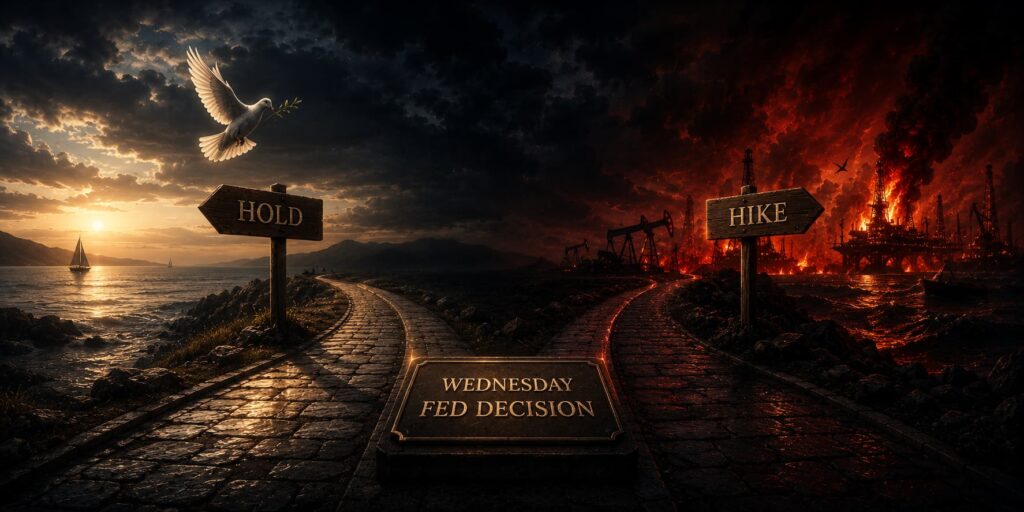
Which means Wednesday’s Fed decision comes down to two things:
1. Does the pause hold?
The US paused strikes on Iran after thirteen nights. Saturday, nothing. Sunday, nothing. Tehran has said it holds as long as Washington holds. If this holds, the pressure on oil eases, and Warsh gets room to hold rates while talking tough. The Fed decision becomes straightforward.
2. Does the Red Sea calm down, or catch fire?
The Houthis put missiles and drones into two Aramco sites on the Red Sea coast. Jizan took a hit and burned. First direct strike on Saudi oil infrastructure in four years. If the Red Sea escalates, oil takes out 100 and stays there, and Warsh has no choice. He comes out hawkish, and he is signalling hikes. The Fed decision becomes a hawkish surprise.
The two scenarios:
| Scenario | Outcome for the Fed Decision |
|---|---|
| Pause holds + Red Sea settles | Oil fades, pressure comes off, Warsh holds while talking tough. Market breathes. |
| Red Sea escalates | Oil takes out 100 and stays there, Warsh has no choice, hawkish hike signal. |
That is it. That is the whole meeting. Two variables. One Fed decision.
Keep this one open on Wednesday night, because whichever way it breaks, you will already know which of the two you are watching. The Fed decision will be determined by what happens with oil between now and then.
Conclusion: Watch the Variables, Not the Headlines
Sunday night. Quick one, because Wednesday just got a lot more interesting.
The US paused after thirteen nights of strikes. That de-escalates the Iran front. But the Houthis hit Saudi oil infrastructure on Saturday, opening a second front. Three days before a Fed decision.
The whole meeting comes down to two variables:
- Does the pause hold?
- Does the Red Sea calm down, or catch fire?
The pause holds and the Red Sea settles. Oil fades, pressure comes off, Warsh holds while talking tough. The Fed decision is a straightforward hold.
The Red Sea escalates. Oil takes out 100 and stays there, and he has no choice. He comes out hawkish, signalling hikes. The Fed decision becomes a hawkish surprise.
That is the whole meeting. That is the Fed decision.
We are ready for it. Not because we are trading the headlines, but because we are watching the things that actually decide the outcome. That is the difference.
Disclaimer
This article is for educational and informational purposes only. It does not constitute financial advice, trading recommendations, or an offer to buy or sell any asset. Trading forex, commodities, indices, cryptocurrencies, and futures carries significant risk and may not be suitable for all investors. You can lose more than your initial deposit. Past performance does not guarantee future results. Always read full terms, contract specifications, and risk disclosures before trading. Do your own research. Consult a licensed financial advisor if you need professional investment advice.