


New Week: Hawkish Fed, Switzerland Talks
Markets went into the long weekend calm. They are not coming out of it that way. While US desks were shut for Juneteenth and the weekend, the Middle East moved. The US and Iran talks in Switzerland wobbled, were postponed, then got back up. Lebanon and Israel kept trading fire across a ceasefire that is barely holding. And on Saturday, Iran said the Strait of Hormuz was closed again. None of it is settled, and all of it matters for the open.
This new week covers June 22-28, 2026. The calm into the weekend will be tested fast. This new week brings four inflation and jobs prints in five days, headlined by the US Core PCE the Federal Reserve watches most, with the Switzerland talks sitting over the top of all of it. One question runs through this new week: does the hawkish read hold, or does the data start to crack it?
Every new week should start with a clear map. This new week is no exception. The desk has laid out the prints that matter and how to read each one. The thread through this week is the tension between the hawkish Fed and the geopolitical risk that could disrupt the global outlook.
For a deeper look at [trading around geopolitical events], this guide covers how to position heading into a volatile week.
What Just Happened in Switzerland
Cross-reference everything here, because the headlines are loud and the picture is more delicate than any single one of them.
A 14-point memorandum of understanding signed on 17 June between President Trump and Iran’s President Pezeshkian opened a 60-day window to negotiate. The technical round in Switzerland was postponed on 18 June, then resumed on Sunday 21 June, with US Vice President JD Vance reportedly in the room face to face with Iranian officials. A direct meeting like that is rare. It tells you both sides still want a deal. It does not tell you they will get one.
This new week treats the Switzerland talks as the dominant macro driver. Every headline from Lucerne will move markets this new week. The talks are the wildcard that can override any data print in this new week.
For the latest, Reuters is the primary source for Switzerland wire coverage this new week.
Why Lebanon Is the Whole Game
The sticking point is Lebanon. An Iranian official told CNN that Lebanon is the number one issue, and that Tehran does not treat the next phase as started until Lebanon is addressed. An emergency Lebanon session was added to the Swiss agenda. So the entire framework now hinges on a ceasefire that is actively breaking down.
A truce was reported around 19 June. It is being violated. There have been multiple Israeli air raids and artillery strikes in southern Lebanon after the deadline, a drone strike that killed two, and earlier in the month strikes that killed several people including a local mayor. Hezbollah rejected the earlier version of the deal and is demanding a full Israeli withdrawal. Every exchange of fire chips away at the larger peace.
This new week reads Lebanon as the key variable. If the ceasefire holds, risk assets can rally this new week. If it breaks, oil bids and the dollar firms. The Lebanon situation is the single most important geopolitical factor heading into this new week.
Hormuz: The Part Nobody Can Confirm
Be careful here, because the two sides do not agree and we will not pretend they do. Iran declared on Saturday 20 June that the Strait of Hormuz was closed again, blaming Israel’s failure to pull back from Lebanon and what it called US bad faith. That is a sharp reversal from the framework deal two weeks ago, which had reopened the strait. The US military disputes that Iran controls the strait and says it remains open. Both are being reported. Neither should be treated as settled.
What matters for price this new week is that traffic through the world’s single most important oil chokepoint is, at best, uncertain. Trump has separately threatened to charge US tolls on the strait if there is no final deal in 60 days, framing it as payment for being the Guardian Angel. Markets do not need the strait to actually close. The risk premium goes into oil on the uncertainty alone.
This new week treats Hormuz as the wildcard. Watch the tankers, not the headlines. The Hormuz uncertainty will be a recurring theme this new week.
Oil Is Back on the Bid
Brent finished the last session around 80.57 dollars and WTI around 77.54, both higher on the postponed talks, the Lebanon fighting, and the slow Hormuz traffic. If the new week opens with the weekend’s escalation still live, the path of least resistance for crude is up, possibly with a gap.
Beyond the geopolitical headlines, oil has a technical story that matters for this new week. Brent crude closed last week near 80.57, sitting just above the 80.00 round number that has acted as psychological support for most of June. WTI closed near 77.54, holding above the 77.00 level that marked the May consolidation range.
The desk is watching two technical levels this week. On the upside, Brent needs to clear 82.00 to confirm a breakout, which would open a move toward 85.00. On the downside, a break below 79.00 would negate the bullish setup and suggest the geopolitical premium is fading faster than the headlines suggest.
For more on [inflation data and Fed policy], this guide covers how higher oil feeds into the Fed’s calculus this new week.
The Inflation Problem This Hands Warsh
Now connect it. Higher oil feeds straight into near-term inflation expectations, and it lands on a market already nervous about prices. The May CPI print came in at 4.2 percent headline, the hottest in over three years, with core at 2.9. At the 17 June meeting, Kevin Warsh’s Fed held rates at 3.5 to 3.75 percent and, more importantly, signalled the next move could be a hike. Nine of eighteen members pencilled in a 2026 hike, and the year-end PCE projection was lifted to 3.6 percent.
An oil shock here does not just raise pump prices. It hardens the case for a Fed that is already leaning the wrong way for risk assets. That is the real story, and it is exactly the concern Warsh leaned into last week.
This new week treats inflation as the structural anchor. The data this new week will either confirm or challenge the hawkish read. A hot Core PCE on Thursday is the single most important print of this week.
Watch Gold. It Is the Tell.
The textbook says Middle East escalation means gold up. Gold is down. It slipped to around 4,150 dollars, the lowest since 11 June, even as the region deteriorated. That is not a glitch, it is the market telling you who is in charge. With a hawkish Fed and a firm dollar near 100.79 on the index, real yields and the dollar are doing the safe-haven job that gold usually does. The ten-year sits around 4.44 percent. When rates and the dollar lead, gold struggles even with conflict on the wires.
That can flip intraday. A genuine risk-off shock can hand gold a panic bid for a few hours. But the heavier pull is still rates. Gold is the battleground this new week, not the easy long people assume it is.
For more on [central bank divergence and FX], this guide covers how the Fed’s hawkish stance affects gold and the dollar this week.
What to Expect at the Open
Set expectations, do not predict. Expect a shaky, headline-driven open, with the lean toward risk-off because the weekend ran the wrong way. The honest base case heading into this new week:
- Indices: gap-down risk. US equities closed Thursday before the break on a firm note, which leaves room to give back if the weekend repriced risk.
- Oil: gap-up risk. The path of least resistance is higher while Hormuz and Lebanon stay unresolved.
- Dollar: firm. It is the haven of choice in a rates-led regime.
- Gold: two-way. A safe-haven bid against dollar and rate pressure. Respect both sides.
This is a two-way tape. Diplomacy could cool it in a single headline, the Vance meeting is a real channel, or Lebanon could break it just as fast. Do not marry a direction. Trade the levels, size down, and let the first hour show its hand before you commit.
Where We Left Off
| Asset | Last | What It Is Telling You |
|---|---|---|
| Brent crude | ~$80.57 | Bid on Hormuz and Lebanon |
| WTI crude | ~$77.54 | Watching the gap higher |
| Gold (XAU/USD) | ~$4,150 | 9-day low, rate-pressured |
| DXY | ~$100.79 | The haven bid |
| US 10-year | ~4.44% | The anchor |
The Thread That Runs Through the Week
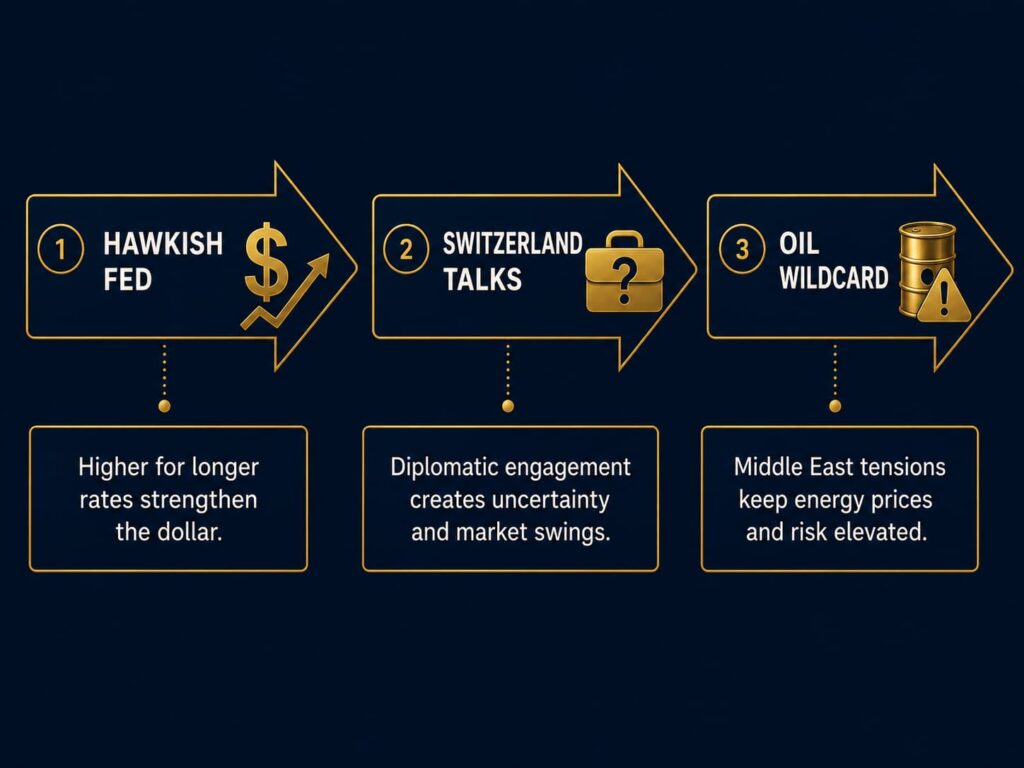
Start with the backdrop, because every number this new week is read against it. At the 17 June meeting, Chair Warsh’s Fed held rates at 3.50 to 3.75 percent and flipped the dot plot hawkish: nine of eighteen members now see at least one hike in 2026, and seventeen of eighteen see inflation risks tilted to the upside. May headline CPI ran at 4.2 percent, the hottest in over three years.
So the lens for this new week is simple. Data that runs hot confirms the hawkish path and tends to firm the dollar. Data that softens starts to question it. And then there is Switzerland, which can override the lot in a single headline.
For the official source, the Federal Reserve publishes the dot plot and meeting minutes that frame the hawkish read entering this new week.
Monday: Canada CPI
The new week opens with Canadian CPI for May, due Monday. The prior print was 2.8 percent year on year, and the read is for it to edge higher toward 3 percent, with energy doing much of the lifting. Statistics Canada also folds in updated basket weights this month, so watch the core measures more than the headline. A firmer number keeps the Bank of Canada cautious and supports the loonie. A soft one does the opposite.
This is the first data test of the new week. Canada CPI will set the tone for the dollar and commodity currencies heading into the rest of the new week.
Australia: The Week’s Real Tension
This is the one to understand properly, because the easy version is wrong. The Australian labour market is cooling. The latest jobs report showed employment fell by 18,600 and unemployment rose to 4.5 percent. That is the soft side of the story.
But the RBA has not softened with it. On 16 June it held the cash rate at 4.35 percent, its first pause of the year after three straight hikes, and the tone stayed hawkish. Governor Bullock called it “a pause, not a pivot,” said no member considered a cut, and warned inflation is still too high, with a June-quarter peak that could push toward 4.8 percent. The monthly CPI did dip to 4.2 percent, but a good part of that was a fuel-excise cut, not underlying cooling.
So this new week is a genuine tiebreaker. Australia’s monthly CPI lands Wednesday and the May jobs report Thursday. A soft CPI plus more labour-market weakness hands the doves real ammunition against the bank’s hawkish hold, and pressures the Aussie. A hot CPI confirms the hold and the upside-risk warning. The cooling jobs market is the counterweight to a central bank that does not want to blink. Traders running AUD pairs should size for two-way risk into both prints.
For the official source, the Reserve Bank of Australia publishes the meeting minutes and policy statements that matter this new week.
Thursday: US Core PCE
Thursday brings the headline act of this new week. US Core PCE for May, the Fed’s preferred inflation gauge, is released as part of the Personal Income and Outlays report. The prior core reading was 3.3 percent year on year and 0.2 percent on the month.
This is the print that either reinforces Warsh or challenges him. A hot Core PCE confirms the hawkish stance, hardens the case against any cut, and is straight dollar fuel, more pressure on gold and the rate-sensitive corners of the market. A soft one is the first real crack in the hawkish read, and would let some air back into risk.
The desk will be reading it the instant it lands, against the dollar, the ten-year and gold, not waiting for the headlines to tell you what it meant. This is the most important data point of the new week.
For the official source, the US Bureau of Economic Analysis publishes the PCE data that will shape the dollar’s path this new week.
Switzerland Is the Wildcard
Over all of it sit the US-Iran talks in Switzerland. US Vice President JD Vance has been meeting Iranian officials near Lucerne to open a 60-day negotiating sprint on Iran’s nuclear program. The flashpoints are Lebanon, where a fragile ceasefire keeps breaking, and the Strait of Hormuz, which Iran says it has closed again and which the US disputes.
This is the part that can override the data. A breakthrough cools oil and lifts risk. A breakdown, more Lebanon escalation or a real Hormuz disruption, sends oil up, reignites the inflation worry that Warsh just leaned into, and turns the tape risk-off. Keep one eye on the wires from Switzerland all week. It is the headline that does not wait for a scheduled release.
This new week has a heavy calendar, but Switzerland is the wildcard that can override any print. Watch the wires.
For the latest, Bloomberg is the primary source for Switzerland wire coverage this new week.
How the Desk Is Reading It
The base case into the new week is a firm dollar and a market that respects the hawkish read until the data forces it to change its mind. Gold sits near 4,150 dollars, pressured by rates and the dollar rather than lifted by the geopolitics, the same tell we flagged over the weekend. The dollar index is around 100.5, the ten-year near 4.49 percent, and equities went into the break risk-on with the S&P around 7,500.
- Dollar: the path of least resistance is firm into Core PCE. A hot print extends it.
- Gold: capped by rates and the dollar, with a safe-haven bid only if Switzerland breaks.
- AUD: two-way into the CPI and jobs double-header, the cooling-labour story against the hawkish RBA.
- Oil: the Switzerland tail. Calm keeps it offered, escalation gaps it up.
Do not try to predict every print. Map the new week, know what each number means before it lands, and trade the reaction, not the forecast.
The Calendar
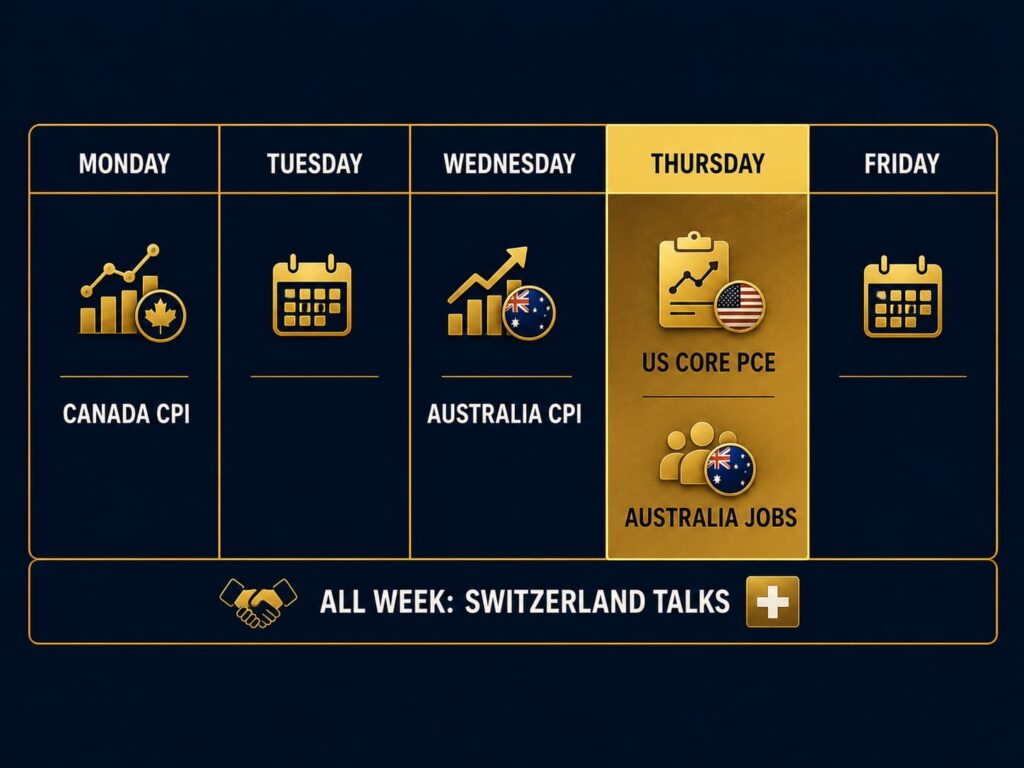
| When | Event | Prior | Why It Matters |
|---|---|---|---|
| Monday | Canada CPI (May) | 2.8% y/y | The loonie and the BoC path |
| Wednesday | Australia CPI (May) | 4.2% y/y | The RBA tiebreaker |
| Thursday | US Core PCE (May) | 3.3% y/y | Warsh’s preferred gauge, the dollar |
| Thursday | Australia jobs (May) | -18.6k, 4.5% | The cooling-labour counterweight |
| All week | US-Iran Switzerland talks | ongoing | Risk sentiment, oil |
Disclaimer
This article is for educational and informational purposes only. It does not constitute financial advice, trading recommendations, or an offer to buy or sell any asset. Trading forex, commodities, indices, cryptocurrencies, and futures carries significant risk and may not be suitable for all investors. You can lose more than your initial deposit. Past performance does not guarantee future results. Always read full terms, contract specifications, and risk disclosures before trading. Do your own research. Consult a licensed financial advisor if you need professional investment advice.