


Something isn’t reacting the way it should. Oil is near $100. Tankers are being hit. Inflation is refusing to disappear. And borrowing costs are under pressure. That’s a very ugly combination. Yet the S&P 500 is still sitting within touching distance of record highs. And that’s where the real story begins.
Because investors aren’t ignoring the pressure. They’re responding to it in a much more selective way. Money is shifting, old relationships are changing, and some of the biggest forces driving this market are starting to collide. Once you connect the pieces, the resilience starts to make a lot more sense. This macro analysis breaks down exactly what is happening and why.
Geopolitical risk is becoming an economic problem rather than just a headline problem. Energy pressure is feeding into inflation while enormous borrowing requirements are keeping pressure on long-term rates. Yet strong earnings and expanding AI adoption are keeping equities remarkably resilient. Markets are now balancing those two realities at the same time. This macro analysis tracks all of these forces.
For more on how geopolitical risk moves oil, see our guide on how geopolitical risk moves oil.
Key Takeaways from This Macro Analysis
- Oil near $100 and diesel at record highs – The Strait of Hormuz conflict is now a physical supply disruption, not just a threat. This macro analysis considers energy the most important variable.
- AI is competing with the U.S. government for capital – Hyperscaler borrowing is becoming a serious bond market force, with $240 billion in potential investment-grade issuance. This macro analysis flags this as a structural shift.
- The S&P 500 is hiding a very different economy – The index is near records, but underneath it, the market is becoming much more selective. This macro analysis examines the divergence.
- Long-term Treasury yields remain stubborn – Persistent inflation, AI borrowing, and fiscal deficits are keeping pressure on the long end. This macro analysis tracks the yield story.
- Gold and Bitcoin are moving together – Both are increasingly being treated as protection against monetary uncertainty, not just alternative assets. This macro analysis considers this a confidence signal.
- The diesel market is becoming the real problem – Diesel at $5.60 per gallon is moving trucks, agriculture, and freight costs, feeding inflation directly. This macro analysis highlights diesel as the key commodity.
- The market is choosing sides – Capital isn’t leaving equities; it’s becoming much more selective about where it stays. This macro analysis considers this the most important market dynamic.
The Charts That Matter – A Macro Analysis Perspective
This market simply refuses to break. Expensive energy, stubborn inflation and another escalation in the Iran war have all landed, yet equities continue holding remarkably firm. That resilience shows just how powerful earnings and concentrated leadership remain. The important distinction is that the index can stay strong even while considerable weakness builds underneath it. This macro analysis examines the divergence in detail.
S&P 500: The Resilience Masking Weakness
The S&P 500 has shown remarkable resilience despite a barrage of negative headlines. Oil near $100, diesel at record highs, and escalating geopolitical tensions would normally be enough to trigger a significant pullback. Yet the index remains within striking distance of record highs. This macro analysis considers this resilience a function of earnings concentration.
Second-quarter blended earnings growth came in around 52%, the strongest pace since the post-pandemic rebound in 2021. That is a staggering number. Companies are not just surviving; they are thriving. And the earnings growth is not confined to a narrow group of technology companies. AI adoption is spreading into finance, manufacturing, retail, and the wider economy.
But underneath the surface, the market is becoming much less forgiving. Nike is leaving the S&P 100 after nearly 18 years, while technology names including Palo Alto Networks, Dell and Arista Networks are moving in. Lululemon has also fallen back toward levels not seen since 2018. That’s more than an interesting reshuffle. It shows where investors increasingly believe the growth is coming from. This macro analysis tracks this rotation.
Nasdaq: AI Doing the Heavy Lifting
AI is still doing the heavy lifting, but the easy part is over. Adoption is spreading beyond technology into finance, manufacturing, retail and the wider economy, giving the Nasdaq something more substantial than hype to lean on. But as more money pours into AI, investors are raising their standards too. The story increasingly depends on which companies can turn enormous investment into actual earnings. This macro analysis considers this the key test for the Nasdaq.
The AI investment thesis is now being tested at scale. Companies are spending billions on data centres, computing capacity, and power infrastructure. The question is whether these investments will generate the returns that justify the valuations. This macro analysis flags this as a key risk.
DXY: The Dollar Should Have an Easier Job
The dollar should have an easier job than this. Persistent inflation and stubborn Treasury yields would normally provide plenty of support, yet geopolitical uncertainty and concerns around U.S. borrowing are complicating that relationship. That makes the dollar an important confidence gauge. Strength would suggest rates remain in control, while weakness despite elevated yields would tell us something deeper is weighing on confidence. This macro analysis considers the dollar a key barometer.
The DXY settled at 99.16 after the NFP report, up about a quarter of a per cent on the day. But look at the week instead of the day and the picture inverts: it closed at 99.68 on 28 August, fell every session into a 99.00 close on Thursday, and Friday’s payroll rally recovered barely a sixth of that. The strongest labour print of the year could not get the dollar back to where Wednesday left it. This macro analysis considers this a significant signal.
For more on how the dollar moves gold, see our guide on how the dollar moves gold.
The Diesel Market Is Becoming The Real Problem – A Macro Analysis Deep Dive
The Strait of Hormuz has spent months moving markets through threats, closures and retaliation. This week went even further. U.S. Central Command confirmed American forces struck three Iranian crude carriers after Iran launched ballistic missiles toward two U.S. Navy warships. Iran responded with further threats against U.S. and U.S.-linked vessels. So right now, this is no longer simply another argument over whether Hormuz might close. Ships are literally being hit like a game of battleships. And the energy market was already tight before the latest escalation arrived. This macro analysis tracks the escalation in detail.
According to Reuters, oil prices have surged on the back of US-Iran strikes and supply disruption fears in the Strait of Hormuz, with Brent settling above $96 a barrel.
The Escalation Sequence
The US-Iran conflict escalated dramatically during the week. Here is the sequence as tracked by this macro analysis:
September 1: The United States launched precision strikes against Iranian IRGC military targets, including coastal oil facilities. This was the first time the US targeted Iranian oil infrastructure directly.
September 2: Tehran retaliated with missile fire at U.S. military bases in Jordan. The escalation pushed oil markets into panic mode, with Brent breaking above $95 and WTI pushing past $90.
September 3: Oil prices settled at six-week highs. Brent crude settled at $95.52, down 11 cents, while WTI rose 29 cents to $91.30. Both contracts touched six-week highs during the session.
September 4: Oil rose for a fourth straight day, taking Brent futures over $96 a barrel. President Trump indicated that the new military campaign against Iran “would not last that long,” but the uncertainty persisted.

Why Diesel Matters More Than Crude
Crude near $100 gets the headlines. But diesel tells us where the economic damage could actually appear. The U.S. Energy Information Administration recorded national diesel at $5.599 per gallon for the week ending August 31, following $5.652 the previous week. That matters because diesel moves trucks, agricultural equipment, construction machinery and huge parts of the supply chain. This macro analysis considers diesel the most important commodity price to watch.
The timing isn’t great either. September begins an important demand period as harvesting, freight and heating-oil preparation compete for middle-distillate supply. So this is where geopolitics becomes an inflation problem. The Institute for Supply Management reported diesel, gasoline and petroleum products rising in price during August, while its Services Prices Index reached 72.6, its highest since August 2022. Energy costs are already appearing inside the economy. This macro analysis tracks this transmission.
The Diesel-to-Inflation Transmission
Diesel is the fuel of freight, agriculture, construction and shipping. It sits in the cost of moving every physical object in an economy. Record distillate cracks with depressed refinery runs is a more direct inflation mechanism than the crude price itself, and it is the reason a headline CPI can re-accelerate in a month when the oil price barely moves.
The July CPI report already shows that channel running. The energy index was up 14.7 per cent over twelve months and gasoline 24.6 per cent, even though both fell on the month. That is what a live supply shock looks like inside an official inflation statistic. This macro analysis considers this the most important inflation dynamic.
What Happens Next with Diesel
If tanker attacks continue while fuel supply remains tight, markets have much less reason to dismiss Hormuz as political theatre. Higher energy costs become a more persistent inflation problem. If shipping continues functioning despite the escalation, crude may remain volatile without creating the economic damage investors fear. If diesel stays expensive even as crude stabilises, the bigger problem is refining and physical fuel availability rather than oil alone.
How Markets May Respond to the Diesel Crisis
Oil will react first to developments around Hormuz. Diesel may tell us whether they actually matter. Persistent fuel pressure feeds into transport costs and inflation expectations, which then matters for bond yields and interest rates. And that’s where this story connects directly to another market under increasing pressure: Treasuries. This macro analysis tracks the transmission chain.
AI Is Now Competing With The U.S. Government For Money
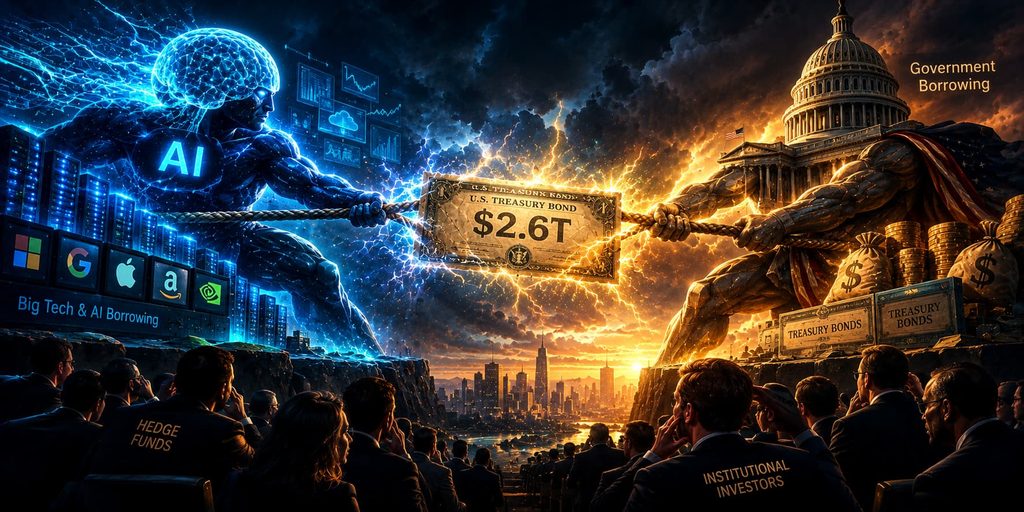
AI has dominated equities for a while. Now it is becoming big enough to matter in bonds too. Building data centres, computing capacity and power infrastructure requires enormous investment, and increasingly that expansion is being financed through debt. This macro analysis considers this a critical development for capital markets.
The Bank of England found that investment-grade issuance from five major AI hyperscalers during the first half of 2026 had already exceeded their issuance for the whole of 2025. Barclays analysis estimates around $240 billion of hyperscaler investment needs could be financed through investment-grade credit this year. AI isn’t just an equity story anymore. It is becoming a serious borrower, and that leads to more implications. This macro analysis tracks this structural shift.
Why This Matters for Capital Markets
AI is no longer just supporting the stock market. It is starting to compete for the money that supports the bond market too. Big Tech increasingly wants capital from the same long-term investors the U.S. government needs to buy Treasuries, just as inflation is making that capital more expensive.
And the buyers themselves have changed. China used to be the Treasury market’s biggest concern. Now hedge funds hold roughly $2.6 trillion, and many of those positions rely on borrowed money. That’s an important difference. China could choose to sell and a leveraged fund can be forced to. If yields rise sharply, forced selling can push them higher again, creating exactly the kind of pressure the bond market doesn’t need when Washington and AI companies are already competing for buyers. This macro analysis considers this a significant risk.
The Bitcoin and Gold Connection
Investors appear to be responding to these pressures. Gold and Bitcoin have been moving increasingly together while Bitcoin has become less connected to the Nasdaq, suggesting both are being treated more like protection against monetary uncertainty. Even De Nederlandsche Bank recently moved around 86 tonnes of gold closer to home, again in retaliation to geopolitical unrest and crisis preparedness.
None of this means a Treasury crisis is coming. It means the market is becoming much more conscious of how much debt is being created, who is buying it and what happens if those buyers suddenly need to leave. This macro analysis flags this as a key risk to monitor.
What Happens Next with AI and Capital
Continued AI borrowing adds another major competitor for long-term capital while Treasury financing needs remain enormous. Persistent inflation makes meaningful relief in long-term borrowing costs harder to achieve. A sharp rise in yields becomes more dangerous if leveraged Treasury holders are forced to reduce positions.
How Markets May Respond to AI Competition
Long-term Treasury yields are becoming the meeting point for several pressures that normally get discussed separately. AI needs money. Washington needs money. Inflation is limiting the Fed. That doesn’t guarantee a Treasury crisis. But it helps explain why long-term yields can remain stubborn and why gold and Bitcoin are increasingly being viewed through a different lens. This macro analysis considers this the most important structural shift in markets.
The S&P 500 Is Hiding A Very Different Economy
Here’s what it looks like right now: Oil is around $100. Inflation remains elevated. The Iran conflict has escalated again. And the S&P 500 is still remarkably close to record territory. That resilience makes more sense when you look at who is actually carrying the market. This macro analysis examines the divergence in detail.
The research supplied for this journal puts second-quarter blended earnings growth around 52%, the strongest pace since the post-pandemic rebound in 2021. Paid AI adoption is spreading beyond technology into finance, manufacturing and retail. Companies outside Silicon Valley aren’t just talking about AI anymore. They’re paying to use it. This macro analysis considers earnings strength the key support for equities.
Why This Matters
The S&P is telling the truth, just not the whole truth. Its biggest companies are producing enormous earnings while AI adoption spreads into finance, manufacturing, retail and the wider economy. That strength is powerful enough to keep the index near records.
Underneath it, though, the market is becoming much less forgiving, which is scarier than it sounds. Nike is leaving the S&P 100 after nearly 18 years, while technology names including Palo Alto Networks, Dell and Arista Networks are moving in. Lululemon has also fallen back toward levels not seen since 2018. That’s more than an interesting reshuffle. It shows where investors increasingly believe the growth is coming from. This macro analysis tracks this rotation.
The Economy Tells a Similar Story
ISM reported stronger services activity and new orders in August, but employment remained in contraction while prices continued climbing. Services are expanding. Hiring isn’t. But prices are. So neither the economy nor the stock market is universally strong. Instead, the strongest businesses are doing enough to hide considerable weakness elsewhere.
That’s why the S&P can sit near records with $100 oil, stubborn inflation and struggling consumer brands. The market isn’t saying everything is fine. It’s becoming much more selective about what deserves to be rewarded. This macro analysis highlights this selectivity.
What Happens Next with the S&P 500
Strong earnings and wider AI adoption could keep headline indices resilient even if weaker companies continue struggling underneath. Persistent services inflation would keep pressure on rates, raising the importance of actual earnings rather than future promises. Broader participation beyond mega-cap technology would show that confidence is spreading rather than remaining concentrated.
How Markets May Respond
The S&P can remain resilient without every part of the economy being healthy. That’s the important distinction. Strong earnings from its largest companies can overpower weakness elsewhere, but the gap underneath the index is becoming increasingly difficult to ignore. Capital isn’t leaving equities altogether. It is becoming much more selective about where it stays.
The Fed Argument – A Macro Analysis Framework
Two speeches give you the whole framework for this week. At Jackson Hole on 28 August, Kevin Warsh described an economy at full employment with inflation he was not prepared to look through, and pointed at PCE inflation running 3.7 per cent over twelve months. He committed to a discipline rather than to a decision, which is a polite way of saying the data would decide it.
The number underneath that is worth pulling out. The twelve month PCE figure is 3.7 per cent, but the six month annualised figure Warsh cited is 4.1 per cent. The recent run rate is faster than the annual rate, not slower. That is the opposite shape to the one a disinflation argument needs. This macro analysis considers this the most important Fed data point.
Then on 3 September, Christopher Waller gave the market the other branch. He said recent data suggested we are finally seeing some signs of disinflation, and that if this continues in the data due over the next two weeks he would be inclined to support holding the target rate where it is. His phrasing was blunter than that in the room: give disinflation a chance, we can wait one meeting.
But he attached a condition, and the condition is this week. If inflation comes in hot, he said, he would consider a rate hike, and he judged that policy is currently only slightly restricting demand, so it may not take much acceleration to nudge him into supporting tighter policy. The data he was talking about is Thursday’s PPI and Friday’s CPI. This macro analysis tracks this condition.
It is also worth remembering where the committee already sits. The target range is 3.50 to 3.75 per cent, and the July meeting held it by nine votes to three, with Hammack, Kashkari and Logan all preferring a hike at that meeting. Three hawks are already on the record. Waller is describing the conditions under which he stops being the fourth. This macro analysis considers the Fed split a key variable.
According to CME FedWatch, September hike odds moved higher following the strong jobs data, but the exact number varies across vendors from the mid-fifties to the mid-sixties.
Cross-Asset Implications – A Macro Analysis Summary
Equities
Index strength remains impressive, but it is masking a much more selective market underneath. The S&P 500 is near record highs, but the composition is shifting dramatically toward AI and technology winners. This macro analysis considers the equity market’s resilience a function of earnings concentration.
Bonds and Currencies
Persistent inflation and enormous borrowing requirements keep long-term Treasury yields central to the wider market story. The dollar should be stronger given the rate backdrop, but geopolitical uncertainty and fiscal concerns are capping its upside. This macro analysis tracks the bond market’s tension.
Hard Assets
Gold and increasingly Bitcoin are reflecting concerns around monetary credibility, debt and geopolitical uncertainty. Both are being treated as protection against monetary uncertainty, not just alternative assets. This macro analysis considers hard assets a key barometer of confidence.
The 2-Year Treasury Yield
The US 2 year Treasury yield closed Friday at 4.37 per cent, two basis points beneath its 2026 high of 4.39 set on 1 September and almost a full point above February’s 3.38 low. The front end is already sitting at the top of its year, which is the part most commentary keeps missing. This macro analysis considers the 2-year yield the most important rate to watch.
For more on how to prepare for high-impact data, see our guide on how to prepare for high-impact data.
Key Conditions to Watch – Macro Analysis Checklist
- Whether diesel remains expensive even if crude stabilises. This is the most important commodity variable in this macro analysis.
- Whether tanker attacks create sustained disruption to physical energy flows. Physical disruption matters more than another round of threats.
- Whether long-term Treasury yields remain elevated as AI-related borrowing competes for capital. This is the structural shift this macro analysis tracks most closely.
- Whether S&P strength spreads beyond AI and mega-cap leadership. Broader participation would change the macro analysis.
- Whether the Fed hikes or holds in September. The FOMC decision is the most important scheduled event.
- Whether CPI confirms the disinflation trend or reverses it. Friday’s CPI is the key data point.
- Whether the ECB provides clear guidance on Thursday. The ECB decision lands 15 minutes before US PPI.
Events That Matter
Hormuz and tanker activity: Physical disruption matters more than another round of threats. This macro analysis considers this the most important unscheduled catalyst.
U.S. inflation data: Whether expensive energy spreads further into underlying prices. CPI on Friday is the key data point.
Treasury markets: Whether long-end yields remain under pressure as borrowing demand grows. The 2-year and 10-year yields are the key levels.
Treasury buybacks: Larger long-end operations begin September 9, putting liquidity back into focus.
ECB decision: Thursday’s meeting with fresh projections and guidance. All 65 economists in the Reuters poll expect a 25 basis point rise to a 2.50 per cent deposit rate.
OPEC+ meeting: Online Sunday, with October production policy expected to be left alone while the group works out 2027 baselines.
Where This Leaves Markets – The Macro Analysis Conclusion
This looks like three different stories. It isn’t. The tanker war matters because expensive energy is becoming an inflation problem. Inflation matters because it limits the Fed while governments and AI companies compete for enormous amounts of capital. And that matters for equities because higher borrowing costs expose the difference between companies delivering genuine growth and those relying on old expectations.
Yet the S&P remains within record territory range still. That isn’t proof the risks don’t matter. It’s evidence that markets still believe earnings and AI are strong enough to absorb them. For now, that belief is holding.
Underneath the index, though, the market has already started choosing sides. Capital isn’t leaving equities altogether. It is becoming much more selective about where it stays. The strongest businesses are doing enough to hide considerable weakness elsewhere. That’s the key insight of this macro analysis.
The bottom line from this macro analysis:
The market is balancing two realities at the same time. Expensive energy, stubborn inflation and geopolitical risk are real and persistent. But strong earnings, AI adoption and selective leadership are also real. The resolution will come from which force wins the battle for capital.
This macro analysis has tracked all the key forces shaping markets. Now it’s up to you to use this framework.
Disclaimer
This article is for educational and informational purposes only. It does not constitute financial advice, trading recommendations, or an offer to buy or sell any asset. Trading forex, commodities, indices, cryptocurrencies, and futures carries significant risk and may not be suitable for all investors. You can lose more than your initial deposit. Past performance does not guarantee future results. Always read full terms, contract specifications, and risk disclosures before trading. Do your own research. Consult a licensed financial advisor if you need professional investment advice.