


The hawkish repricing finally arrived. One jobs print did what six months of Fed-speak could not. The dollar surged. Gold sold off. Equities took the hit. And the entire macro landscape shifted.
For months, markets operated under a simple framework. The Middle East conflict was an unfortunate but temporary shock. Inflation would spike, yes, but it would fade once the Strait of Hormuz reopened. Central banks would “look through” the energy spike and eventually cut rates. That framework is dead.
The hawkish repricing is not a wobble. It is a regime shift. This Sunday preview breaks down what happened on Friday, why the repricing matters for the dollar, gold, and equities, and what to watch in the week ahead. The hawkish repricing changes everything from discount rates to carry trades. Understanding this repricing is the most important task for any macro trader right now.
For a deeper look at understanding interest rate expectations , this Sunday preview recommends reviewing how the curve affects the hawkish repricing.
The Overarching Narrative: The “Exception” Has Become the Rule
The hawkish repricing did not come out of nowhere. It came because the inflation backdrop was already loaded, and the jobs print was the trigger pulled into a primed chamber.
What was once considered an “adverse scenario” has become the baseline. The war is not ending quickly. The Strait is not reopening cleanly. And inflation is no longer just an energy story. It is migrating into the broader economy. This repricing is the market finally accepting that reality.
The core macro tension entering this week is simple. Markets are trying to price a world where central banks are forced to tighten into slowing growth. That is the stagflation setup that everyone feared but few truly prepared for. The hawkish repricing is the first major market move in that direction.
For more on how to trade the FOMC meeting , this Sunday preview covers the mechanics of trading around the hawkish repricing.
The Geopolitical Anchor: Why Nothing Else Matters
The single most important variable driving every other macro indicator is the status of the Strait of Hormuz. Until that resolves, all economic data is secondary. The hawkish repricing is amplified by this geopolitical anchor.
Here is the reality that markets are slowly accepting. Even if a ceasefire is announced tomorrow, physical oil flows will not normalize for weeks or months. The backlog of tankers, the mines that need clearing, the inspections that need to be negotiated – these are not solved by a handshake. This geopolitical anchor is why the hawkish repricing has legs.
The OPEC+ meeting over the weekend is a perfect example of why geopolitics has eclipsed traditional market mechanisms. The cartel could announce production increases. But it does not matter. As analysts are now openly stating, there is very little OPEC can do. The problem is not supply. The problem is access. Oil is in the ground, but it cannot be shipped out. This reality feeds directly into the hawkish repricing.
The geopolitical anchor means one thing for macro traders. Oil volatility is not going away. Every headline from the Gulf will move markets. And until the Strait is fully operational, elevated energy prices are the baseline assumption. That baseline assumption is what drove the hawkish repricing in the first place.
What Actually Happened on Friday
Friday’s US employment report was the catalyst, not the story. The story is that the market had been carrying a dovish skew into the print, looking for soft payrolls to validate a cut path. It got the opposite. Jobs added came in firm. Average hourly earnings came in firm. Both readings, landed together, are the textbook hot print, the kind of release where the hawkish repricing triggers immediately.
The curve flinched immediately. SOFR, OIS, and STIRs moved within seconds of the print and kept moving through the New York session. By the time London handed over to North America, the question had stopped being “how many cuts this year” and become “are hikes back on the table into 17 June.” That is the repricing in one sentence.
Crucially, this hawkish repricing did not happen in a vacuum. Inflation was already elevated coming into the print. Tariffs continue to leak into core goods. The war has held oil roughly 40 to 50 percent above pre-war levels, and that price floor has been showing up in shipping, fertiliser, and second-order producer-price prints for months. Stack a tight labour market on top of that, and the Fed loses its excuse to ease. The repricing was the inevitable result.
According to the BLS Employment Situation , the jobs market remains remarkably resilient.
The Dollar: DXY Surge and the Filled April Gap
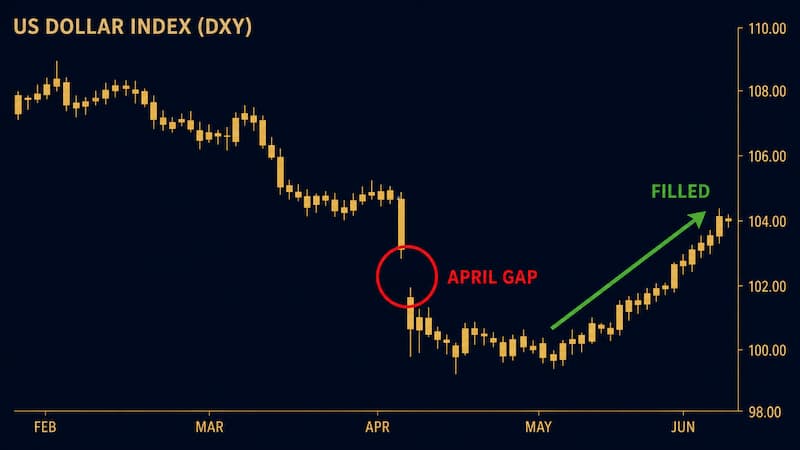
DXY is the cleanest read on the hawkish repricing. The dollar index sat at 98.57 into the weekend after Friday’s surge, and crucially, that move filled the downside gap that DXY had left back in early April when the ceasefire optimism trade ripped through the index. That gap had been an open wound on the chart. It is closed now. The repricing filled it.
The mechanism here is straightforward. When the curve reprices hawkishly, US front-end rates rise relative to the rest of G10, the real-yield differential moves in the dollar’s favour, and carry trades funded out of dollars get squeezed. Friday delivered all three on the same print. EUR/USD sat heavy, GBP/USD under pressure, and USD/JPY pushed up toward 160. The repricing drove all of it.
USD/CHF is the one to watch as a tell. The franc usually catches a bid in a global risk-off, but when the catalyst is US-specific hawkish repricing rather than generalised fear, the franc lags. That lag confirms that this was a rates story, not a fear story.
The CME FedWatch tool shows exactly how the hawkish repricing has shifted rate expectations. The probability of a 2026 rate hike has surged. The repricing is now firmly embedded in market pricing.
Gold: Real Yields Plus a Firmer Dollar
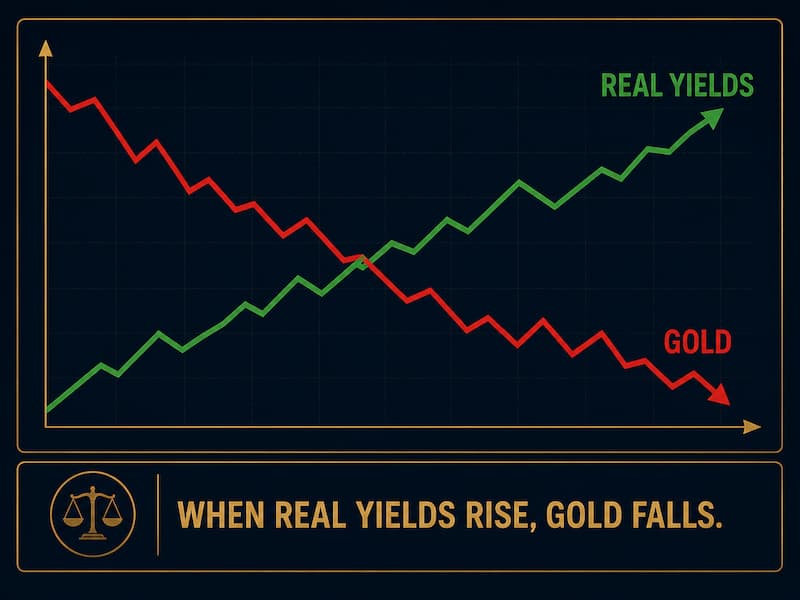
Gold traded down to 4330 into the weekend after Friday’s sell-off. The mechanism here is the cleanest in macro. Gold has two main inputs: the real yield and the dollar. When real yields rise, the opportunity cost of holding a non-yielding asset goes up. When the dollar rises, every other currency has to pay more of itself to buy the same ounce. Friday delivered both. The hawkish repricing pushed nominal yields up faster than breakevens, which means real yields rose, and the DXY surge did the rest.
The hawkish repricing has taken the first leg of the gold bull case off the table in a single session. The geopolitical bid is still there. Oil is still elevated. The war premium has not gone anywhere. But the rates leg of the gold bull case just flipped. That is a regime shift, not a wobble. The repricing changes the entire calculus for gold.
For a deeper look at gold and real yields correlation , this Sunday preview covers the mechanics behind the hawkish repricing and gold’s reaction.
Silver underperformed, as expected. The gold-silver ratio widening on a repricing day is normal behaviour. Silver has a higher industrial-demand beta and gets hit twice on a growth-scare-plus-rates print.
US Equities: The Discount-Rate Hit
The S&P 500 closed the week lower. The Nasdaq took the biggest hit. The intraday moves are what mattered. Every one of those indices took the hit on the same vector: discount-rate expansion from the hawkish repricing.
The textbook equity-pricing identity is simple. A stock is worth the present value of future cash flows discounted by the policy-path-implied rate plus an equity risk premium. When the curve reprices hawkishly, the discount rate goes up. The present value of those cash flows compresses. The longest-duration assets, read the Nasdaq, take the biggest hit. That is exactly what happened on Friday. The hawkish repricing hit tech hardest.
There is a second-order effect that matters more than most desks acknowledge. When the Fed pivots from easing to potentially hiking, the equity-risk-premium component widens too, because the recession-tail thickens. You get a one-two punch on the multiple. Friday was the first innings of that punch. The hawkish repricing is not done with equities yet.
The Inflation Cocktail: Jobs, Tariffs, War
This is the part the algorithms missed. The hawkish repricing did not come out of nowhere on Friday. It came because the inflation backdrop was already loaded, and the jobs print was the trigger pulled into a primed chamber. Three forces are stacked on top of each other right now.
Force one: a tight labour market. The June 5 print showed jobs being added at a pace that, paired with rising average hourly earnings, indicates the labour market is not cooling. Wage growth feeds services inflation directly. The Fed has been waiting for the labour market to weaken to justify cuts. It just did the opposite. This labour market strength is a core driver of the hawkish repricing.
Force two: tariffs. The tariff regime has been leaking into core goods inflation for months. Importers absorbed some of the initial pass-through, then passed the rest on as their margins compressed. That is not a one-shot price-level adjustment any more. It is a persistent quarterly drip into PCE. Tariffs are contributing to the hawkish repricing.
Force three: the war and oil. Brent traded near 100 into the weekend. Oil sitting roughly 40 to 50 percent above pre-war levels is not a transient shock any more. It is the new pricing floor. It feeds into transport, fertiliser, plastics, and air freight directly. Every CPI release for the rest of the year will carry that floor. The war premium is a permanent feature of the repricing.
Stack the three: tight labour plus tariff leak plus elevated oil. That is the cocktail. The Fed cannot ease into that mix without losing inflation credibility. The hawkish repricing is the curve finally accepting that reality.
The Federal Reserve monetary policy page provides the official framework for understanding how the Fed views these inflation forces. The hawkish repricing aligns with their stated concerns.
The VIX Tell: Quiet Fear, Not Panic
VIX printed lower on the session. That is a hugely important detail. Equities sold off, the dollar surged, gold cracked, and VIX fell. That is not a panic tape. That is the tape of a market re-rating its policy expectation in an orderly way. The hawkish repricing was absorbed, not panicked.
Why does this matter? Because a panic-tape repricing usually overshoots and mean-reverts within 48 hours. An orderly repricing sticks. The fact that VIX fell on Friday tells you that this is not a one-day spasm. It is the market settling into a new baseline. The repricing is likely to hold.
This has implications for how to think about CPI next week. If the orderly hawkish repricing is the new baseline, a hot CPI does not need to spark a further panic-wave to keep the dollar bid and gold pressured. It just needs to validate the path. The hawkish repricing has already done the heavy lifting.
The Central Bank Divergence: Not What Markets Expected
Heading into 2026, the consensus was that the Federal Reserve would lead a global pivot toward rate cuts. The ECB and the Bank of England would follow. The opposite is happening. This divergence is amplifying the hawkish repricing.
The ECB is expected to raise rates this week. The debate is no longer whether they will hike but how many more will follow. The market has already priced in additional tightening for later this year. The ECB’s primary objective at this meeting is not to surprise markets but to confirm expectations. The hawkish repricing is not just a US story.
The Bank of Canada is on hold, watching and waiting. But the pressure is building there as well. The hawkish repricing is a global phenomenon.
And the Federal Reserve? It is trapped. The US economy remains remarkably resilient for the Fed to justify cutting rates. But inflation is running well above target. The bond market has already made its judgment. Long-term yields have moved to levels not seen in years. The hawkish repricing reflects both inflation concerns and fears that the Fed’s political independence may be eroding.
This divergence creates a confusing landscape for currency markets. The dollar remains supported by higher yields and safe-haven demand. But the hawkish repricing has also lifted the euro on ECB expectations. The yen remains structurally weak, though intervention risks create periodic reversals.
The Week Ahead: What to Watch
Two events define the next ten trading days. Both will test the durability of the hawkish repricing.
US CPI (next week): This is the single most important macro print of the month. Core services, supercore, and the energy pass-through into core goods are the components to watch first. A hot print ratifies Friday’s hawkish repricing. An in-line print buys the Fed optionality. A soft print would force a reassessment of the regime.
FOMC 17 June: The meeting itself, the SEP, the dot plot, the press conference. Powell rarely pre-commits, but the SEP can do the talking for him. A hawkish dot drift plus one or two hawkish dissents would ratify the hawkish repricing into the back half of the year.
Beyond those two, the market is watching Brent, USD/JPY intervention risk above 160, and the gold-silver ratio as an industrial-demand tell.
Scenario Map into CPI and FOMC
The hawkish repricing is now the base case. But three scenarios exist.
Scenario 1: Hot CPI ratifies the repricing (45%)
CPI prints in line or above consensus, particularly on core services. The curve holds the Friday hawkish repricing, the dot plot drifts higher, Powell stays non-committal but the SEP does the hawkish talking. DXY extends above 99.00, gold drifts toward 4300, and the Nasdaq tests prior-week lows.
Scenario 2: CPI in line, Fed holds, dot plot static (35%)
CPI is uneventful. The curve holds some of Friday’s hawkish repricing but unwinds the most aggressive hike pricing. DXY drifts back into the 98.00 support zone, gold reclaims 4350, equities catch a relief bid. This is the muddle-through path.
Scenario 3: CPI prints soft, Friday becomes a one-day spasm (20%)
Headline and core CPI both undershoot. The Friday hawkish repricing reverses violently. DXY gives back the April gap fill, gold rebounds above 4400, equities rip. Lowest weighting because the inflation cocktail makes a soft surprise structurally hard to deliver.
Key Levels Worth Watching
| Asset | Support | Resistance | Current |
|---|---|---|---|
| DXY | 98.00 | 99.00 | ~98.57 |
| Gold | 4300 | 4400 | ~4330 |
| USD/JPY | 159.50 | 160.50 | ~160.33 |
| S&P 500 | 7100 | 7200 | ~7128 |
| Brent | 100.00 | 105.00 | ~100.95 |
Every level above carries its own context. None of them are trade recipes. They are the structural anchors for watching how the hawkish repricing evolves through CPI and FOMC.
Asset Class Implications
The Dollar: The hawkish repricing supports the dollar. Higher yields, sticky inflation, and a Fed that cannot cut are all dollar-positive. But the 100 handle has rejected rallies before. Respect the repricing, but do not marry it.
Gold: The hawkish repricing is bearish for gold. Higher real yields and a stronger dollar are headwinds. The geopolitical bid is still there, but the rates leg of the gold bull case just flipped.
Equities: The hawkish repricing is a headwind for equities, especially tech. Higher discount rates compress valuations. The narrow AI-driven rally is the weak link in the current market structure.
Oil: The geopolitical anchor keeps oil bid. The hawkish repricing is partly driven by oil. Until the Strait reopens, elevated energy prices are the baseline.
Bottom Line
The hawkish repricing finally arrived. Jobs did what Fed-speak could not. The dollar surged. Gold sold off. Equities took the hit. The old rules no longer apply.
What was once considered an “adverse scenario” has become the baseline. The war is not ending quickly. The Strait is not reopening cleanly. Inflation is migrating into the broader economy. The hawkish repricing is the market finally accepting that reality.
This week’s CPI will test the hawkish repricing. A hot print ratifies it. A soft print forces a reassessment. The FOMC on 17 June will decide if the repricing has legs through the summer.
The hawkish repricing is real. But the 100 handle has rejected dollar rallies before. Respect the move. Do not marry it.
Have a great trading week.
Disclaimer: This article is for educational and informational purposes only. It does not constitute financial advice, trading recommendations, or an offer to buy or sell any asset. Trading forex, commodities, indices, cryptocurrencies, and futures carries significant risk and may not be suitable for all investors. You can lose more than your initial deposit. Past performance does not guarantee future results. Always read full terms, contract specifications, and risk disclosures before trading. Do your own research. Consult a licensed financial advisor if you need professional investment advice.