


Technology has revolutionized the way we trade in today’s fast-paced and interconnected world. With the rise of digital platforms, trading can now be done almost instantly, with a click of a button, primarily thanks to the power of technology.
However, as the market becomes more competitive and complex, traders must learn to continuously adapt. This is where API trading comes into play—a method that utilizes technology to streamline the trading process.
API trading, short for Application Programming Interface trading, refers to the use of software interfaces that allow different trading systems to communicate directly with a brokerage platform. Through API integration, traders can connect their brokerage accounts to custom-built systems, algorithmic trading models, or third-party platforms to automate and optimise execution.
Instead of placing trades manually through a standard trading interface, API trading enables orders to be transmitted programmatically. This allows for faster execution, systematic strategy deployment, and seamless access to live and historical market data.
API trading is widely used by professional traders, hedge funds, quantitative analysts, and institutions that require precision, speed, and automation in dynamic markets.
What Is a Trading API?
An Application Programming Interface, or API, is a set of rules and protocols that software programs use to communicate with one another. Simply put, it’s like a menu in a restaurant—you, the customer, ask for a specific dish and the kitchen (another software) prepares and serves that dish based on the instructions in the menu (API).
Of course, APIs aren’t exclusive to the financial markets. In fact, they are used extensively across various industries, serving as the backbone of many services we use daily. For instance, when you use an app like Uber, it pulls data from Google Maps using APIs.
A trading API allows traders to execute trades automatically based on pre-set criteria. This not only speeds up the trading process but also reduces the chance of human error. The use of APIs in trading has evolved over the years, with more advanced APIs now offering features such as real-time pricing, historical data access, and even risk modeling.
In the context of financial markets, a trading API connects:
- A brokerage account
- A trading platform or custom-built system
- Market data feeds
- Order management systems
Through this connection, traders can retrieve real-time price quotes, access historical data, monitor positions, and automatically execute trades based on predefined rules.
API trading is particularly relevant in derivatives markets, futures trading, commodities, forex, and equities, where execution speed and data responsiveness are critical.
API trading enables [algorithmic trading strategies] that automatically trigger buy or sell orders based on technical indicators, price thresholds, and statistical arbitrage conditions.
How API Trading Works
API trading follows a structured integration process that transforms manual trading decisions into automated, programmatic execution.
Step 1: Authentication
The trader obtains API credentials (such as API keys or tokens) from the brokerage provider. These credentials verify identity and authorize secure access to trading systems. This is the security layer that ensures only authorized users can access the trading infrastructure.
Step 2: Integration
The API is integrated into a trading platform, algorithmic engine, or custom-built application. This may require coding knowledge in programming languages such as Python, Java, or C++. Many modern platforms offer user-friendly interfaces that reduce the need for extensive coding.
Step 3: Data Retrieval
The system connects live data feeds and historical databases, enabling automated monitoring of price movements and market conditions. Real-time data is essential for strategies that rely on speed and precision.
Step 4: Strategy Execution
Predefined trading logic sends orders automatically when conditions are met. Orders are transmitted directly to the exchange via the broker’s infrastructure. This eliminates the delay between decision and execution.
Step 5: Monitoring and Risk Controls
API systems continuously monitor open positions, risk parameters, and account exposure, allowing for automated stop-loss management and portfolio adjustments.
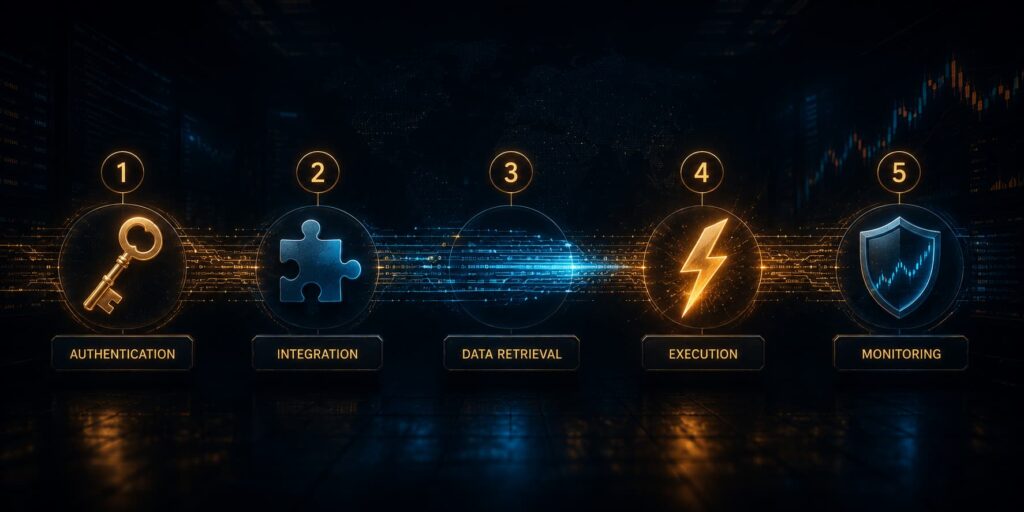
This structured approach enables traders to remove emotional decision-making and execute strategies with consistency and precision.
Why Use API Trading?
API trading offers significant operational advantages over manual trading. It enhances execution efficiency, supports advanced analytics, and allows complex strategies to operate continuously without direct human intervention.
1. Trade Automation
One of the core benefits of API trading is automation. Traders can design algorithmic strategies that automatically trigger buy or sell orders based on:
- Technical indicators
- Price thresholds
- Statistical arbitrage conditions
- Market spread relationships
- Risk management parameters
Automation eliminates emotional decision-making and ensures disciplined execution according to defined strategy rules. This is particularly valuable in markets where emotion often overrides logic.
2. Real-Time Market Data Access
Trading APIs provide direct access to:
- Live price feeds
- Order book depth
- Trade confirmations
- Account balances
- Position data
Immediate access to market data enables faster reaction times and improved decision-making, particularly in volatile or fast-moving markets such as crude oil futures, metals, agricultural commodities, and foreign exchange.
3. Reduced Latency and Faster Execution
API trading reduces latency by sending orders directly from a trading algorithm to the broker’s execution system. This direct routing:
- Minimises manual input delays
- Improves fill speed
- Reduces slippage risk
- Enhances price accuracy
For high-frequency strategies or arbitrage models, milliseconds can materially affect profitability. The speed advantage of API trading is often the difference between profit and loss in competitive markets.
4. Advanced Data Processing and Backtesting
Through API connectivity, traders can pull large volumes of historical market data for research and development. This supports:
- Backtesting trading strategies
- Statistical modeling
- Risk simulations
- Performance evaluation
Access to structured market data enables more sophisticated strategy development and systematic improvement. Traders can refine their approaches before risking real capital.
Key Benefits of API Trading
Enhanced Speed and Operational Efficiency
Orders are transmitted electronically without manual delay, improving overall responsiveness to market changes. This efficiency is critical in fast-moving markets where every second counts.
Strategy Consistency
Algorithm-based execution ensures disciplined application of trading rules without emotional bias. This consistency is often the difference between long-term profitability and erratic performance.
Scalability
API systems can handle multiple instruments, markets, and strategies simultaneously. As your trading grows, API infrastructure grows with you.
Customisation
Traders can build bespoke dashboards, analytics tools, and order management systems suited to their specific needs. This flexibility is unmatched by standard trading platforms.
24-Hour Market Access
Automated systems can operate continuously, especially useful in global futures and commodities markets that span multiple time zones. Crypto markets never close, making API trading particularly valuable.
The API is integrated into a trading platform, algorithmic engine, or custom-built application. For a deeper understanding of how these systems are built, explore our guide on [trading systems and automation].
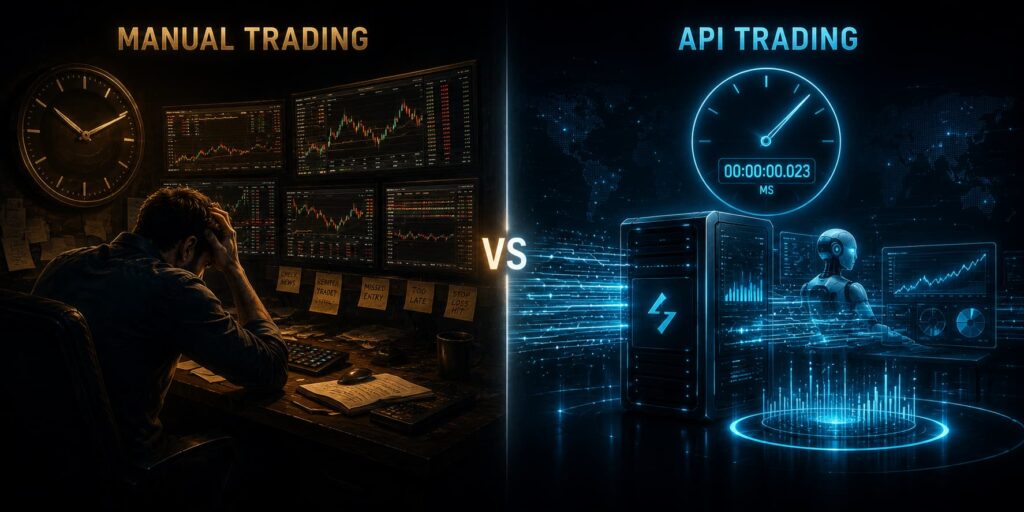
API Trading vs Manual Trading: Side-by-Side Comparison
| Factor | API Trading | Manual Trading |
|---|---|---|
| Execution speed | Milliseconds via automated orders | Slower, human reaction dependent |
| Monitoring burden | Lower, but still requires oversight | High and continuous |
| Failure modes | API downtime, logic bugs, infinite loops | Missed trades, emotional errors |
| Slippage & partial fills | Can be reduced but still occurs in fast markets | Often higher during volatility |
| Adaptability to news | Weak unless explicitly coded | Strong human interpretation |
| Cost stack | Infra, tools, development, monitoring | Mostly time and trading fees |
| Best market types | Range-bound, systematic, multi-pair | News-driven, discretionary, low frequency |
Who Uses API Trading?
API trading is commonly used by:
- Institutional investors
- Hedge funds
- Proprietary trading firms
- Commodity trading houses
- Quantitative analysts
- Algorithmic traders
Retail traders with programming knowledge may also use APIs to build customized systems tailored to their trading strategies. The barrier to entry has lowered significantly in recent years, with many brokers offering user-friendly API access.
Popular API Data Providers
Finnhub
Finnhub – Stock Market Data API is a popular stock market data provider that offers real-time pricing and historical data through its APIs. It also has advanced features such as sentiment analysis and technical indicators that can aid traders in their decision-making process. With comprehensive coverage of financial data, the platform covers a wide range of global markets not just limited to stocks but also includes ETFs, forex, and cryptocurrencies.
Alpha Vantage
Similar to Finnhub, Alpha Vantage – Free Stock Market API offers real-time and historical stock market data through its APIs. While the extent of its data is not as rich as with other stock trading APIs, Alpha Vantage is a suitable free stock market API, as its free plan allows up to 500 API requests per day.
Financial Modeling Prep
Financial Modeling Prep is one of the best stock market data providers, offering real-time pricing and financial statements through its API service. It also has incredibly advanced and detailed features, such as price targets, insider trading data, and analyst ratings to aid traders in their decision-making process. Its free plan offers 250 API requests per day, which may suffice for most entry-level traders.
Common API Trading Use Cases
| Use Case | Best Method | Reason |
|---|---|---|
| DCA or SIP-style buying | API trading | Fully rule-based automation |
| Grid trading strategies | API trading | Repetitive execution logic |
| Portfolio rebalancing | API trading | Periodic, systematic process |
| Discretionary breakout trades | Manual or hybrid | Context-dependent |
| News-based trading | Manual trading | Human interpretation matters |
These use cases show where automation clearly wins and where discretion still dominates.
Risks and Challenges in API Trading
While API trading offers substantial benefits, traders should consider:
System Errors or Coding Bugs
A single logic error can execute unwanted trades at scale. Thorough testing and code review are essential.
Connectivity Interruptions
API downtime can prevent order execution at critical moments. Having backup systems or manual override capabilities is important.
Inadequate Risk Controls
Without proper safeguards, automated systems can accumulate large losses quickly. Daily loss limits and position caps should be implemented.
Over-Optimised Backtesting Models
Strategies that perform perfectly on historical data often fail in live markets. Out-of-sample testing and realistic assumptions are crucial.
Security Vulnerabilities
API keys must be protected. IP whitelisting, secure storage, and restricted permissions are non-negotiable safety measures.
Best Practices for API Trading
Manage Your Risk Tolerance
API trading, while beneficial, comes with its own set of risks. One of the key strategies for managing these risks is implementing stop-loss and take-profit orders into your API trading strategy. Stop-loss orders limit your losses when the market doesn’t move in your favor, while take-profit orders ensure you cash-in your potential profits when the market reaches your desired level.
Optimise Your Trading Strategies
To optimize your trading strategies with APIs, it’s crucial to backtest your strategy before implementation. Backtesting allows you to evaluate the efficiency of your strategy using historical data, helping you refine and optimize it. Furthermore, consider leveraging the advanced features that APIs offer, such as sentiment analysis and technical indicators.
Stay Updated on Changes
API providers often update their services to improve functionality or add new features. To ensure you’re getting the best out of your trading API, it’s important to stay updated on these changes. You can do this by subscribing to your provider’s newsletter or regularly checking news websites. Also, consider joining online communities or forums where discussions about updates and improvements often take place. This will not only keep you informed but also provide you with tips and strategies from other API users.
Implement Safety Measures
Critical safety measures include:
- Restricting API key permissions
- Enabling IP whitelisting
- Secure key storage practices
- Rate-limit handling and retries
- Kill switches and daily loss caps
- Paper trading before live deployment
Most trading bot risks come from poor controls, not automation itself.
How to Get Started with API Trading
To begin using API trading:
- Open a brokerage account that provides API connectivity support
- Request API access credentials from your broker
- Integrate the API into your chosen trading software or custom-built system
- Test strategies in a simulated environment
- Deploy live trading with defined risk parameters
Professional traders often begin with smaller allocations to validate system stability before scaling capital.
When choosing an API provider, you should always look for reliability, as an API that frequently experiences downtime or glitches can severely disrupt your trading. You should also consider the range of features and data provided, such as real-time pricing, historical data, and technical analysis tools.
Why API Trading Matters in Modern Markets
Financial markets are increasingly data-driven and technology-enabled. In futures, commodities, forex, and equities trading, competitive advantage often depends on speed, analytics, and automation.
API trading supports:
- Algorithmic trading strategies
- Quantitative research
- Cross-market arbitrage
- High-frequency execution
- Institutional-grade portfolio management
As global markets become more interconnected, API-based systems provide the infrastructure needed for precision and scalability.
Crypto markets never close. Prices move overnight, on weekends, and during global events. Humans cannot monitor markets continuously, but automated systems can. API trading allows traders to capture opportunities during off-hours, manage risk automatically during sudden volatility, use real-time data streams via WebSockets, and run rule-based strategies like DCA, grid trading, and rebalancing.
The Hybrid Approach: Best of Both Worlds
Many experienced traders combine both manual and API trading approaches.
Humans define strategy and risk. Automation handles execution and monitoring. This hybrid model often outperforms purely manual or fully automated systems.
When manual trading is the better choice:
- News-driven or event-based trades
- Low-frequency swing trading
- Strategy depends on context and narrative
- You are still developing market intuition
When API trading is the better choice:
- Strategies are clearly rule-based
- You need 24/7 crypto market coverage
- You trade multiple markets or pairs
- Discipline and consistency are critical
Common Mistakes to Avoid in API Trading
While API trading offers significant advantages, many traders make avoidable mistakes that undermine their success. Understanding these common pitfalls can help you navigate the learning curve more effectively.
Over-Optimizing on Historical Data
One of the most common mistakes in API trading is over-optimizing strategies on historical data. When traders adjust their parameters excessively to achieve perfect backtest results, they create systems that perform well only on past data but fail in live markets.
The fix: Always reserve a portion of your data for out-of-sample testing. If your strategy performs significantly worse on unseen data, you have likely over-optimized.
Neglecting Error Handling
Many traders focus on the core trading logic and overlook error handling. APIs can return errors for various reasons—network issues, rate limits, invalid parameters, or server outages. Without proper error handling, your system may crash or behave unpredictably.
The fix: Implement comprehensive error handling that gracefully manages API errors, retries failed requests, and alerts you when issues arise.
Underestimating Latency and Execution Delays
While API trading is faster than manual execution, it is not instantaneous. Network latency, API processing times, and broker execution speeds can all introduce delays that affect your strategy’s performance.
The fix: Account for realistic execution speeds in your strategy design. Avoid strategies that depend on millisecond-level precision unless you have the infrastructure to support it.
Ignoring Rate Limits
Most API providers impose rate limits to prevent abuse. Exceeding these limits can result in temporary or permanent bans, disrupting your trading operations.
The fix: Understand the rate limits of your API provider and design your system to operate within them. Implement queuing mechanisms to handle requests without exceeding limits.
Conclusion: Is API Trading Right for You?
API trading offers a powerful way to automate and optimize your trading. It provides speed, consistency, and scalability that manual trading simply cannot match.
However, it also requires technical knowledge, ongoing monitoring, and robust risk management. The key is to start small, test thoroughly, and scale gradually.
For traders who are disciplined, systematic, and willing to learn, API trading can be a game-changer. For those who prefer discretion and contextual decision-making, manual trading or a hybrid approach may be more suitable.
The choice depends on your trading style, technical comfort, and long-term goals. But one thing is certain: understanding API trading is essential for any trader looking to compete in modern markets.
Disclaimer
This article is for educational and informational purposes only. It does not constitute financial advice, trading recommendations, or an offer to buy or sell any asset. Trading forex, commodities, indices, cryptocurrencies, and futures carries significant risk and may not be suitable for all investors. You can lose more than your initial deposit. Past performance does not guarantee future results. Always read full terms, contract specifications, and risk disclosures before trading. Do your own research. Consult a licensed financial advisor if you need professional investment advice.