


One of the most dangerous lies new traders believe is this:
“The more trades I take, the more chances I have to win.”
It sounds logical. It feels empowering. It creates the illusion of productivity.
But in trading, more is rarely better. More trades often mean more noise, more emotional decisions, more losses, more stress, and more chaos. The forex market is a relentless beast, churning with constant activity and seemingly endless opportunities. It’s easy to get caught in the whirlwind, believing that the more trades you make, the greater your chances of profit. But this mindset often leads to a treacherous path of overtrading and, ultimately, losses. Trading quality is the antidote to this destructive pattern.
Top traders don’t win by trading more — they win by trading better. They understand a fundamental truth that the bottom 95% ignore: it’s the quality of your trades, not the quantity, that determines your success. Trading quality is what separates professionals from amateurs.
Trading is not about the number of opportunities you take, but the quality of the decisions you make. The truth is, in forex, the quality of your trades matters far more than the quantity. Like a skilled craftsman who carefully selects the finest materials for their masterpiece, a successful trader prioritizes meticulous research, disciplined execution, and a deep understanding of market dynamics. This is the essence of trading quality.
In fact, the fastest way to blow an account is to trade too much. And the fastest way to grow one is to trade less, with exceptional precision, patience, and planning. This article explores why high-quality trades outperform frequent trades every time — and how shifting your mindset around this single principle can transform your entire trading journey. Trading quality is the transformation you need.
For more on the mental discipline required in trading, see our guide on trading psychology and discipline.
The Market Doesn’t Reward Activity — It Rewards Accuracy
Unlike a regular job, where working more hours means more pay, trading doesn’t work like that. In trading, you don’t get paid for activity. You get paid for accuracy. This is a core principle of trading .
Every trade you take either aligns with your system or goes against it. Every trade you take pulls emotional, psychological, and financial energy from you. Yet most retail traders behave as if trading more is automatically better.
This is a fundamental misunderstanding.
Professional traders might take only a handful of trades per week. Some even take one or two. And yet, they make far more money than someone taking 50 trades a day.
Why? Because pros don’t chase adrenaline — they chase precision. They don’t chase the market — they let it come to them. This is the definition of trading quality.
Quality gives them consistency. Quantity gives most traders chaos.
By focusing on fewer, well-researched deals, you minimize the potential for losses. You’re not chasing every fleeting price movement but waiting for the right moment to strike with calculated precision. Quality forex trades often involve larger positions, allowing for greater potential returns. You’re not spreading your capital thinly across multiple mediocre trades but concentrating it on a few high-conviction opportunities. This trading quality strategy allows you to capture substantial profits from well-timed entries and exits. Trading is about concentration, not dispersion.
Overtrading Is a Symptom of Emotional Trading
Overtrading rarely comes from strategy — it comes from emotion. This destroys trading quality.
- Fear of missing out
- Fear of not making enough
- Frustration after a loss
- Boredom
- Ego
- Greed
These emotions push traders to take trades they shouldn’t — trades that don’t fit the plan, the setup, or the market conditions. Trading quality requires emotional awareness.
And every emotional trade you take weakens your discipline. It shifts your mindset from controlled execution to reckless reaction. The appeal of quantity trading is frequently rooted in the misconception that “more trades equal more profits.” This line of thinking can be detrimental, as overtrading—executing too many trades without a thoughtful strategy—is one of the most hazardous patterns in the forex landscape. Trading quality is the solution.
Mark Douglas taught that your job as a trader is not to control the market but to control yourself. Overtrading is the clearest sign that you’ve lost self-control. Trading quality requires self-mastery.
Quality, on the other hand, requires emotional mastery. It requires patience, discipline, and the willingness to wait — even when the urge to trade is screaming inside you. This is what true trading quality demands. Trading quality is emotional mastery in action.
Every Trade Has a Psychological Cost
Traders think only in terms of financial risk — entry, stop-loss, lot size, leverage. But they forget the psychological risk attached to every trade they take. Trading quality requires awareness of this cost.
Every trade you enter engages your emotions, your expectations, your attention, and your mental energy. It adds to your psychological load. Engaging in overtrading imposes tremendous psychological pressure on traders, potentially leading to emotional burnout. As the frequency of trades rises, so too does the temptation to make decisions driven by emotions. A trader fixated on quantity may become easily swept up in the market’s volatility, resulting in heightened levels of stress, anxiety, and fear—factors that are detrimental to sound trading quality.
Too many trades drain your mental clarity and make it harder to make rational decisions. Trading quality protects your mental capital.
Professional traders protect their mental capital even more fiercely than their financial capital. They know that once your mind is fatigued, discipline collapses. Trading quality preserves your psychological energy. Low-quality trades drain it. Trading quality is mental capital preservation.
Quality Trades Come From a Tested Edge
A high-quality trade is one that aligns with:
- Your trading plan
- Your system’s edge
- Market structure
- Conditions favorable to your strategy
- Proper risk management
It’s a trade that has reason, logic, and probability behind it. This is the hallmark of trading quality.
Quantity, however, often comes from randomness. Traders take setups that are “almost” valid, “kind of” good, or “maybe” will work. They force trades where none exist. This destroys trading quality.
But in trading, “almost good” is bad. “Kind of valid” is invalid. “Maybe” is dangerous.
Professionals only take trades where the conditions match their edge with high clarity. They don’t compromise. They don’t negotiate with the market. They wait for their setups the same way a sniper waits for the perfect shot. That is trading quality.
Quality trading methods yield more consistent profits over time. By channeling efforts toward well-researched trades, traders can refine their entry and exit points, ensuring higher success probabilities. These trades typically rely on robust technical and fundamental analyses, significantly amplifying the chances of realizing substantial returns. Trading quality is about seeking the best opportunities rather than merely any opportunity. Trading quality is selectivity.
More Trades Increase the Chance of Error
Each trade you take increases your exposure — not just to market risk, but to human error. Trading quality reduces this risk.
The more trades you take:
- The more likely you misread a chart
- The more likely you enter impulsively
- The more likely you risk too much
- The more likely you violate your rules
- The more likely you miss something important
The human mind cannot process infinite decisions with consistency. Traders who take countless trades burn out quickly. This is why professional traders: automate, create strict rules, limit trade frequency, and reduce decision fatigue. Trading quality is the solution.
Quality reduces error. Quantity magnifies it. The fixation on numerous trades often results in erratic results. Markets do not consistently behave in predictable patterns, and excessive trading heightens exposure to volatility. Though some trades may yield favorable outcomes, the sheer volume increases the likelihood of losses. Trading quality protects you from this.
Traders who prioritize quantity may fall into the “chasing the market” trap, making impulsive decisions based on short-term shifts rather than long-term trends. This impatience undermines trading quality, as volatile market conditions often require a more measured approach.
In contrast, quality traders remain steadfast, engaging the market only when optimal conditions arise. By patiently awaiting the right opportunity and conducting comprehensive trend analysis, these traders are more likely to achieve consistent, positive outcomes. Trading quality delivers results. Trading quality is consistency.
High-Quality Trades Produce a More Predictable Equity Curve
A trader’s goal is not just profit — it’s consistent, controlled growth. Trading quality is the path to this goal.
When you only take high-quality trades, your equity curve becomes:
- Smoother
- More predictable
- Easier to analyze
- Easier to improve
When you overtrade, your equity curve becomes a roller coaster — a chaotic mix of wins and losses with no structure or pattern. This makes it:
- Hard to identify issues
- Hard to refine your system
- Hard to grow your account reliably
Your goal as a trader is to create a repeatable process — one that can be analyzed, reviewed, and improved. Trading quality creates repeatability. Quantity creates confusion.
When quantity overshadows quality, traders can neglect vital aspects of risk management. The more trades you open, the tougher it becomes to control exposure. With numerous positions, setting appropriate stop-loss orders for each can become challenging, leading to dangerous overexposure in adverse market conditions. Trading quality demands better risk management.
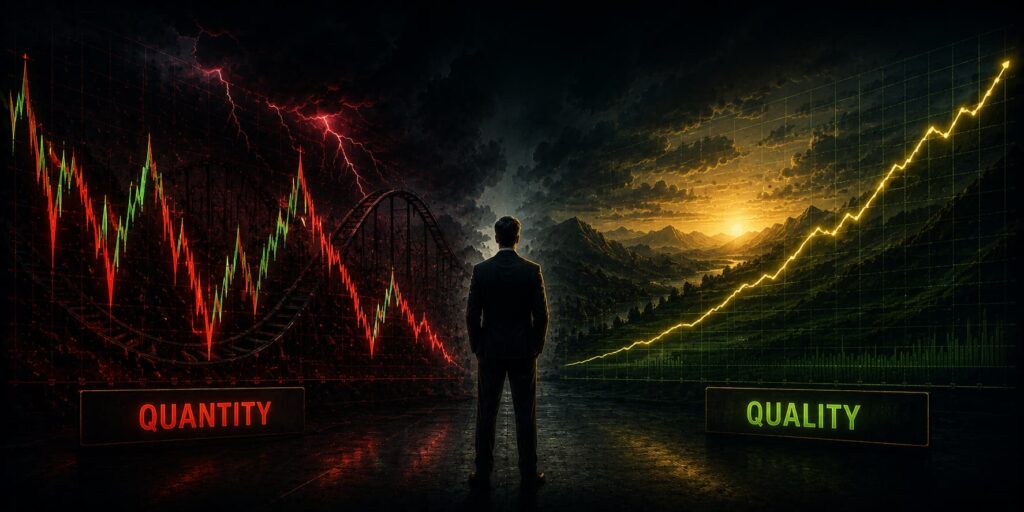
In contrast, quality-focused traders emphasize meticulous risk management. With fewer trades to monitor, they can diligently set tight stop-losses, manage leverage judiciously, and safeguard their capital. They are more likely to maintain a balanced portfolio, thus mitigating risks rather than exacerbating them. Trading quality is risk management.
High-Quality Trades Align With Market Conditions
Not all days are equal. Not all sessions are equal. Not all market environments are ideal for your system. Trading quality means recognizing this.
But traders who believe in quantity trade in every condition — trending, ranging, choppy, news-driven, erratic. Taking a trade just because the market is open is like driving fast just because the road exists. It’s reckless. Trading quality demands better judgment.
Professional traders know that quality comes from timing. You trade only when:
- Volatility suits your style
- The structure is clear
- The setup is clean
- The conditions support your edge
This is what creates long-term profitability. Trading quality is about being selective.
Trading in poor conditions is like fishing in muddy water — you might catch something, but it’s mostly luck, not skill. Trading quality is about fishing in clear water. Trading quality is timing.
Quality Trades Are Easier to Execute With Confidence
Confidence comes from clarity. When you take a trade that perfectly matches your rules, you feel calm, focused, and aligned. You’re not guessing — you’re executing. This is the confidence that trading quality brings.
Poor-quality trades create anxiety. You second-guess them. You manage them emotionally. You exit too early or too late. You stress over every candle. Trading quality eliminates this anxiety.
When you choose quality, you choose peace. You eliminate doubt because the setup is clean. Your job becomes simple: enter, manage, and exit — according to plan. Trading quality makes execution simple. Trading quality is peace.
Quantity Leads to Emotional Burnout
Trading too often creates:
- Mental exhaustion
- Emotional fatigue
- Frustration
- Anxiety
- Loss of discipline
- Impulsive behavior
Burnout is one of the greatest silent killers of trading careers. Many traders don’t blow their accounts because of lack of skill — they blow them because they’re psychologically drained. Trading quality prevents burnout.
High-quality trading is sustainable. Low-quality trading is draining. When you wait for high-quality setups, you reduce stress dramatically. You trade fewer hours but make better decisions. Your mind stays sharp, your discipline stays strong, and your trades stay focused. Trading quality is sustainability.
Quality Teaches Patience — One of the Most Valuable Skills in Trading
Patience is hard because the market tempts you. Price wiggles and moves constantly, whispering, “Enter now. Don’t miss out.” Trading quality demands that you resist.
But the pros wait. They know that patience is not inaction — it is preparation. It is the filtering mechanism that separates randomness from opportunity. Trading quality is patience in action.
Quality trains your mind to think long-term, while quantity trains your mind to think impulsively. The more patient you become, the better your results get. The less patient you are, the faster you lose control. Trading quality builds patience.
High-Quality Trades Eliminate the Need for Revenge Trading
Revenge trading comes from frustration — often caused by poor-quality trades. When you enter bad setups and lose, your ego forces you to chase the loss. Trading quality prevents this.
But when you stick to high-quality trades, even your losses feel justified. You followed your plan. You executed correctly. You acted professionally. There’s no emotional need to chase. Nothing to “get back.” Trading quality gives you peace.
Quality is the antidote to chaos. It keeps you grounded. For more on breaking the revenge trading cycle, see our guide on revenge trading rules.
Quality Helps You Build a Professional Mindset
When you begin to prioritize quality over quantity, your entire identity as a trader transforms. You stop being a gambler. You stop being impulsive. You stop chasing excitement. Trading quality redefines you.
You become deliberate. You become thoughtful. You become disciplined. You become patient. You start thinking like a professional. You start behaving like a professional. You start trading like a professional. Trading quality makes you a professional.
And your results begin to mirror the mindset you’ve built. Quality trading is not just about what you do, it’s about who you become. Trading quality is identity transformation.
The Fewer the Trades, the Easier the Analysis
If you take 2–5 high-quality trades a week, analyzing them becomes simple. You can review every detail with clarity. You can identify strengths and weaknesses. You can refine your edge. Trading quality simplifies analysis.
But if you take 50–100 trades a week, your journal becomes a blur. Patterns disappear. Errors blend together. You can’t separate good decisions from bad ones. Quantity destroys feedback.
Quality trading strengthens your feedback loop. And strong feedback loops accelerate your growth. Trading quality accelerates learning.

The Market Makes Big Moves — Not Constant Moves
The market doesn’t make you rich through constant small fluctuations. It makes you rich through major, high-probability moves — trends, breakouts, retests, clean reversals. Trading quality positions you for these moves.
These moves don’t happen every hour. Sometimes they don’t happen every day. But when they do, they’re worth waiting for. Trading quality is about waiting for these moments.
Quantity traders miss the big moves because they’re busy reacting to noise. Quality traders catch the big moves because they wait for signal. Trading quality is about capturing the moves that matter.
Trading fewer, better trades puts you on the side of probability, not hope. Trading quality is the difference.
How to Make the Shift: Practical Steps for Better Trading Quality
Here are actionable steps to shift from quantity to quality:
1. Define Your Edge. Identify your unique advantage, whether it’s technical analysis, fundamental research, or expertise in a specific currency pair. This is the foundation of trading quality.
2. Develop a Solid Trading Plan. This plan should outline your entry and exit strategies, risk management, and profit targets. Trading quality requires a plan.
3. Embrace Patience. Don’t be afraid to wait for the right opportunity. The best trades typically require the most patience. Trading quality is patient.
4. Continuously Learn and Adapt. The market is constantly evolving, so it’s crucial to stay updated with new information and strategies. Trading quality requires evolution.
5. Focus on Process, Not Outcome. Did you follow your rules? Did you take every valid trade? Those are the questions that matter. Trading quality is about process.
6. Track Your Trades. Record every trade, including your emotional state, the setup, and the outcome. Trading quality requires feedback.
7. Review and Refine. After each session, review what worked and what didn’t. Trading quality requires continuous improvement.
According to Investopedia, overtrading is one of the most common mistakes that leads to account depletion. Understanding the psychological drivers behind excessive trading is essential for developing trading quality. Similarly, Mark Douglas emphasizes that discipline and self-control are the foundations of consistent profitability. Trading quality is built on these principles.
For more on risk management and position sizing, see our guide on risk management strategies.
Conclusion: Slow Down to Speed Up
If you take one thing from this article, let it be this: your trading success is determined not by how much you trade but by how well you trade. Trading quality is the deciding factor.
Most retail traders fail not because they lack knowledge, but because they lack discipline and patience. They try to force the market to give them opportunities. They chase candles, signals, and excitement. They trade too much, too often, with too little clarity. They never achieve trading quality.
But the top 5% do something different. They slow down. They wait. They filter ruthlessly. They execute only the highest-quality trades. Trading quality is their superpower.
That’s why they last. That’s why they win. That’s why their accounts grow consistently.
You don’t need more trades. You need better trades. You don’t need more action. You need more discipline. You need trading quality.
Trading fewer, better trades isn’t a strategy — it’s a transformation. It’s the shift that takes you from losing trader to consistent trader. It’s the shift to trading quality.
The transition from quantity to quality requires a conscious shift in mindset. It’s about embracing patience, meticulous research, and a deep understanding of market dynamics. Once you embrace it, everything changes. Trading quality changes everything.
Disclaimer
This article is for educational and informational purposes only. It does not constitute financial advice, trading recommendations, or an offer to buy or sell any asset. Trading forex, commodities, indices, cryptocurrencies, and futures carries significant risk and may not be suitable for all investors. You can lose more than your initial deposit. Past performance does not guarantee future results. Always read full terms, contract specifications, and risk disclosures before trading. Do your own research. Consult a licensed financial advisor if you need professional investment advice.