


Every trader hits a losing streak. It is not a sign that you are broken, and it is not necessarily a sign that your system is broken either. Even a genuinely profitable strategy will string together losses purely by chance.
The question is not whether you will have a losing streak. The question is whether you will survive it.
Losing streaks in trading are tough, but they are normal. Even strategies with a 60% win rate will experience extended periods of losses. The key to overcoming them is managing your mindset, controlling risks, and refining your strategy.
This guide covers why losing streaks happen, the emotional impact, practical steps to recover, and how to rebuild confidence.
For a deeper look at [trading psychology and discipline], this guide covers the mental side of handling a losing streak.
Why Losing Streaks Happen
A losing streak can happen for several reasons. Understanding the cause is the first step to fixing it.
Market cycles. Markets shift between trending and rangebound conditions. A strategy that worked well in a trending environment can quietly stop working when conditions shift to choppy and rangebound. Discipline applied to a broken edge just loses money more neatly.
Variance. Even a profitable strategy will experience losing streaks purely by chance. With a 60% win rate, there is a statistically significant probability of losing five trades in a row over a large sample. This is not a failure. It is math.
Emotional spirals. What turns a normal drawdown into a real disaster is almost never the streak itself. It is what the trader does in response to it. The worst losses tend to come after a losing streak has already started, when frustration takes the wheel and a calm process turns into a frantic attempt to win the money back.
Strategy decay. Markets evolve. A strategy that worked last year may not work this year. If your journal shows high rule adherence and you are still bleeding over a meaningful sample, the issue may genuinely be the edge rather than the execution.
The first job is not to recover. The first job is to stop the bleed.
The Emotional Impact of a Losing Streak
The emotional roller coaster that follows a significant loss can be overwhelming. The frustration, disappointment, and anger that accompany a losing streak can cloud judgment and lead to destructive behaviors.
Revenge trading is a common response. The trader tries to recover the loss by taking unnecessary risks. This often exacerbates the situation and results in even more substantial losses.
Self-doubt creeps in. You start questioning your strategy, your analysis, and your ability to trade at all.
Fear takes over. You hesitate on valid setups. You exit winners too early. You move stop losses.
A losing streak does two kinds of damage: it shrinks your account, and it shrinks your judgment. The second is far more dangerous than the first. A smaller account recovers with time and good trades. A trader who keeps making emotional decisions while tilted can turn a manageable ten percent drawdown into a catastrophic one in a single afternoon.
Protect the judgment first. The capital follows.
Coping Strategies During a Losing Streak
Allow Yourself to Feel
It is important to acknowledge and process your emotions. Whether it is screaming, crying, or talking to a friend, find healthy ways to express your feelings and release the emotional pressure. Suppressing emotions only makes them stronger.
Start Fresh
After venting your emotions, embrace a new mindset. Recognize that today is a new day, and treat it as “Day One” of your trading journey. Focus on learning from your mistakes rather than dwelling on them. A losing streak does not define you. How you respond to it does.
Back to Basics
Return to the fundamental principles of your trading strategy. One trade at a time, stick to your well-defined plan, and avoid making impulsive decisions. Regaining control over your actions is crucial for rebuilding confidence during a losing streak.
Break Down the Recovery
The urge to make back a significant loss quickly can lead to more losses. Instead, break down the recovery process into smaller, achievable goals. This shift in perspective can alleviate the pressure and help you focus on consistent, sustainable growth.
Time Is Your Ally
Understand that making up a substantial loss in a single trade or a short period is unrealistic and risky. Give yourself time—whether it is a couple of weeks or a few months—to work towards your recovery goals. A losing streak takes time to overcome. Do not rush it.
Learn from Mistakes
Reflect on what led to the loss. Were there errors in your analysis, execution, or risk management? Learning from your mistakes is vital to prevent repeating them in the future.
The First Rule: Stop Trading
When you are in a losing streak, every instinct is screaming at you to trade your way out, right now, with size. That instinct is the enemy.
Stopping the bleed usually means doing less, not more. Cut your position size hard, or step away from live trading entirely for a day or two.
This feels counterintuitive. But a trader who keeps making emotional decisions while tilted can turn a manageable ten percent drawdown into a catastrophic one in a single afternoon.
Signs it is time to step away:
- You are feeling overwhelmed by frustration or anxiety
- You are overtrading in an attempt to recover losses
- You are ignoring your own risk management rules
“You must step away to clear your head; only then can you identify mistakes and reset your trading ‘ship.'” – Nial Fuller
The Journal Review – Find the Pattern
Once you have stopped trading on tilt, you need a clear-eyed look at what actually happened. This requires separating two things that feel identical in the moment but are completely different: bad luck and bad decisions.
A good system loses sometimes. A bad process loses for reasons you can fix. The only way to tell them apart is to go through your recent trades honestly.
The Four-Box Debrief
Sort every trade into one of four buckets.
| Bucket | Description | Action |
|---|---|---|
| Good decision, good outcome | Followed rules and the trade worked | Repeat without a second thought |
| Good decision, bad outcome | Followed rules and still lost | Accept as variance. No change needed. |
| Bad decision, bad outcome | Broke a rule and it cost you | Study this. Fix the behavior. |
| Bad decision, good outcome | Broke a rule and got away with it | Most dangerous box. The profit tricks you into repeating the mistake. |
The debrief usually reveals one of two stories.
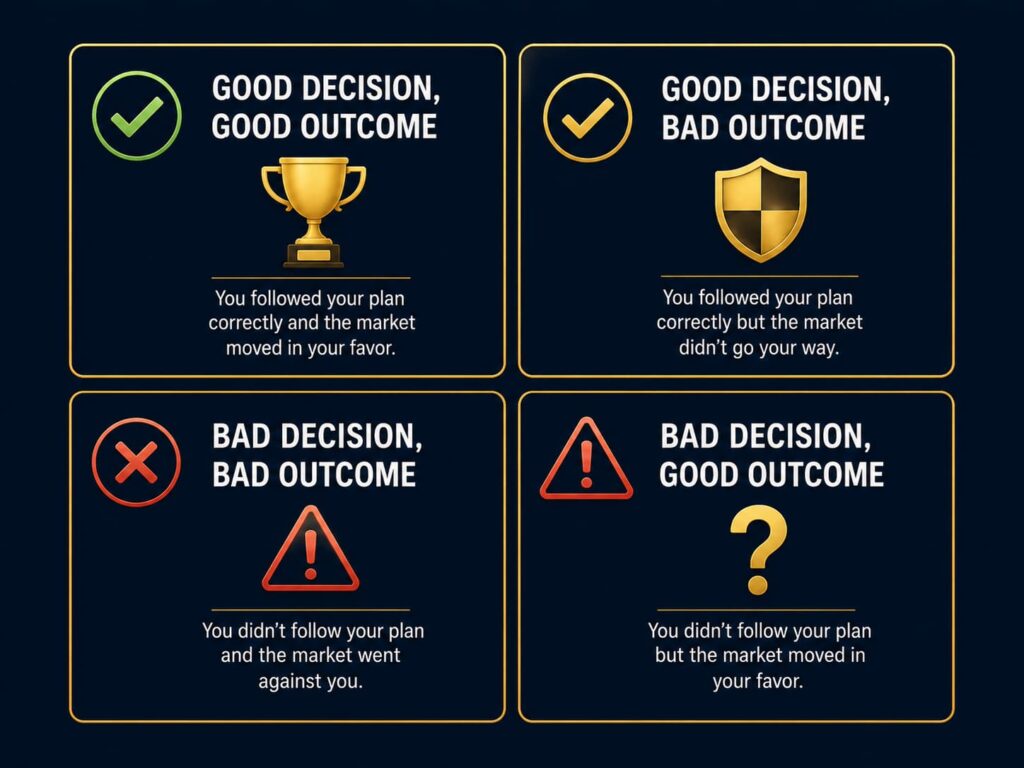
Either your losses are mostly good-decision, bad-outcome trades, which means you hit a rough patch of variance and your job is simply to keep executing and let the edge reassert itself. Or your losses cluster in the bad-decision boxes, which means the streak is self-inflicted and you have a specific behavior to fix.
Those two situations call for opposite responses. Confusing them is how traders either abandon a working system out of impatience or keep feeding a broken one out of stubbornness.
A losing streak only exists when you 100% religiously follow your rules, adhere to the trading plan and do everything correctly and then still end up with multiple losses.
Use a trade review checklist to keep your analysis consistent:
| Review Element | Questions to Ask |
|---|---|
| Entry Rules | Did the trade meet all entry criteria? |
| Position Size | Was the position sized appropriately for your account? |
| Stop Loss | Was the stop-loss placed at logical technical levels? |
| Market Context | Were market conditions suitable for this strategy? |
| Trade Management | Did emotions influence your decisions during the trade? |
The Danger Zone: Emotional Drawdown
The deepest losses usually come from trying to win it all back at once. This is the danger zone of a losing streak.
The emotional impact is not just financial. It is psychological. The frustration, the need to prove yourself, the refusal to accept a loss—all of these feed into a cycle that makes the situation worse.
Understanding that losses are a natural part of the trading journey is crucial for long-term success. The path to success is paved with setbacks that are overcome through perseverance, discipline, and a commitment to continuous improvement.
Reduce Size – Prove Discipline First
When your account takes a hit, reducing your trade size can help you manage losses and recover.
For example, if your $25,000 account drops 3% to $24,250, use this lower amount for your risk calculations. Adjust your lot sizes as your drawdown increases. Smaller positions mean less risk per trade, giving you more breathing room to bounce back.
Recovering from a drawdown may be a slow process. Rushing will only make the hole deeper.
This is a critical part of surviving a losing streak.
Setting Stricter Stop-Losses
Stop-losses should be based on technical levels, not random percentages. They act as your safety net, helping you exit trades before losses spiral out of control.
A stop loss is set after a trade entry at the price level on a chart where a trader will accept being wrong and exit for a small loss.
Key guidelines for stop-losses:
- Set them at technical support or resistance levels before entering a trade
- Stick to your stop-loss—do not move it further away
- Base your position size on the stop-loss distance
- Exit immediately once the stop-loss is triggered
Don’t let your ego cause a huge loss just because you do not want to exit and accept you were wrong.
Using Daily Loss Caps
A daily loss cap can protect your account from emotional decisions. Set a limit—like a small percentage of your starting balance—and pause trading if you hit it.
When this happens:
- Close all open positions
- Step away to clear your head
- Analyze what went wrong and adjust your strategy
This is especially important during a losing streak.
The Asymmetry of Drawdowns
It helps to put real numbers on why slow recovery wins. A drawdown and the gain needed to erase it are not symmetrical.
| Drawdown | Gain Needed to Recover |
|---|---|
| 10% | 11% |
| 25% | 33% |
| 50% | 100% |
That asymmetry is exactly why protecting capital during a losing streak matters far more than chasing it back. Every extra percent you give away while tilted makes the climb back disproportionately steeper.
Recovering slowly from a shallow hole beats recovering heroically from a deep one, because the deep hole may simply be too steep to climb at all.
When to Re-Evaluate the Strategy Itself
Sometimes the honest conclusion is that the strategy, not the trader, is the problem. This is where your journal becomes priceless.
If your records show high rule adherence, you have been taking your A-setups and managing them correctly, and you are still bleeding over a meaningful sample, then the issue may genuinely be the edge rather than the execution.
The key word is “sample.” One bad week tells you nothing. Reacting to it by tearing up your strategy is itself a classic mistake. Constantly switching systems means you never give any edge the time it needs to show up.
Look at a meaningful run of trades—dozens at least—with good adherence, before you conclude the strategy is the culprit.
High rule adherence with persistent losses points at the strategy. Frequent rule-breaks point at the trader. Your journal is how you tell which.
How to Rebuild Confidence
Even if you are trading in a simulated account, a pause can help reset your mindset for live trading. A losing streak damages confidence. Rebuilding it takes time.
Here is how to rebuild your confidence:
Review your trading journal. Look for patterns in your decisions and identify emotional triggers.
Practice with a demo account. Regain confidence by trading without putting real money at risk.
Set re-entry rules. Define specific criteria for when you will return to live trading.
Start small. Prove discipline before you prove profit.
Step away for 24 hours. When you return, a fresh perspective makes losses feel less daunting.
Rebuild in Stages
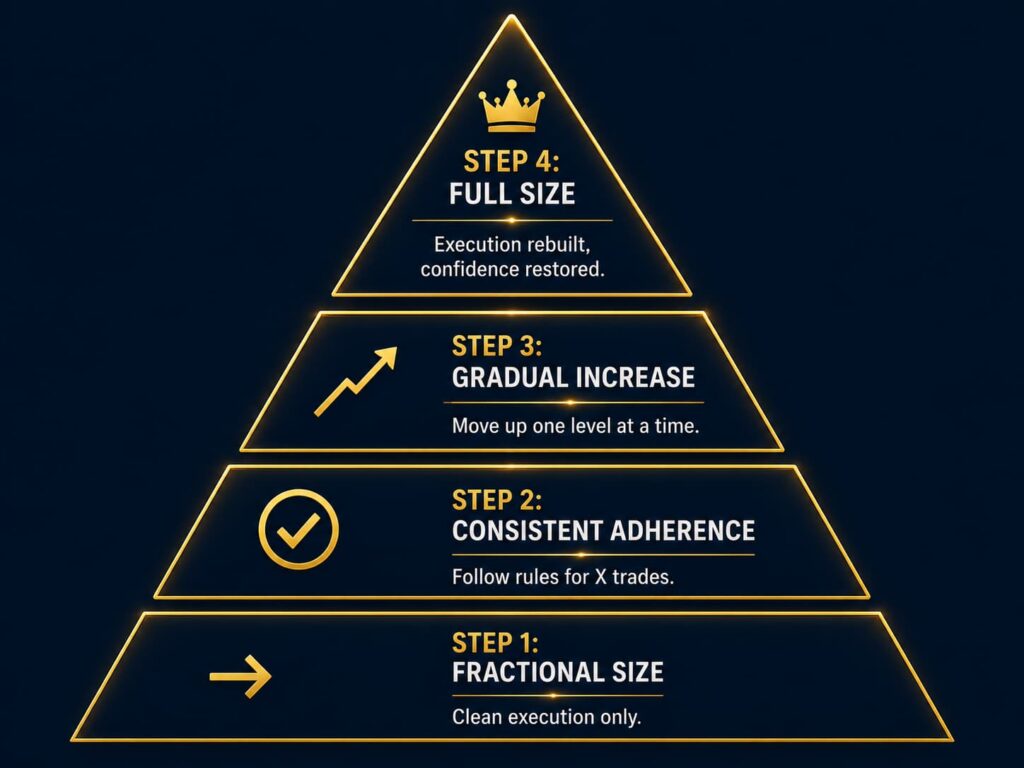
Whatever the debrief showed, you rebuild the same way: gradually, and on the strength of process rather than profit.
The mistake is to come back at full size the moment you feel better. Confidence is fragile after a losing streak, and one more loss at full size can knock you straight back into the hole.
Instead, earn your size back in stages:
- Start at a fraction of your normal size
- Define a clear standard for stepping up (e.g., a set number of trades that followed your rules)
- Increase size in measured steps
- Drop back down a level immediately if you break a rule
- Judge each stage on plan-adherence, not on the dollar result
- Return to full size only once consistent execution has been rebuilt
Daily Routine During Recovery
The routine matters because recovery is as much about rebuilding trust in yourself as it is about rebuilding the account. Each day you follow the process, win or lose, is a small deposit in that account of self-trust.
Before the session: Reread your rules and your size-stage standard. Set a hard daily loss limit you will honor by walking away.
During the session: Take only A-setups. Log each trade with the emotion you felt, not just the numbers.
After the session: Run a short debrief. Grade your adherence. Note one thing you did well.
Real Example: A Trader Who Survived a Losing Streak
Let me share a real example from my own experience.
I had a losing streak that lasted three weeks. Seven losing trades in a row. My account was down 12%. I felt like I had forgotten how to trade.
Here is what I did.
First, I stopped trading for two days. I did not look at charts. I did not think about the market. I just reset.
Second, I reviewed my journal. Every trade was a good-decision, bad-outcome trade. I had followed my rules. The market was just in a choppy phase that did not favor my strategy.
Third, I cut my size in half. I traded 0.5% risk per trade instead of 1%. I proved to myself that I could still execute.
Fourth, I set a daily loss cap of 2%. If I hit it, I walked away.
Fifth, I returned with one goal: follow the rules for one day. Not to make money. Just to follow the rules.
The streak ended after that. The market shifted back into a trending phase. My strategy started working again. The recovery was slow, but it was steady.
That losing streak taught me more than any winning streak ever did.
Common Mistakes During a Losing Streak
| Mistake | Why It Is Dangerous |
|---|---|
| Increasing size to recover | Turns a small loss into a big one |
| Revenge trading | Emotional decisions lead to more losses |
| Abandoning your strategy | You never give your edge time to work |
| Overtrading | More trades = more chances to lose |
| Ignoring your journal | You repeat the same mistakes |
| Trading on tilt | Judgment is impaired |
Avoid these mistakes, and your losing streak will stay manageable.
Final Thoughts
A losing streak is painful, but it is also the most honest feedback you will ever get about where your risk management is too loose. The goal of this process is not to maximize profit. It is to guarantee survival. The one unbreakable rule of this game is that you cannot recover from a blown-up account. Stay in the game and you always have another chance. Lose your stake and the math is over.
Professional traders do not fear losing streaks because they know exactly what they will do when the next one comes. They will. They always do.
The goal is not to avoid losing streaks, which is impossible. It is to make sure no streak can ever take you out of the game. If your process guarantees survival, then every drawdown becomes temporary by definition.
Survive first. Recover second. Grow third. Always in that order.
Checklist: The First 7 Days Back
- Trade at reduced size, with the only goal being clean execution rather than recovering losses
- Run the four-box debrief on every trade, and be brutally honest about which box it belongs in
- Honor your daily loss limit without exception, and walk away the moment you hit it
- Grade each day on plan adherence, and step size up only after a clear run of disciplined trades
Bottom Line
Bouncing back from a losing streak is not about a heroic run of winners that makes you whole in a week. It is about a sequence: stop the bleed, debrief honestly to separate variance from mistakes, rebuild size in stages on the strength of your execution, harden your risk controls, and re-evaluate the strategy only over a real sample.
Do those things in order and recovery becomes almost mechanical—a process rather than a prayer. The trader who internalizes this stops fearing drawdowns, because they know exactly what they will do when the next one comes.
The goal is not to avoid losing streaks. It is to make sure no streak can ever take you out of the game.
Disclaimer
This article is for educational and informational purposes only. It does not constitute financial advice, trading recommendations, or an offer to buy or sell any asset. Trading forex, commodities, indices, cryptocurrencies, and futures carries significant risk and may not be suitable for all investors. You can lose more than your initial deposit. Past performance does not guarantee future results. Always read full terms, contract specifications, and risk disclosures before trading. Do your own research. Consult a licensed financial advisor if you need professional investment advice.