


Most traders spend years searching for an edge outside themselves.
A better indicator.
A sharper entry model.
A new strategy promising consistency.
Yet after all that searching, they still find themselves in the same place: losing money, chasing the next system, and wondering why nothing works.
Alexander Elder ends Trading for a Living with a sobering realization: the market does not reward cleverness. It rewards control. The final edge is not found on the chart. It is found in how a trader behaves when nothing is clear, nothing is certain, and nothing feels comfortable. Alexander Elder ends Trading for a Living with a sobering realization. You can learn more about his work at Alexander Elder .
This article explains how to build a trading edge that lasts. It covers the psychology behind edge, the practical steps to develop one, and the common mistakes that destroy it. A true trading edge is not a secret indicator. It is a repeatable advantage that shifts the odds in your favor over time.
For a deeper look at [trading psychology and discipline], this guide covers the mental side of maintaining a trading edge.
Key Takeaways
- A trading edge is a repeatable advantage that improves the odds of profitable trades
- Many traders unknowingly use the same strategies as the crowd, reducing their chances of consistent success
- Some edges are temporary and depend on specific market conditions, regulations, or technology
- Lasting edges often come from adding unique rules, cross-verification, and disciplined trade management to familiar strategies
- The ultimate trading edge is self-mastery: the ability to execute your plan regardless of emotional state
Why the Market Cannot Be Conquered
Markets are adaptive. The moment a mechanical advantage becomes obvious, it fades. This is why traders who rely purely on tactics experience cycles of success followed by breakdowns. The market is not a puzzle to be solved. It is a living system that evolves constantly.
Elder makes this clear: you do not dominate the market. You coexist with it. The only variable you can consistently control is yourself. This is the foundation of any lasting trading edge.
A true trading edge does not come from outsmarting the market. It comes from outgrowing your weaknesses. When you understand this, the search for a trading edge shifts from external indicators to internal discipline.
What Is a Trading Edge?
A trading edge is a technique, observation, or approach that creates a cash advantage over other market players. It does not have to be complex. Any improvement that shifts the odds slightly in your favor can become a valuable trading edge over time.
Don’t be discouraged if you haven’t found one yet. Many traders don’t even realize a true trading edge exists. It is one reason a small number of traders generate strong profits while many others struggle with weak or negative returns.
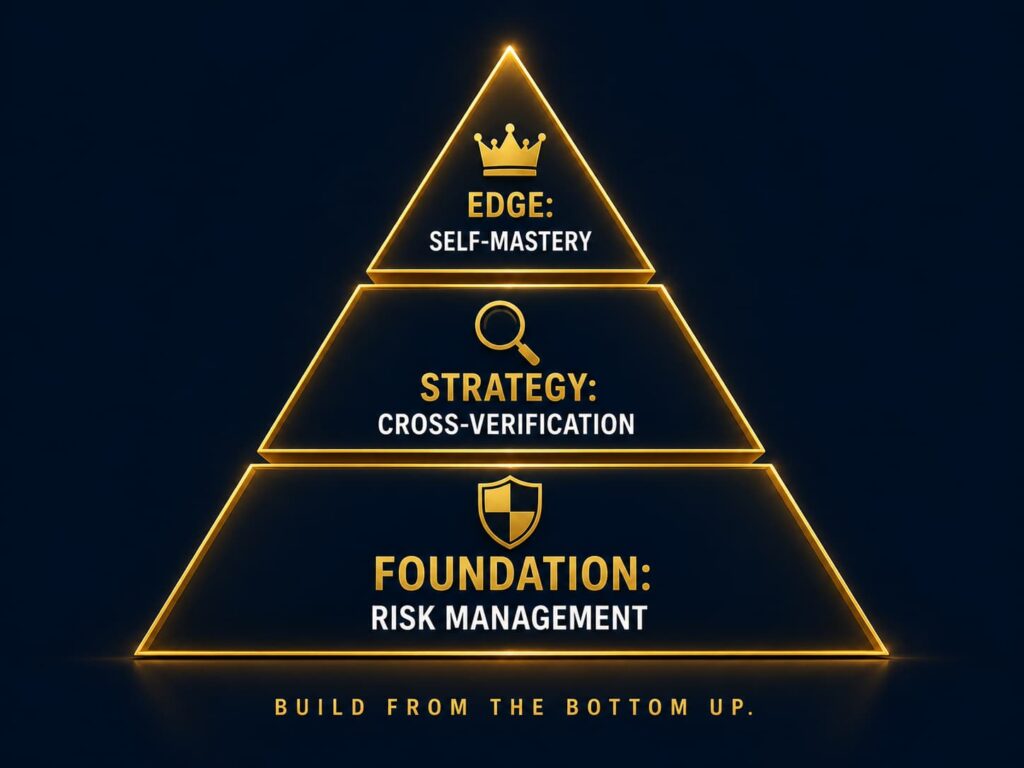
There are many ways to build a trading edge, but we will focus on one that builds on technical skills you may already use. It is a simple process that takes an established strategy and adds detailed rules to filter out the majority of potential candidates, focusing your attention squarely on the most promising opportunities.
For more on [building a trading system], this guide covers how to structure your trading edge.
Edgeless Strategies – The Crowd Trap
A quick reality check will tell you if your trading strategy has a definable trading edge. List the most common methods you use to find new opportunities, entry and exit positions, and manage risk.
Then try to remember where you learned those specific concepts, whether from a book, website, or another trader. Finally, consider how many other market participants are playing the exact same strategies, often at the exact same time.
Through this exercise, many traders realize they are using the same strategies as thousands of other market participants. There are two reasons why it is impossible to book reliable profits when you are part of this crowd.
First, you are competing with all those people for the same pot of gold. Second, crowds attract unwanted attention from other traders who notice the liquidity pool and execute predatory strategies to shake out weak hands.
The sheer number of participants acting in the same way eliminates the trading edge that made those strategies work in the first place. But that does not mean you need to abandon the trading and technical analysis skills you have taken so long to learn.
In fact, edgeless strategies popularized in books and websites work well as building blocks for more powerful techniques that will retain their trading edge for a lifetime.
Temporal Edges – Cycle-Specific Advantages
Markets change all the time, creating and destroying trading edge that tap into the complexities of the current cycle. The trick with these temporal edges is to work them aggressively until the crowd shows up, and then back off, utilizing them only when other folks are leaning the wrong way.
“Buy the dips” strategies, which were very popular at the turn of the millennium and after the 2008 crash, are classic temporal edges that failed miserably in more challenging market conditions… unless specialized rules are applied.
Regulations and technology also give way to temporal edges, with the rise of high-frequency trading (HFT) as a strong example. Prior generations enjoyed similar edges with bullet trading and Level II scalping.
System traders have an advantage over discretionary traders with these highly technical strategies, but destroy their trading edge by over-reliance on back-tested results that fail to account for the market’s dynamism.
A lasting trading edge adapts to changing conditions. It does not rely on a single market environment. It works across multiple cycles because it is built on principles that endure.
For more on [adapting to market conditions], this guide covers how to maintain your trading edge across different regimes.
Self-Mastery Is Risk Control in Disguise
Self-mastery begins with survival. This is why Elder places such heavy emphasis on risk control before profits. A trader who controls risk survives losing streaks, avoids emotional spirals, and stays mentally available for opportunity.
This is not defensive trading. It is strategic endurance. A true trading edge cannot exist without risk management. You can have the best strategy in the world, but if you do not manage risk, you will not survive long enough to see it work.
The 1% rule is the foundation. Never risk more than 1% of your account on a single trade. This is not arbitrary. It is a mathematical survival rule. It ensures that a normal, expected losing streak does not end your career.
This is the first step in building a trading edge. Without it, nothing else matters.
Thinking in Probabilities
Retail traders ask: “Will this trade win?”
Professionals ask: “Does this fit my trading edge over a series?”
Once thinking shifts from outcomes to expectancy, losses lose emotional weight, discipline becomes easier, and confidence becomes quieter. The trader stops reacting to individual outcomes.
Your trading edge is not about being right on any single trade. It is about having a positive expectancy over a large sample of trades. This is the probabilistic mindset that separates professionals from amateurs.
When you think in probabilities, a single loss does not hurt. It is just part of the process. A winning streak does not make you invincible. It is just part of the process. Your trading edge is the process. The results are the byproduct.
How to Build Your Own Edge
Like edgeless concepts found in books and websites, temporal edges provide a foundation for more powerful strategies. To show how this works, we will take the “buy the dips” strategy and apply special rules that identify entry prices where the crowd is unlikely to join us.
It is easy to get shaken out if we enter too early, so our primary task is to identify narrow levels where reversal odds are so great we can utilize tight stops with confidence. Then, if we can replicate results across multiple securities in divergent markets, we have overcome the temporal disadvantage and identified a trading edge that may last a lifetime.
Step 1: Start with a Familiar Strategy
Choose a strategy you already understand. It does not need to be unique. It just needs to be a foundation.
Step 2: Add Filtering Rules
Add rules that filter out low-probability setups. For example, if you trade breakouts, only take them when they occur at key levels with volume confirmation.
Step 3: Add Trade Management Rules
Add rules that maximize your winners and minimize your losers. For example, move your stop to breakeven after a certain number of pips, or scale out of positions at key levels.
Step 4: Test and Refine
Test your new trading edge on historical data. Then forward test it with small size. Track your results and refine as needed.
Cross-Verification – Improve Trade Selection
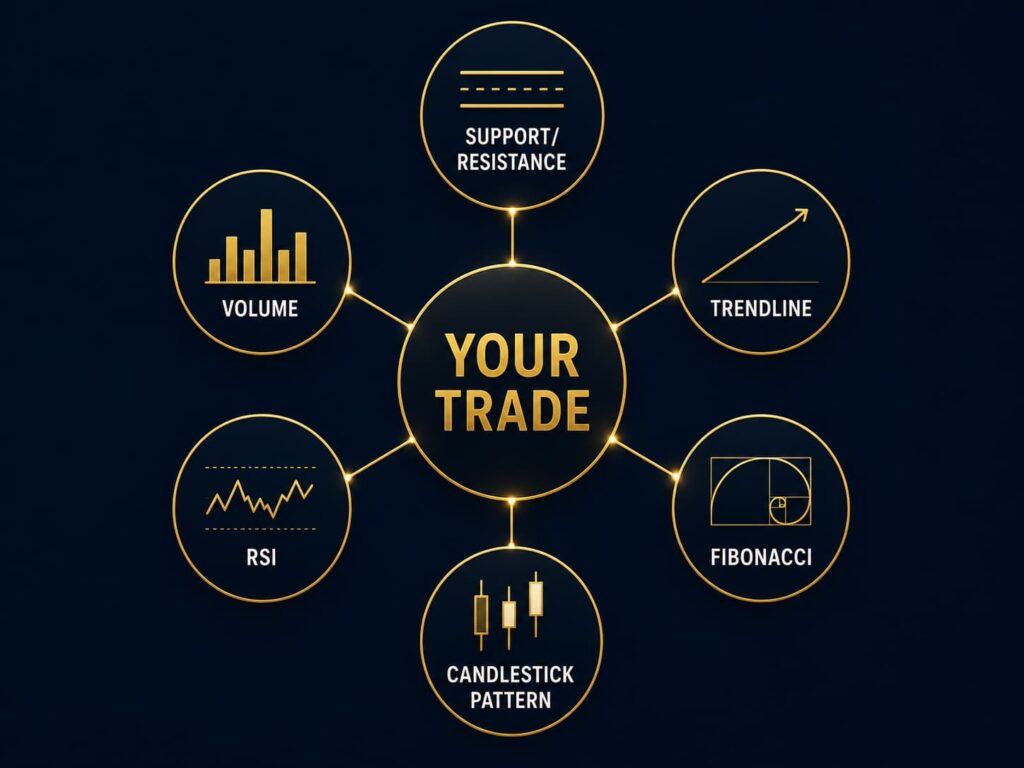
We will look for as many technical reasons as possible that a security will reverse at a specific price level. The more confirmation signals that converge in the same area, the higher the odds that support will hold and trigger a bounce.
We will pass on the opportunity if we cannot find at least four cross-verification points. Finally, we will apply opportunistic management rules to book the biggest profit, which usually means taking advantage of the crowd after they see the bounce and jump in mindlessly.
| Confirmation Signal | What to Look For |
|---|---|
| Support/Resistance | Key historical levels |
| Trendline | Diagonal support or resistance |
| Fibonacci | 38.2%, 50%, or 61.8% retracement |
| Candlestick Pattern | Reversal patterns (pin bars, engulfing) |
| RSI | Overbought or oversold readings |
| Volume | Increasing volume at key levels |
| Moving Average | Price reacting to 50 or 200 period MA |
| Market Structure | Higher low or lower high formation |
The more of these signals that converge at the same price level, the stronger your trading edge.
Identity-Based Trading
Strategies can be copied. Indicators can be learned. But identity cannot be borrowed.
When trading becomes identity-driven, rules are followed naturally, discipline feels less forced, and consistency becomes behavioral. You stop asking, “Should I take this trade?” You ask, “Is this what a disciplined trader would do?”
Your trading edge is not just in your strategy. It is in who you become as a trader. The traders who succeed are not the ones who found the perfect system. They are the ones who became the type of person who follows their system consistently.
This is the ultimate trading edge. It cannot be copied. It cannot be bought. It must be built.
Emotional Awareness vs Emotional Suppression
Elder does not teach emotional numbness. He teaches emotional awareness.
Fear, greed, boredom, and frustration will always exist. The difference between amateurs and professionals is how they respond to these emotions.
Professionals:
- Recognize emotions early
- Reduce position size when emotions rise
- Step aside instead of forcing execution
Self-mastery means emotions inform decisions – not control them. Your trading edge is not about eliminating fear. It is about acting correctly despite it.
When you feel fear, reduce size. When you feel greed, take profits. When you feel revenge, walk away. These are the building blocks of a lasting trading edge.
The Review Process – Your Edge Tracker
The best traders are not the most excited. They are the most reflective.
Elder treats review as non-negotiable. Journals are not for nostalgia. They are for pattern recognition. Review reveals repeated mistakes, emotional patterns, and system leaks.
What you review improves. What you ignore repeats.
Your trading edge depends on your ability to learn from your mistakes. Every trade, win or lose, should be a learning experience. Maintain a diary of your trades, why you entered, what happened, and the lesson learned.
| Journal Entry | What to Record |
|---|---|
| Date and Time | When the trade was taken |
| Asset and Direction | What you traded and which way |
| Entry, Stop, Target | The trade parameters |
| Position Size | Percentage of account risked |
| Emotional State | How you felt before entry |
| What Happened | The actual outcome |
| What I Did Right | Strengths to reinforce |
| What I Would Change | Weaknesses to address |
| Lesson Learned | The key takeaway |
Reviewing your journal weekly reveals patterns in your behavior and sets you on the road to improving decision-making. Growth in trading is attained through reflection. The market can become a great tutor—if you are willing to listen to it.
For more on [journaling and self-reflection], this guide covers how to track your trading edge.
Common Mistakes That Kill a Trading Edge
| Mistake | Why It Destroys Edge |
|---|---|
| Over-reliance on backtesting | Markets change. Past performance does not guarantee future results. |
| Strategy hopping | No strategy works every time. Hopping means you never give an edge a chance. |
| Adding too many rules | Overcomplication creates analysis paralysis and reduces sample size. |
| Ignoring the psychological side | Even the best strategy fails without discipline. |
| Chasing new systems | The search for the “perfect” system is a trap. |
| Not tracking performance | If you don’t track it, you cannot improve it. |
| Failing to adapt | Markets evolve. Your edge must evolve with them. |
Avoid these mistakes, and your trading edge will survive.
Confidence vs Cockiness
Confidence is belief in your system and your ability to execute it. It comes from having prepared, having backtested, and having experience. Cockiness resides in the assumption that you always win.
A confident trader follows through with the plan even when faced with a string of losses. A cocky trader throws the plan out the window whenever the way of the market takes an unintended course.
Your trading edge is built on confidence. It is destroyed by cockiness. The difference between the two can make or break your trading career.
Adaptability and Humility
Markets change. A strategy that might have been working last year might not be so today. A trader having the right mindset needs flexibility open to learning from any situation. Few will become enamored with a certain approach. Being adaptable means accommodating the changes in new information and market conditions.
Humility must therefore accompany adaptability. High-handedness in trading means the trader will overestimate his experience, choose an oversized position, and have a disastrous result. A trader with humility respects the market and understands they cannot fully control it, thus staying alert and cautious at all times.
Your trading edge requires both adaptability and humility. The moment you think you have figured it out, the market will humble you.
Discipline Over Emotion
The most crucial trait for a successful trader is discipline. Markets are unpredictable, and prices change in seconds. An undisciplined trader will find himself abandoning his plan amidst a drawdown or chasing losses or overtrading after a win.
Emotions have programmed human behavior to be irrational at key moments. Fear makes traders exit too soon. Greed makes them extend too far.
Discipline is what binds you to your trading plan. It is allowing yourself to make and accept the small losses, but not alter your judgment because of emotions. Your trading edge depends on this discipline.
Patience Is Power
Many traders fall into the trap of wanting constant action. Yet the market does not always provide opportune moments. Patience allows the setups to develop and patience to let winners run. An impatient trader will enter trades early or chop profits by closing trades too early.
The patient trader understands that consistency does not equate to the number of days a trader trades daily. Instead, it translates into trading a handful of times when the odds deem fit. Your trading edge requires patience.
From Trader to Operator
By this final stage, trading transforms. It no longer feels like a fight against the market, a battle with emotions, or a test of intelligence.
It becomes execution inside boundaries. The market is no longer the enemy. It is simply the environment.
This is the ultimate trading edge. When you stop fighting the market and start operating within it, everything changes. Fear loses control. Discipline stabilizes. Growth compounds.
The market does not need to change. You do. That is where the real trading edge lives.
Final Challenge
Ask yourself honestly: “Am I trying to outsmart the market… or outgrow my weaknesses?”
Write down one behavior—not strategy—that you will refine this month. That is where the real trading edge lives.
A proper trading edge does not predict. It prepares. It is the framework that saves you when nothing is clear, nothing is certain, and nothing feels comfortable.
Bottom Line
The real edge in trading was never a secret indicator or magic formula. It is always the mindset brought to the market. Once you are instilled with discipline, patience, humility, and emotional control of yourself, you will be on solid ground to trade with consistency, to face challenges directly, and to grow through the inevitable highs and lows.
Trading is an extended process that in the long run tests not only your strategy but also your psychology. Mastering the mental game is by far your biggest advantage. That is your trading edge.
Build it. Protect it. And let it carry you through the inevitable cycles of the market.
Disclaimer
This article is for educational and informational purposes only. It does not constitute financial advice, trading recommendations, or an offer to buy or sell any asset. Trading forex, commodities, indices, cryptocurrencies, and futures carries significant risk and may not be suitable for all investors. You can lose more than your initial deposit. Past performance does not guarantee future results. Always read full terms, contract specifications, and risk disclosures before trading. Do your own research. Consult a licensed financial advisor if you need professional investment advice.