


Ask a trader how they manage risk and the answer is often immediate: “I risk one percent per trade.”
The 1% rule is everywhere. It is taught in every beginner course, repeated in every trading forum, and treated as gospel by retail traders. It introduces discipline. It prevents overexposure. For many, it is where risk management begins.
But here is the problem. The 1% rule is failing traders today.
Markets have changed. Volatility has expanded. Liquidity shifts. And a fixed percentage applied uniformly across all conditions creates a false sense of control.
This article explains why the 1% rule is no longer enough, what professional traders do instead, and how to build a risk system that adapts to real market conditions.
As we covered in our [risk management guide], position sizing is the difference between a losing streak that stings and one that ends your career.
What Is the 1% Rule?
The 1% rule is simple. Never risk more than 1% of your trading account on a single trade.
If you have a 10,000 account , your maximum risk per trades is 100. if you have a 50,000 account, your maximum risk is 500. The math is straightforward. The logic is sound. A string of losses does not wipe you out.
But simple does not mean sufficient.
The 1% rule is a great starting point. It is not a complete risk system.
Why the 1% Rule Is Failing Today
The core issue is not that the 1% rule is mathematically flawed. It is that the market context has fundamentally changed, and the rule does not adapt.
1. It Cripples Growth for Small Accounts
For traders with small capital, risking only 1% yields returns that are so small they are often eaten up entirely by trading costs like spreads and commissions. The account simply cannot grow fast enough to overcome fees. This leads to demotivation and abandonment.
The deeper issue is that the 1% rule treats every trade as if it carries the same level of uncertainty. It does not. A trade taken during quiet Asian session liquidity is not the same as a trade held through a US CPI print. A trade on a major currency pair with tight spreads is not the same as an exotic cross with wide spreads and thin order books. Professional risk systems account for these differences. They reduce size ahead of known events. They widen stops in volatile conditions. They do not apply a fixed number to every situation. The 1% rule ignores all of that. That is why it fails when conditions change.
2. It Ignores Setup Quality
The 1% rule treats every trade the same. It ignores that a high-probability setup with strong confluence is fundamentally different from a low-probability trade. A rigid 1% risk on a mediocre trade is poor risk management. A 2% risk on an A+ setup can be a calculated, strategic decision.
3. It Fosters False Discipline
Many traders use the 1% rule as a psychological crutch. They feel disciplined simply because they risk 1%, while ignoring more important factors like trade timing, emotional control, and the overall market environment. This leads to a mechanical approach that fails to prevent losses.
4. It Does Not Account for Today’s Volatility
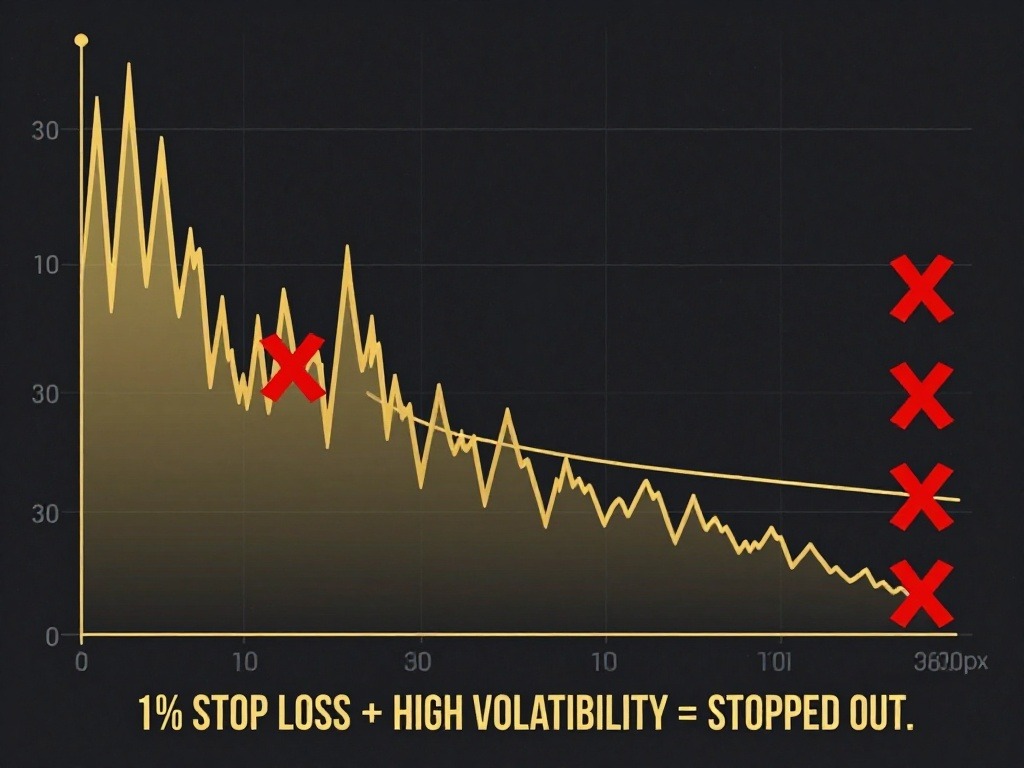
Markets have become far more sensitive to macro data, central bank announcements, and geopolitical shocks. A 1% stop loss that worked perfectly in a calm, low-volatility environment is often too tight for today’s volatile, headline-driven market. Traders get stopped out before their trade can work.
For more on [position sizing and leverage], our guide covers the formulas and calculators you need to adapt to different market conditions.
Analyst Views on Risk Management
Professional traders and researchers have long understood that a fixed 1% rule is not enough.
Van K. Tharp, a leading trading psychology researcher, famously stated: “Position sizing is the most important factor in trading success. It accounts for 90% of your performance.” You can explore his research on [Van K. Tharp’s website].
The [CME Group] warns that in volatile markets, a fixed stop loss percentage may not reflect actual market conditions. Traders should consider volatility-based adjustments.
[Investopedia] notes that the 1% rule is a guideline, not a law. Professional traders often adjust their risk based on conviction and market conditions.
The consensus is clear. A fixed 1% rule is a starting point, not a destination.
The Problem with Fixed Rules
Markets are not static. Volatility expands and contracts. Liquidity shifts. Trade quality varies. A fixed percentage applied uniformly across these conditions can create a false sense of control.
Professional traders approach the problem differently. They treat risk not as a rule, but as a system.
Beyond the fixed percentage, a more developed approach adjusts position size dynamically, reflecting current volatility, the quality of the setup, and the broader environment. The question shifts from “how much should I risk per trade?” to “how should risk adapt to this situation?”
Another common mistake is to define position size first and adjust the stop accordingly. Professional practice reverses this sequence. The stop is placed where the trade idea is invalidated. Position size is then adjusted to fit that level. This keeps risk anchored to market structure rather than personal comfort.
For a deeper look at [trading psychology], our guide covers the emotional discipline required to implement any risk system consistently.
The Old vs New Framework
| The Old 1% Rule | The New Dynamic Framework |
|---|---|
| Rigid: Fixed 1% risk per trade | Dynamic: Risk scales with setup quality and conviction (0.5% to 2%) |
| Ignores market context | Context-aware: Reduces size during major news events or low-liquidity periods |
| Focuses only on risk % of account | Focuses on risk/reward (R:R): Prioritizes a favorable ratio over a fixed % |
| Blind discipline for any trade | Selective discipline: Only takes trades that meet strict criteria, then applies risk |
The difference is clear. The 1% rule is a rule. The dynamic framework is a system.
Common Beginner Mistakes
The main reason traders lose money is not bad luck. It is a total lack of basic risk management. Many beginners risk half their portfolio on a single trade. That is not trading. That is gambling.
The majority of traders lose money because they:
- Trade without a clear plan or strategy
- Act on emotion instead of logic
- Chase fast profits instead of consistent growth
- Ignore risk management completely
Trading without rules destroys your account balance very quickly. When you lack a high-probability strategy, you make choices based strictly on deep fear or pure greed. That ends badly.
Chasing fast money is the trap almost everyone falls into. We are constantly sold the dream of overnight success. But fast money often leads to faster losses. When you chase quick wins, you ignore risk, skip the process, and take trades that were never in your favor. That is not strategy. That is gambling.
How to Build a Smarter Risk System
The solution is not to abandon the 1% rule. It is to build a system around it.
1. Size Around the Trade
Place your stop where the trade idea is invalidated. Then size your position to fit that level. Do not start with position size and adjust the stop to match.
2. Adjust for Volatility
In higher volatility, reduce position size. In more stable conditions, you can increase exposure modestly, provided the setup supports it.
3. Use Risk/Reward as Your Guide
A 1% risk on a trade with a 1:3 risk/reward ratio offers 3% upside. A 2% risk on the same trade offers 6% upside. Focus on the ratio, not just the percentage.
4. Keep a Trading Journal
Track every trade. Record your setup, your emotional state, your planned risk, and your actual outcome. Data does not lie. A journal shows you exactly where you are breaking the rules.
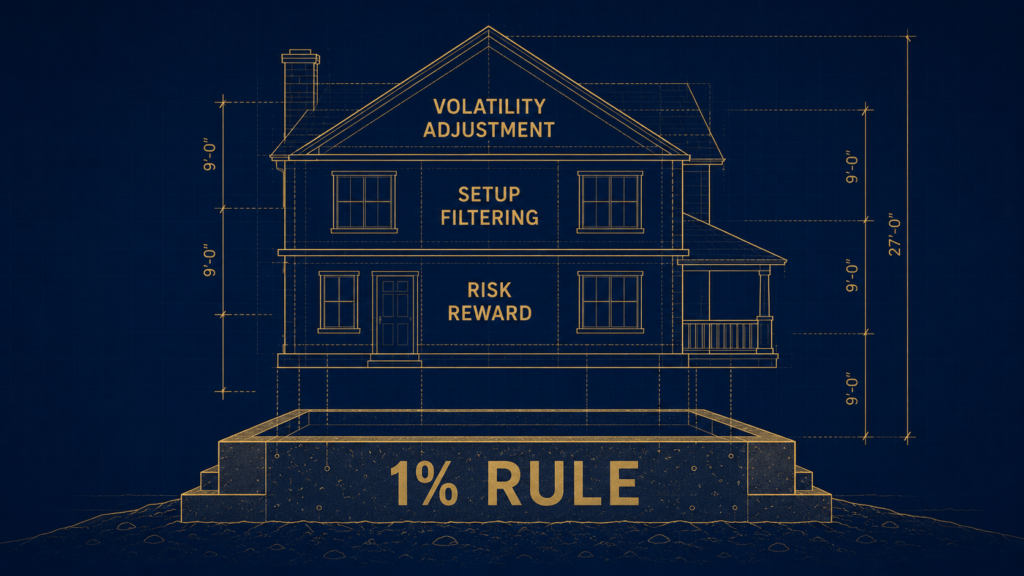
Here is what most traders miss. The 1% rule is not wrong. It is incomplete. Think of it as the foundation, not the house. A foundation alone does not protect you from the storm. You need walls, a roof, and windows. In risk management, those are volatility adjustment, setup filtering, position sizing based on stop distance, and a clear process for scaling in and out. The traders who survive long enough to become profitable do not stop at 1%. They build the rest of the house. The traders who fail treat 1% as the finish line. It is not. It is the starting point.
Final Thoughts
The 1% rule is a good starting point. It introduces discipline. It prevents overexposure. But it is not enough.
Markets reward those who manage risk intelligently, not those who follow rules blindly. The difference between failure and survival is simple: a fixed rule versus a dynamic system.
In trading, capital protection comes first. Profits are a byproduct of doing the right things repeatedly over time. Stay disciplined. Stay patient. And build a risk system that adapts to the market, not one that ignores it.
Disclaimer: This article is for educational and informational purposes only. It does not constitute financial advice, trading recommendations, or an offer to buy or sell any asset. Trading forex, commodities, indices, cryptocurrencies, and futures carries significant risk and may not be suitable for all investors. You can lose more than your initial deposit. Past performance does not guarantee future results. Always read full terms, contract specifications, and risk disclosures before trading. Do your own research. Consult a licensed financial advisor if you need professional investment advice.