


This is the post-Jackson Hole market wrap covering everything you need to know from the week of August 23-29, 2026. The Jackson Hole symposium dominated the macro landscape, with Fed Chair Kevin Warsh delivering his first keynote as chair, three regional presidents calling for tighter policy, and the Treasury’s buyback program continuing to reshape the long end of the curve. Gold held above $4,600, the dollar caught a bid inside a broader downtrend, and the FX majors coiled into the event. This Jackson Hole impact report breaks down all the key moves.
The Jackson Hole symposium ran from August 27-29, with Warsh’s speech landing on Friday at 15:00 London alongside the preliminary annual benchmark payrolls revision. The combination of a new chair’s first major address and a significant labour market data revision created one of the most volatile sessions of the quarter. This Jackson Hole impact analysis covers what moved and why.
For more on how the dollar moves gold, see our guide on how the dollar moves gold.
Key Takeaways from the Jackson Hole Impact
- Gold absorbed the most hawkish day of the month and did not break, holding above $4,600 and printing a higher low.
- The dollar caught a bid on hawkish Fed speakers but remains inside a broader downtrend, with 99.222 as the key pivot.
- EUR/USD coiled into Jackson Hole, with higher lows on the swing chart but falling highs inside the week.
- GBP/USD broke a short-term shelf but the trend backdrop remains intact, with 1.3526 as the structural invalidation.
- The Treasury’s buyback program remains the dominant driver of the dollar, with the Jackson Hole impact confirming the fiscal trade.
Jackson Hole Impact: The Macro Backdrop
The Jackson Hole symposium was the defining event of the week. Day one was hawkish, with three Federal Reserve officials warning that inflation is too high. Beth Hammack repeated her call for higher rates and said “I believe now is the time to act,” noting inflation has run above target for more than five years and that financial conditions show no sign of restriction. Jeff Schmid said policy at 3.50 to 3.75 per cent may be accommodative rather than restrictive and put a 16 September hike explicitly on the table. This Jackson Hole impact was felt across every asset class.
The Treasury simultaneously at least doubled the size of its long end buyback operations from 9 September, taking the 10 to 20 and 20 to 30 year nominal sectors from a 2 billion dollar maximum to at least 4 billion per operation. Scott Bessent said operations could run larger still and that the signal is deliberate because yields do not reflect the underlying fundamentals. The July federal deficit was 432.3 billion, the largest month since March 2021, with the fiscal year to date near 1.8 trillion. The 30 year printed 5.33 per cent on 18 August, the highest since 2007. This Jackson Hole impact was amplified by the Treasury’s actions.
The dollar index rose 0.21 per cent on the session to its highest level since 19 August, which is the day it broke down. The curve came with it: 2 year 4.232, 10 year 4.686, 30 year 5.204, the long end higher again than earlier in the week. So unlike Tuesday, this pullback now has a reason behind it, and that is worth respecting rather than dismissing. The Jackson Hole impact on yields was immediate and significant.
For more on how geopolitical risk moves oil, see our guide on how geopolitical risk moves oil.
Jackson Hole Impact: Gold
Gold is 4,602.57, 4,602.78 and 4,603.03 across three independent sources, a spread of 46 cents and comfortably the tightest recorded, holding a 4,571.82 to 4,614.59 range so far today against a settled 4,594.68 Thursday close. The higher low read is the best supported call on the board this morning, and it has independent corroboration that was arrived at separately: a third party technical desk published its overnight note at 01:07 UTC under the title “Gold Price Searches for a Higher Low.” This Jackson Hole impact on gold was constructive.
Here is the shape. Session highs run 4,697.66 on Tuesday, 4,674.20 on Wednesday, 4,643.35 on Thursday and 4,614.59 today, four consecutive lower highs stepping down roughly 25 to 30 dollars each. Session lows run 4,605.17, 4,582.82, 4,566.17 and today 4,571.82. So the ceiling has fallen 84 dollars in four sessions while the floor has just turned up for the first time, 5.65 dollars above Thursday’s low. That is a compression, and it is being wound into a 15:00 event with no question and answer session. Compressions into a binary do not usually resolve gently. The Jackson Hole impact on gold’s structure was a compression.
What changed. Gold took the most hawkish day of the month and did not break. Thursday’s low of 4,566.17 was the lowest print since 21 August and it came on a session in which Hammack said now is the time to act and Schmid put a 16 September hike on the table, while the dollar index reached an eight day high. Gold closed 4,594.68, one dollar above Wednesday’s close, and is roughly eight dollars higher again now, having been seventeen higher at 09:15. A market that absorbs that supply and closes green is not a market that is finished. The Jackson Hole impact confirmed gold’s resilience.

Main driver. The same one that has driven this since 19 August. The dollar is being priced off the Treasury rather than the Federal Reserve, so gold is trading fiscal arithmetic rather than the funds rate. Treasury at least doubles its long end buybacks from 9 September while auction sizes stay unchanged, possibly funded from a Treasury General Account that closed at 935 billion on 20 August, against a July federal deficit of 432.3 billion and a 30 year yield at 5.204 that printed 5.33 on 18 August, the highest since 2007.
Underneath all of it is official demand that does not trade the news: central banks bought a record 289 tonnes in the second quarter and the People’s Bank of China added roughly 20 tonnes in July to 2,366 tonnes, a twenty first consecutive month and the longest run on record. This Jackson Hole impact on gold’s fundamentals remains supportive.
What would invalidate the view. Below, a daily close beneath 4,566.17 removes this morning’s higher low and puts the 4,508 to 4,526 confluence directly in play, and a close beneath 4,490 removes the swing low of the entire leg and ends the higher low sequence, at which point the continuation read is finished rather than paused.
Above, the market has to close through 4,700 to end the argument that the round number is capping it, and that number has now stopped this market twice in four sessions without price ever actually reaching the retracements published above it. Gold is up roughly 13.2 per cent on the month and 33.4 per cent year on year on one vendor’s read, and remains roughly 17 to 18 per cent beneath the January record. The Jackson Hole impact has not broken this structure.
Jackson Hole Impact: Dollar Index
The dollar index is 99.18 and 99.182 across two sources, effectively the same print, holding a 99.10 to 99.24 range so far today against a settled 99.16 Thursday close. The structural read is that the dollar has caught a bid inside a broader downtrend, that it is pulling back into the liquidity it broke, and that a retest into that supply produces a lower high and resumes the move down. That map is right and it is the map we have been running since 19 August. The Jackson Hole impact on the dollar was a temporary bid.
Two things in the brief need correcting before anyone trades off it. First, the retest is not happening at 99.50. Our own published liquidity band runs 99.40 to 100.21 and price has not been within twenty ticks of its lower edge all week. The level actually being retested is 99.222, the 61.8 per cent retracement of the move from the 97.628 war era low to the 101.801 high of 24 June, and the 200 day average on the day the index broke below it.
Second, the lower high has not formed. Thursday went the other way: the settled series has 99.12 open, 99.26 high, 99.07 low, 99.16 close, and 99.26 is above Wednesday’s 99.23. Session highs run 99.06, 99.12, 99.23, 99.26.
What is live right now is that today’s high of 99.24 sits just two ticks beneath Thursday’s 99.26, and it got there by tagging the 99.222 pivot for a third time. The margin was five ticks at 09:15 and it is two now. If it still holds into the close, today is the lower high, and it needs a close beneath 99.07 to mean anything at all. The Jackson Hole impact on the dollar’s structure is still unresolved.
What we are watching. 99.222, for a fourth consecutive session, and now the shape of the rejection rather than the level itself. Two tags, two closes back underneath, and the highs still rising each day. Immediately above it an independent 200 period average sits at 99.308, so 99.22 to 99.31 is a nine tick band that has to be cleared on a close before the 99.40 to 100.21 zone is even live.
The daily 200 average has itself declined to roughly 99.12 to 99.15, so price is sitting on it this morning. Beneath, 99.07 is Thursday’s low and it is the first thing that has to break for the lower high read to start paying. The Jackson Hole impact will decide this.
Key levels. Resistance starts at 99.24 which is today’s high and the third tag of the pivot, then the 99.22 to 99.31 pivot band where the 61.8 per cent retracement at 99.222 sits with an independent 200 period average at 99.308, tagged at 99.23 on Wednesday and 99.26 on Thursday, then 99.41 which is a published vendor level, then 99.48 where a four hour 100 period average sits, then the heavy zone from 99.69 to 99.7145 where a vendor level, our 50 per cent retracement and a third party 100 day average land inside four ticks, then 100.03 to 100.207 where the round number and the 38.2 per cent sit together.
Support starts at 99.10 which is this morning’s low, then 99.07 which is Thursday’s low, then 99.04 and 98.96 which are the 50 and 100 day averages, then 98.90 which is Wednesday’s low, then 98.86 which is Tuesday’s low, then 98.521 which is the 78.6 per cent retracement and where the three month low printed 98.55 to 98.57 on 20, 21 and 22 August, three separate holds inside four ticks. Beneath that there is very little until 97.628.
What would invalidate the view. A daily close above 99.31 reclaims the retracement and the independent average together, turns the 19 August break into a stop run, and makes this a base rather than a pullback, with 99.7145 the next objective. That is the cleanest single invalidation on the board and it is fourteen ticks away, so it can resolve today.
In the other direction the lower high needs two things in order: today’s high to hold beneath 99.26, which is now a two tick margin rather than five, and a close beneath 99.07. Full confirmation of the structure needs a close beneath 98.90. A close beneath 98.521 reopens 97.628 with almost nothing in between. The Jackson Hole impact will determine which path emerges.
According to CME FedWatch, September pricing runs 30 to 38 per cent for a hike and 62 to 70 per cent for a hold across vendors, against a 30 to 65 per cent spread for the same meeting on a single morning last week.
Jackson Hole Impact: EUR/USD
EUR/USD is 1.1645 and 1.16457 across two independent sources, effectively the same print, holding a 1.1639 to 1.1656 range so far today against a settled 1.1654 Thursday close. The read is higher lows on the higher time frame for continuation upward, and the honest answer has two halves that pull in opposite directions. On the swing chart the read is right and the number is 1.1576 on 18 August against 1.1637 on 27 August, a higher low with sixty one pips of room.
Inside this week it is not: the lows have stepped down three sessions running at 1.1651, 1.1642 and 1.1637, each one a deeper probe into the 1.1631 to 1.1649 band published for nine sessions, and each one closed back above the top of it at 1.1675, 1.1651 and 1.1654. So the floor is doing its job and the rallies are not. Highs run 1.1680, 1.1678, 1.1660 and this morning 1.1656. Falling highs on a held floor is a coil, and this one is being wound directly into a 15:00 event. The Jackson Hole impact has coiled EUR/USD.
What changed. The euro gave back nothing of consequence, and on this particular Thursday that is the information. The pair opened 1.1651, ran to 1.1660, was pushed to 1.1637 and closed 1.1654, a three pip net gain on a session in which three Federal Reserve officials called for tighter policy and the dollar index reached an eight day high. A pair that will not break on that news is telling you something about how it is positioned. The Jackson Hole impact showed the euro’s resilience.
What has not changed is the reason to own it: money markets price roughly 40 basis points of further European Central Bank tightening by year end with a September hike largely anticipated, and Isabel Schnabel has said rates might rise further if Middle East tensions persist. The euro therefore carries one confirmed hike and a conditional second, and the condition is geopolitical.
Main driver. The driver is American and has been for ten sessions, which is why an empty European calendar has not mattered. The 19 August session remains the template: hawkish FOMC minutes were published, the dollar fell 0.86 per cent to a three month low, and this pair broke an eight week range on a Treasury announcement rather than a European one.
What would invalidate the view. A daily close beneath 1.1631 takes out the 200 day average and the bottom of the published band together and turns this from a consolidating trend into a completed bounce. It is deliberately a close and not a wick, because three sessions in a row have now tagged inside the band intraday and settled nothing at all. Beneath that, a close through 1.1576 removes the 18 August low and ends the higher low sequence outright.
On the upside, a daily close above 1.1712 clears the double top and puts the 1.1750 to 1.1800 ceiling in play, and that is the only thing that turns this from a range back into a trend leg. The Jackson Hole impact will likely determine this.
Jackson Hole Impact: GBP/USD
GBP/USD is 1.3590 on both sources, holding a 1.3580 to 1.3599 range so far today against a settled 1.3598 Thursday close. This is the page where the brief needs the most work, and the split is the same as the euro but wider. On the swing chart the higher low read is intact and comfortable: 1.3526 on 18 August has not been touched and the 200 day average at 1.3431 is 158 pips away and irrelevant this week. The Jackson Hole impact on cable has been a key driver of this week’s price action.
Inside this week the tape has done the opposite. Session highs run 1.3660, 1.3658, 1.3657, 1.3604 and this morning 1.3599, a clean sequence of lower highs. Session lows run 1.3615, 1.3619, 1.3583, 1.3569 and today 1.3580, which is lower lows until today. Thursday’s 1.3569 was the lowest print since 20 August. So the first higher low of the week is hours old, it is unconfirmed, and it is forming beneath a shelf the pair broke on Wednesday. 1.3618 was support, it is resistance now, and it has not been reclaimed on a close in two sessions. The Jackson Hole impact on cable was a breakdown that traders are still assessing.
What changed. Thursday was a recovery that earned nothing. Cable was pushed to 1.3569 in the London session and closed 1.3598, a four pip net gain, having failed at 1.3604 on the way back. That is a pair which stopped falling without starting to rise. None of it was domestic: the United Kingdom calendar is empty until the Monetary Policy Committee meets on 17 September, so every pip this week has been American, and Thursday’s specifically was three Federal Reserve speakers talking about hikes while the dollar index reached an eight day high. The Jackson Hole impact was felt most acutely in cable’s inability to rally on its own merits.
Main driver. The Bank of England is not driving this and it is worth being explicit, because the temptation with a pair that was at a six month high last week is to invent a domestic story. Bank Rate is 3.75 per cent after a 6 to 3 hold on 30 July in which the three dissenters wanted a hike, and the Committee does not meet again until 17 September.
Markets still price at least 25 basis points of tightening by year end after July inflation accelerated to 2.9 per cent from 2.6. But that rise was a 14.7 per cent gas move following the Ofgem cap increase rather than wages, and services inflation actually eased to 3.4 per cent. The Jackson Hole impact on cable was amplified by the lack of domestic catalysts.
What we are watching. 1.3618, from the wrong side, for a third session, and the 50 period average at roughly 1.3599 which price has been pinned to within a pip or two for three days and which is exactly this morning’s high. Those two numbers frame the whole repair job: reclaim 1.3599 on a close and the pair is back at the shelf, reclaim 1.3618 on a close and the break is repaired.
Beneath, the sequence that keeps the structure alive runs 1.3569 which is Thursday’s low and the base of this morning’s higher low, then 1.3549 where a 100 period average sits, then 1.3526 which is the 18 August low. The honest reassurance on this page is that the trend backdrop is completely intact and what has broken is a short term shelf, not the structure. The Jackson Hole impact on cable was structural but not terminal.
Key levels. Resistance begins at 1.3599 which is today’s high and where a 50 period average sits, then 1.3600 as the round number, then 1.3604 which is Thursday’s high, then 1.3618 which was support until Wednesday and is the first thing that has to be reclaimed on a close, then 1.3632 to 1.3636 which was last week’s trading shelf, then 1.3655 to 1.3665 which is our band published on 21 August and which capped the session on three consecutive days, then 1.3677 which is Friday’s wick, then 1.3707 and 1.3735.
Support starts at 1.3580 which is today’s low, then 1.3572 which is an independent vendor’s support and was cut through on Thursday, then 1.3569 which is Thursday’s low and the lowest print since 20 August, then 1.3549 where a 100 period average sits, then 1.3526 which is the 18 August low and the structural invalidation, then 1.3431 which is the 200 day average.
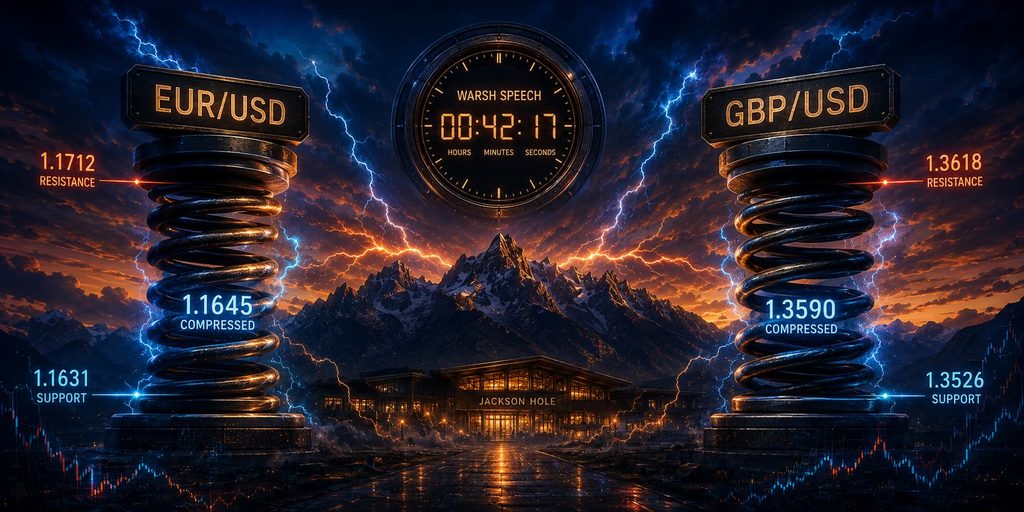
What would invalidate the view. Two levels, in this order. A daily close back above 1.3618 repairs the break, puts the pair back inside the shelf it fell out of and makes Wednesday a shakeout rather than a turn. Until that happens the burden of proof sits with the bulls for the first time in two weeks.
A daily close beneath 1.3526 removes the 18 August low and ends the higher low sequence outright. Between those two the pair settles nothing. On the upside the original test still stands and has not been met once in seven attempts: a daily close through 1.3665, not a wick, which opens 1.3677 and then 1.3700. The Jackson Hole impact will decide which way cable breaks.
Key Levels Summary
| Instrument | Support | Resistance | Current |
|---|---|---|---|
| DXY | 99.07, 98.90, 98.86, 98.521 | 99.24, 99.31, 99.41, 99.71 | 99.18 |
| Gold | 4,571, 4,566, 4,525, 4,508 | 4,614, 4,643, 4,674, 4,700 | 4,602 |
| EUR/USD | 1.1639, 1.1637, 1.1631, 1.1576 | 1.1656, 1.1660, 1.1678, 1.1712 | 1.1645 |
| GBP/USD | 1.3580, 1.3569, 1.3549, 1.3526 | 1.3599, 1.3604, 1.3618, 1.3665 | 1.3590 |
Week Ahead Preview
The Jackson Hole impact will continue to be digested into next week. Key events to watch:
- Monday: German flash inflation
- Tuesday: Euro area flash inflation
- Thursday: ECB meeting
- 15-16 September: FOMC with updated projections
- 17 September: Bank of England meeting
The September Fed pricing runs 30 to 38 per cent for a hike across vendors, against a 30 to 65 per cent spread for the same meeting last week. This remains the key variable for all assets. The Jackson Hole impact has set the stage for the September FOMC.
Disclaimer
This article is for educational and informational purposes only. It does not constitute financial advice, trading recommendations, or an offer to buy or sell any asset. Trading forex, commodities, indices, cryptocurrencies, and futures carries significant risk and may not be suitable for all investors. You can lose more than your initial deposit. Past performance does not guarantee future results. Always read full terms, contract specifications, and risk disclosures before trading. Do your own research. Consult a licensed financial advisor if you need professional investment advice.