


The Loss That Changes Everything
You just took a loss. Maybe it was a stop hunt, maybe you made a mistake, maybe the market was just being random. The reason doesn’t really matter. What matters is the feeling that follows.
A voice in your head says: “Just one more trade to get back to even.” Your finger is already on the buy button before you’ve even looked at a setup.
This is revenge trading, and it might be the most destructive psychological pattern in trading. It’s not just bad on its own: it cascades. Revenge trades cause more losses, which cause more revenge trades, which eventually crater your account.
The data backs this up: research consistently shows that emotional trading after losses leads to progressively worse outcomes. Kahneman and Tversky’s prospect theory (1979) explains why: losses are felt about twice as intensely as gains, creating an almost irresistible urge to “fix” the pain immediately.
For more on [trading psychology and discipline], our guide covers the mental discipline required for consistent trading.
What Is Revenge Trading?
Revenge trading is when you enter trades mainly because you want to recover recent losses quickly. It looks like this:
- Trading right after a loss with bigger size or higher frequency
- Ditching your strategy to “make back” what you just lost
- Getting emotionally attached to breaking even for the day
- Taking weaker setups because you “need” a win
- Switching to higher-risk instruments (options, leveraged products) to accelerate “recovery”
The name says it all: you’re trying to get “revenge” on the market for taking your money. But the market doesn’t know you exist. It’s just doing its thing.
Revenge trading is a natural and emotional response when a trader suffers a significant loss. Before taking time to think about their next move or looking at their strategy, they enter another trade after their big loss. The idea is to recover from the loss immediately. The thinking behind it is by putting on another trade (which is expected to be a winning trade), the losses can be recovered quickly.
But as you already know, markets are not easy to predict. The expected winning trade would most likely turn into a losing trade — only bigger than the one the trader is trying to recoup.
According to Brett Steenbarger, a well-known trader and trading coach: “Revenge trading is caused by wrath as you are angry that you lost and have the lust to make it all back quickly.”
According to Investopedia – Revenge Trading , revenge trading is when you try to force a trade in order to recover from a previous loss.
Why Revenge Trading Is So Common
Nearly every trader has revenge traded at some point. It’s common because the emotional logic behind it is compelling even though the financial logic is terrible.
When you take a loss, your brain registers it as a threat. The fight-or-flight response kicks in, and “fight” in trading means taking another trade immediately to neutralize the threat. This is a survival instinct operating in an environment where survival instincts produce the worst possible outcomes.
The break-even fixation makes it worse. Traders mentally anchor to their starting account balance for the day, and being below it creates a sense of open-loop anxiety that won’t resolve until they “fix” it. This is why many of the worst revenge trading spirals happen after relatively small initial losses. The loss itself isn’t the problem. The anxiety about being in the red is.
A lot of emotions – anger, fear, shame, and greed – are behind this irrational activity which must have affected every trader at one time or another in their trading journey. Mind you, revenge trading is not limited to new traders. Even some professional traders and those with years of experience can succumb to this practice. And that’s what makes it more irrational.
Trading coaches who have worked with different levels of traders attest to the destructive impact of revenge trading.
The Psychology Behind Revenge Trading
1. Loss Aversion Amplification
We feel losses roughly 2x as intensely as equivalent gains. A $500 loss doesn’t just sting. It creates an almost physical urge to make that pain go away, which often overrides logical thinking.
Kahneman and Tversky’s prospect theory (1979) showed that this asymmetry is hardwired into human decision-making. In trading, this means a loss doesn’t just reduce your capital. It changes your emotional state in a way that makes your next decision worse.
2. Sunk Cost Fallacy
The lost money feels like it’s still “recoverable” if you just take one more trade. Financially, this makes no sense (the money is gone either way), but emotionally it’s very convincing.
3. Break-Even Anchoring
Your starting account balance becomes a mental anchor. Being below it feels like failure, which creates pressure to fix it right now instead of sticking to your process. Shefrin and Statman (1985) documented this behavior extensively in their research on the disposition effect: traders treat unrealized losses as temporary problems to solve rather than realized costs to accept.
4. Frustration and Ego
Losing trades can feel personal. Revenge trading is often an attempt to prove to yourself that you’re not a bad trader, that the last trade was just a fluke. With anger (at the markets) and greed as the dominant emotion driving your decision after a big loss, a trader may automatically enter a trade without hesitation.
5. Fear and Shame
For some traders, the fear of realising and accepting a loss (particularly a big one) is so real that they would rather put on a revenge trade right away. The urge to recover from a loss can also be driven by the fear of facing friends, relatives, or colleagues who will know of the loss. For many traders, saving face is a strong driver particularly if they have a reputation as being a good trader who wins most of their trades.
6. Time Pressure
If you trade on a daily timeframe, there’s a ticking clock. The market closes in a few hours, and your brain tells you that you need to fix the P&L before then. This creates artificial urgency that makes impulsive decisions feel necessary. Weekly and monthly traders are somewhat insulated from this, but the same dynamic plays out on longer timescales too.
Why Revenge Trading Is So Dangerous
Revenge trading damages both your trading capital and your decision making.
When emotions take over, the brain shifts from analytical thinking to reactive thinking. Studies from Harvard Business Review have shown that emotional stress reduces rational decision making and increases impulsive behaviour.
In trading, that creates a dangerous combination.
You Abandon Your Edge
Every profitable trader relies on a repeatable edge. Revenge trading destroys consistency because you stop following the rules that made your strategy profitable in the first place.
Losses Become Larger
Many revenge traders increase position sizes after losses. In most cases, traders who resort to revenge trading tend to double or triple their trading position thinking the next trade will be a winner. This creates an uneven risk profile where a few emotional trades erase many disciplined trades.
Trading Psychology Deteriorates
Once traders lose confidence, they often hesitate on valid setups or continue forcing trades. Emotional instability creates inconsistent execution.
You Create a Negative Feedback Loop
Losses trigger emotional trading. Emotional trading creates more losses. More losses increase frustration. Without intervention, the cycle continues.
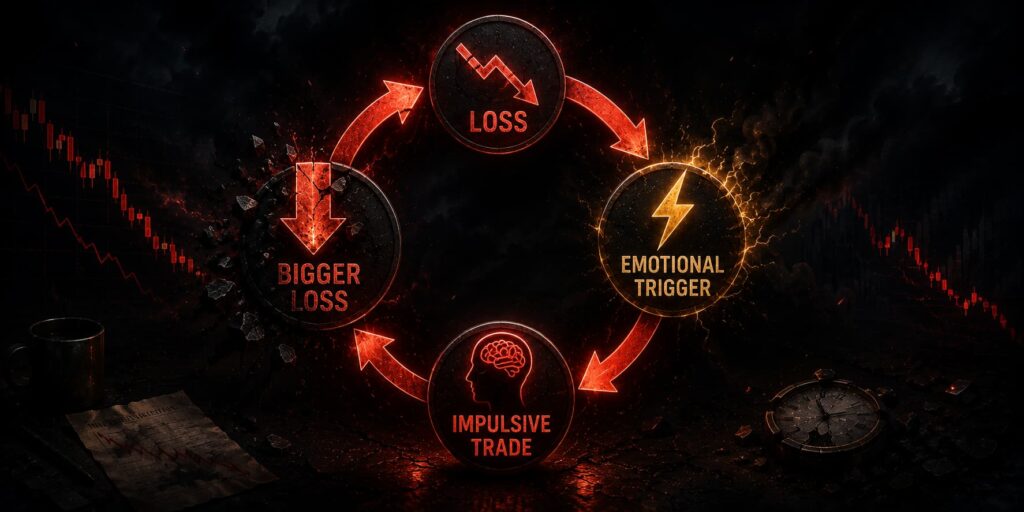
Revenge trading has been identified as one of the major causes of traders’ failure. Brett Steenbarger described revenge trading as a “dangerous and irrational way to use your trading capital.” While many traders may not admit to it, the fact is most traders have succumbed to revenge trading at some stage in their trading journey as it is one of the most common trading mistakes.
For more on [risk management strategies], our guide covers how to protect your capital from emotional decisions.
Common Causes of Revenge Trading
Understanding why revenge trading happens is the first step toward preventing it.
Lack of a Trading Plan
Traders without defined rules are more likely to make emotional decisions. A proper trading plan should define:
- Entry conditions
- Exit conditions
- Risk per trade
- Maximum daily loss
- Trading sessions
- Position sizing
- Market conditions to avoid
Without structure, emotions fill the gap.
Risking Too Much per Trade
Large losses create emotional pressure. If a trader risks 10% of their account on one position, every losing trade feels catastrophic. Professional traders usually focus on capital preservation first. Many experienced traders risk between 0.5% and 2% per trade to reduce emotional volatility.
Unrealistic Expectations
Many beginners believe trading should produce fast income every day. When markets do not cooperate, frustration builds quickly. Trading is probabilistic. Even profitable strategies experience losing streaks.
Lack of Experience
New traders often confuse random outcomes with personal failure. A losing trade does not necessarily mean the trade was bad. Even strong setups can fail. Experienced traders understand that losses are part of the business.
Fatigue and Stress
Mental exhaustion reduces discipline. Trading for long hours, watching multiple markets, or dealing with external stress can increase emotional reactions.
Signs You Are Revenge Trading
Many traders do not realise they are revenge trading until significant damage has already occurred.
Common warning signs include:
- Entering trades immediately after a loss
- Increasing lot sizes emotionally
- Ignoring your trading checklist
- Trading markets you do not normally trade
- Moving stop losses further away
- Refusing to accept losses
- Feeling angry at the market
- Trading continuously without breaks
- Breaking your maximum daily loss rule
The earlier you recognise these behaviours, the easier it becomes to stop the cycle.
7 Rules to Break the Revenge Trading Cycle
Stopping revenge trading requires structure, discipline, and emotional awareness. The goal is not to eliminate emotions entirely. The goal is to stop emotions from controlling your execution.
Rule 1: Use Automatic Cool-Down Rules
After any loss, wait at least 15-30 minutes before your next trade. Make this non-negotiable, no exceptions. The revenge impulse fades significantly after even a short break.
The science behind this is straightforward: cortisol (the stress hormone) spikes after a loss and takes roughly 20-30 minutes to return to baseline. Trading while cortisol is elevated impairs your prefrontal cortex, the part of your brain responsible for risk assessment and impulse control.
Rule 2: Set Daily Loss Limits
Before the market opens, decide your maximum daily loss. When you hit it, you’re done for the day. Period. This stops a single loss from turning into a disaster. Common thresholds range from 1-3% of account value, but the specific number matters less than the discipline of actually stopping.
One of the most effective ways to prevent revenge trading is to define a hard daily loss limit. For example:
- Stop trading after losing 3% in one day
- Stop trading after 3 consecutive losses
- Reduce size after a losing streak
Once the limit is reached, step away from the platform. Professional prop firms often use daily drawdown limits because they understand emotional trading increases dramatically after losses.
Rule 3: Reduce Your Position Size
Large position sizes amplify emotions. If every trade feels stressful, your risk is probably too high. Reducing position size helps traders think more objectively and execute consistently. Smaller positions also make it easier to follow your stop loss.
Rule 4: Use Stop Losses Correctly
Many revenge traders remove stop losses because they hope losing trades will recover. This behaviour often turns small losses into catastrophic losses. Using properly placed stop losses protects trading capital and removes emotional decision making during volatile moves.
Rule 5: Take a Break After a Loss
One of the simplest ways to stop revenge trading is to pause. After a significant loss:
- Leave the trading desk
- Go for a walk
- Avoid chart watching
- Review your trade later
- Wait until emotions settle
Even a 15 minute break can reduce impulsive behaviour. Some traders use mandatory cooling off periods after consecutive losses. Taking a day or two off from trading, stop trading, or if you really must, place a small trade if you feel you need to be in the markets. You could also consider revising your trading plan.
Rule 6: Focus on Process Instead of Money
Revenge trading usually happens when traders become obsessed with recovering money. Profitable traders focus on execution quality instead. Good trading habits include:
- Following setups correctly
- Respecting risk management
- Recording trades in a journal
- Maintaining consistency
- Thinking in probabilities
The market does not reward emotional urgency. It rewards disciplined execution over time.
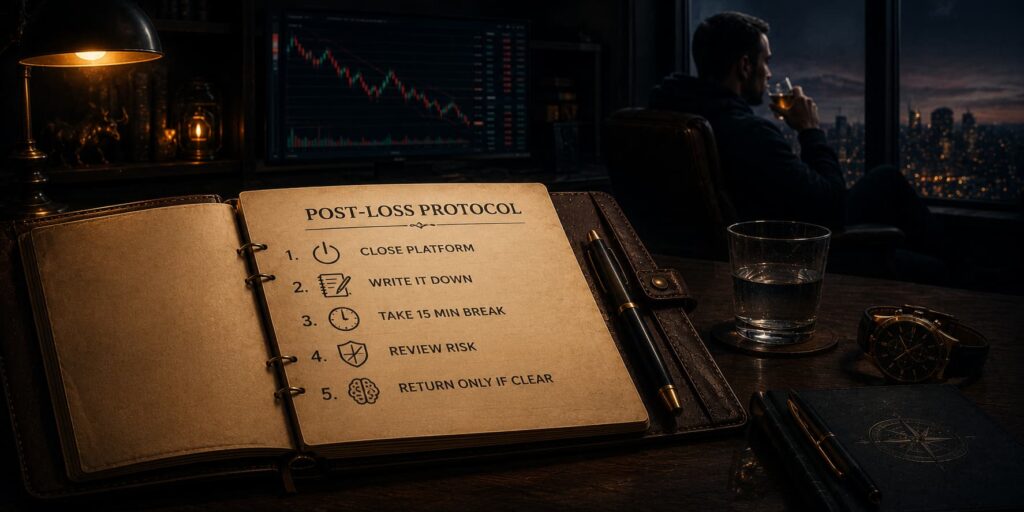
Rule 7: Create a Post-Loss Protocol
Create a written protocol for what you do after a loss. Something like:
- Close the trading platform
- Write down what happened and whether you followed your rules
- Take a 15-minute break
- Review whether the loss was within your risk parameters
- Only return to trading if the loss was a clean, planned loss and your emotional state has reset
Having a predefined process removes the decision-making at exactly the moment when your decision-making is worst.
In his book ‘High Performance Trading’, author and trader Steve Ward suggested traders develop a post-loss ritual. He shared this four-step strategy based on Jeffrey Hodges’ book ‘Sportsmind’:
- Acknowledge that the losing trade was not what you wanted/expected
- Note the feedback and what you learned, then ‘throw’ the trade away
- Imprint or mentally rehearse what you wish had happened
- Affirm to yourself – that’s how I will do it next time
Brett Steenbarger and Steve Ward are two of the most highly respected trading coaches in the world and their books provide useful information on different trading psychology challenges and issues.
How to Stay Disciplined When Trading
In order to steer away from a revenge trade you need to stay disciplined. Trading without discipline can lead to bad results and distracting emotions.
Stick to your trading plan: Your plan is your roadmap. Deviating from it almost always leads to poor outcomes.
Understand that losses are a part of trading: Accept the loss and move on. Even the best traders in the world have losing streaks.
Know when it’s the right time to stop: After 3 bad trades, take a step back and a small break. The market will still be there tomorrow.
Learn from your mistakes: Every loss is a lesson. Review what went wrong and adjust your approach.
Maintain your trading routine: Consistency in your daily routine leads to consistency in your trading.
Keep a trading journal: A trading journal helps traders identify emotional patterns. Record:
- Why you entered the trade
- Your emotional state
- Risk size
- Trade outcome
- Mistakes made
- Market conditions
Over time, revenge trading patterns become easier to spot. Many traders discover they revenge trade during specific market sessions or after specific types of losses.
Make a self-assessment: Once you have made that temporary break from the markets, it is time to have an objective and emotion-free self-assessment to find out what led to the loss and the revenge trade. Steenbarger said it is critical for a trader to be self-aware when faced with revenge trading and other challenging trading situations.
Conclusion: Replace Emotion with Structure
Revenge trading stops when you replace emotional decisions with a structured trading process. The fastest way to break the cycle is to pause after losses, reduce position size, follow pre-defined risk limits, and only take trades that match your trading plan.
Most traders lose more money during emotional recovery attempts than during the original losing trade.
Revenge trading is one of the most common reasons retail traders blow up their accounts. It usually happens after a painful loss when a trader tries to win the money back immediately. Instead of following a strategy, they start increasing risk, forcing entries, ignoring stop losses, and trading emotionally.
The bottom line:
Revenge trading isn’t an emotion problem. It’s a rules problem.
Your emotions will always be there. You can’t eliminate fear, greed, or frustration. But you can build a structure that prevents those emotions from controlling your execution.
The rules are simple:
- Cool down after losses
- Set daily loss limits
- Reduce position size
- Use stop losses
- Take breaks
- Focus on process, not money
- Follow a post-loss protocol
If you follow these rules, revenge trading becomes virtually impossible. Your emotions can scream all they want, but your rules keep you safe.
That’s how professional traders survive. Not by controlling their emotions, but by controlling their actions.
Disclaimer
This article is for educational and informational purposes only. It does not constitute financial advice, trading recommendations, or an offer to buy or sell any asset. Trading forex, commodities, indices, cryptocurrencies, and futures carries significant risk and may not be suitable for all investors. You can lose more than your initial deposit. Past performance does not guarantee future results. Always read full terms, contract specifications, and risk disclosures before trading. Do your own research. Consult a licensed financial advisor if you need professional investment advice.