


Price doesn’t move in a straight line. It oscillates within swings, creating areas where buying or selling becomes more favourable. Understanding discount and premium zones is how professionals identify where the market offers opportunity and where it carries unnecessary risk. It is a simple framework, but it shifts your mindset from chasing movement to positioning with intention.
Every significant swing in price has two halves. The upper half of a swing is the premium zone; the lower half is the discount zone. Premium is where smart money distributes or looks for short exposure. Discount is where accumulation and long positioning become attractive. These discount and premium zones reflect nothing more than logic: buy lower than average, sell higher than average.
To identify these areas, start by marking a clear swing high and swing low. The midpoint between them creates an equilibrium. Above that midpoint, the market trades at premium; below it, at discount. This doesn’t guarantee reversal points, but it provides structure for understanding where traders with size can enter with reduced risk.
In an uptrend, the goal is to position within discount zones. Buying in premium exposes you to deeper retracements, failed impulses, and weaker continuation. Discount buying aligns you with the dominant direction while keeping your risk defined. In downtrends, the logic reverses: premium becomes the ideal zone to sell into, not chase.
What elevates this concept is combining it with liquidity and structure. A discount zone with a strong higher low carries far more weight than discount alone. A premium zone paired with equal highs or a liquidity sweep becomes a cleaner short. These layers create clarity on where the market is likely to react, rather than relying on individual candles.
Discount and premium zones also prevent emotional trading. When price is in premium during an uptrend, the temptation to chase a breakout is high. The framework reminds you that continuation is less probable and patience often pays. When price enters discount, the market offers a logical window to build positions without relying on prediction.
For a deeper look at [support and resistance levels], this guide covers how discount and premium zones fit into the broader structure.
The Equilibrium and the Two Halves
The concept begins with a dealing range — a defined stretch of price between a significant swing low and a significant swing high. The midpoint of that range, the 50% level, is called the equilibrium. It represents fair value: the price at which the market is neither cheap nor expensive relative to the range it is trading in. Everything above equilibrium is the premium zone, where price is expensive; everything below it is the discount zone, where price is cheap.
The rule that follows is disciplined and clear. In the premium zone, you look to sell — price is expensive, so it is a favourable place to enter short. In the discount zone, you look to buy — price is cheap, so it is a favourable place to enter long. You avoid buying in premium or selling in discount, because those are the unfavourable locations where the crowd typically enters and where risk-to-reward is poor. It is the buy-low-sell-high principle made geometric and enforceable.
A proper understanding of discount and premium zones helps traders avoid the most common mistake: buying high and selling low.
How to Find the Zones
Marking premium and discount is straightforward. Identify a clear dealing range — a move from a meaningful swing low to a meaningful swing high (or vice versa) — and find its 50% midpoint. Most traders use a Fibonacci retracement tool for this, anchoring it across the range so that the 50% level is drawn automatically along with the other ratios. Once equilibrium is marked, the upper half is premium and the lower half is discount, and you have an instant read on whether current price is in a favourable location to buy, to sell, or to wait.
The judgement, as always, is in choosing the right range. The dealing range should be defined by significant, structurally important swings rather than arbitrary minor wiggles, and on the timeframe relevant to your trading. A position trader uses a large higher-timeframe range; a day trader uses a smaller intraday one. Defining the range sensibly is the one subjective step, and anchoring it to clearly significant higher-timeframe swing points keeps it honest.
Discount and premium zones are a location filter, not a signal. They tell you where to look, not when to enter.
Premium, Discount and Optimal Trade Entry
Discount and premium zones become more powerful when combined with the idea of an optimal trade entry (OTE). Rather than treating the entire discount half as equally good for buying, ICT-derived methods focus on a deeper sweet spot — roughly the 62% to 79% retracement zone of the move — as the optimal place to enter. This deep-discount (or deep-premium, for shorts) area offers the most favourable location of all: the tightest stop and the best potential reward relative to risk, because you are entering near the extreme of the retracement rather than just past the midpoint.
This is where the Fibonacci toolkit and SMC overlap most cleanly. The same retracement levels that define the optimal trade entry are the ones explored in Fibonacci ratios, and the 62%–79% zone corresponds to the deep retracements that other frameworks also prize. Whatever the vocabulary, the underlying point is identical: the best entries come from waiting for price to pull back to a favourable, discounted location rather than chasing it at the extremes.
The key insight of discount and premium zones is that they answer where, not whether. It does not tell you to take a trade — it tells you that if you are going to buy, do it in discount, and if you are going to sell, do it in premium.
Combining Location with Other Tools
Discount and premium zones are rarely used alone; their job is to filter and improve the other trading tools. An order block in the discount half of an uptrend’s range is a far higher-quality long setup than the same order block sitting in premium. A bullish fair value gap that price returns to in discount is more attractive than one in premium. The location zone acts as a confluence factor that strengthens or weakens every other signal: a setup in the right zone is worth taking; the same setup in the wrong zone is best left alone.
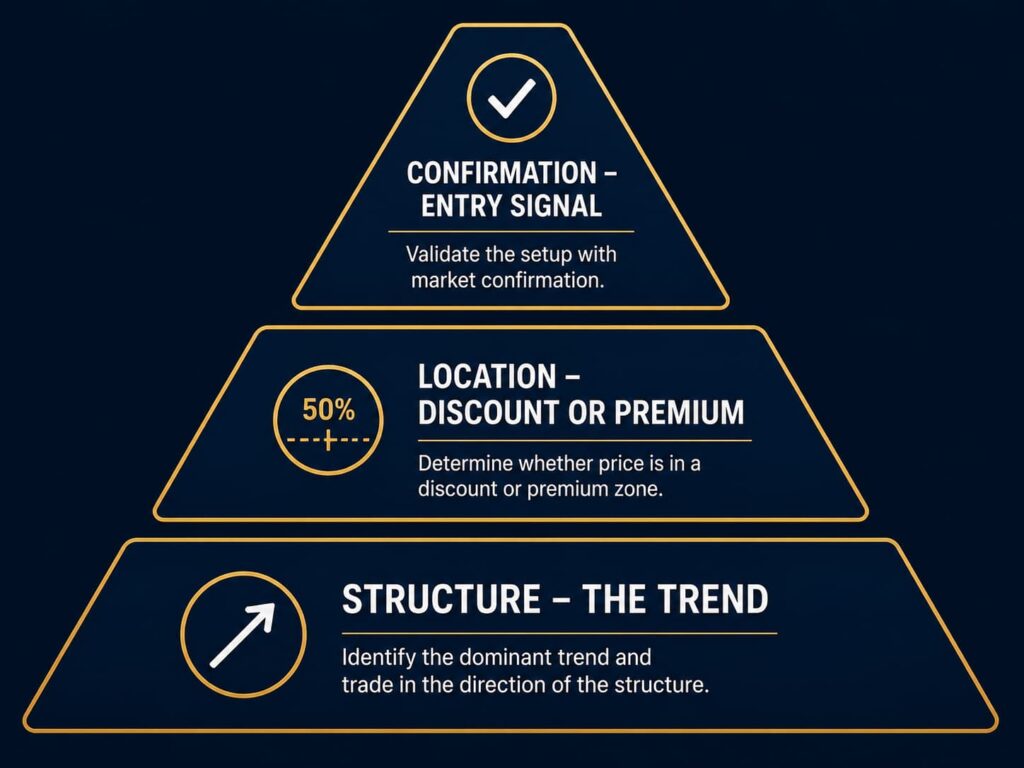
This is the disciplined way to use it. First read structure to establish the trend and the dealing range; then apply discount and premium zones to know which half you should be operating in; then look for your entry signal — an order block, a fair value gap, a change of character — specifically within the favourable zone. Layering location onto signal in this order is what keeps a trader from the classic mistake of taking a technically valid setup at a terrible price.
Caveats and Realism
Discount and premium zones are one of the more defensible trading concepts because they rest on the sound, universal principle of trade location rather than on an unverifiable institutional story. That said, they carry the same caveats as the rest of the framework. The biggest is the subjectivity of defining the range: choose a different swing low or high and the equilibrium shifts, changing which zone price is in. The discipline of anchoring to significant, higher-timeframe swings addresses this, but it cannot eliminate the judgement involved.
It also works best within a trending context. In a clear uptrend, buying discount pullbacks is buying dips in a rising market — sound practice. In a choppy, directionless range, the same zones whipsaw and the edge fades. Discount and premium zones are therefore best understood as a location filter that sharpens good setups in trending conditions, not as a standalone signal that works everywhere. Used with that understanding, and always with a defined invalidation, it is a simple and genuinely useful discipline.
Premium and Discount on Forex
On currency pairs, discount and premium zones are typically applied by marking the dealing range on a higher timeframe — the daily or four-hour — and using it to bias intraday decisions. If the daily range has price sitting in deep discount within an uptrend, the trader spends the session looking only for longs, ignoring short setups however tempting they appear. This top-down application of location keeps intraday trading aligned with the higher-timeframe picture and stops the trader from fighting the larger trend at unfavourable prices.
Combined with the structure, liquidity and entry tools of the broader framework, discount and premium zones provide the “where” that turns a valid signal into a well-located trade.
For more on [trading major currency pairs], this guide covers how discount and premium zones apply to FX.
Common Mistakes with Premium and Discount
Three errors account for most of the trouble traders have with discount and premium zones.
1. Choosing the wrong range. Because the zones depend entirely on where you anchor the dealing range, picking an arbitrary or insignificant swing high and low produces an equilibrium that means nothing. A range drawn from minor intraday wiggles will have price flipping between “premium” and “discount” constantly, generating noise rather than insight. The fix is to anchor the range to genuinely significant, higher-timeframe swings — the major structural points that define the move you are actually trading.
2. Ignoring the trend. Discount and premium zones are a location filter, not a reversal signal, and applying them blindly against a strong trend is a fast way to lose money. In a powerful uptrend, price can sit in “premium” for a long time while continuing higher; mechanically shorting every touch of premium because the rule says “sell expensive” ignores that the trend bias should come first. The zones are meant to refine entries in the direction of the trend — buying discount pullbacks in an uptrend, selling premium rallies in a downtrend — not to fight the dominant move.
3. Treating location as a signal. Price reaching discount does not, by itself, mean buy; it means discount is a favourable place to look for a buy signal. Without an actual entry trigger — an order block, a fair value gap, a change of character — a location is just a location. Traders who enter purely because price is “in discount,” with no confirming setup, are using only half the method. Used correctly, discount and premium zones answer where, the trend answers which way, and the entry signal answers when — all three are needed.
What Are Premium vs Discount Entry Zones?
Premium vs Discount Entry Zones help you understand where price is expensive and where it’s cheap within a given range. The concept is simple, yet powerful: buy from areas where price is discounted and sell from zones where price is considered premium — but only when structure and confirmation align.
Rather than entering at random spots, this strategy helps you define value-based trading zones, giving your entries more logic and higher probability. Discount and premium zones are the foundation of this approach.
Why the Premium vs Discount Concept Works
Smart money doesn’t buy at the top or sell at the bottom. Instead, they look for entries at fair value — or better. By measuring the range between a significant swing high and swing low, we can divide price into two halves:
- The upper half is the premium zone, ideal for selling
- The lower half is the discount zone, ideal for buying
When price reaches these areas with structure and confirmation, it sets the stage for a reversal or continuation move. Trading within discount and premium zones aligns you with institutional logic and avoids emotional entries.
Tools and Conditions to Use
This strategy is structure-driven and doesn’t require any indicators. Here’s what you need to use discount and premium zones:
- A clear swing high and swing low to define your range, as explained by Investopedia
- A midpoint drawn using the Fibonacci tool or manual 50% level
- Price entering the premium or discount zone with confirmation
- Timeframes like 1-hour and 4-hour are best for clear zones
- Works well in trending or range-bound markets when used correctly
These conditions set the foundation for clean and confident entries using discount and premium zones.
Step-by-Step Guide to the Premium vs Discount Entry Zones
Step 1: Define Your Range
Start by selecting a valid swing high and swing low.
- In an uptrend, use the recent swing low to swing high
- In a downtrend, use the recent swing high to swing low
- Draw a 50% line (or use the Fibonacci tool for added levels)
This gives you a clean range to work with for discount and premium zones.
Step 2: Mark Premium and Discount Zones
Now split the range into two parts.
- The upper 50% is the premium zone — avoid buying here
- The lower 50% is the discount zone — avoid selling here
- Highlight the top and bottom quarters if you want deeper entries
These zones give you a price map for value-based trading using discount and premium zones.
Step 3: Wait for Price to Reach a Zone
Once your zones are set, be patient and wait.
- If you’re looking to buy, wait for price to dip into the discount zone
- If you’re looking to sell, wait for price to rise into the premium zone
- Let price reach these zones organically — don’t force trades
Discipline here is what turns this strategy from theory into results.
Step 4: Look for Confirmation
Now that price is in the value zone, it’s time to watch for signs of reversal.
- Look for wick rejections or engulfing candles
- Consider lower timeframe structure breaks
- Confluence with imbalance, order blocks, or trendlines adds strength
Only enter if price shows a clear willingness to reverse from value.
Step 5: Enter the Trade
Once confirmation is in place, go ahead and enter.
- Enter on the candle close or a limit order with clear structure
- Use a lower timeframe for precision if needed
- Ensure that you’re trading in the direction of your higher timeframe bias
You’re no longer chasing — you’re entering from value using discount and premium zones.
Step 6: Use a Logical Stop Loss
Protect your capital by placing a stop in a smart spot.
- Place it below the structure or wick that confirmed the reversal
- Don’t use tight stops right at the 50% level — allow space
- If you’re entering off a lower timeframe, adjust your stop to match structure
Let the trade breathe while still managing risk tightly.
Step 7: Set a Take Profit That Makes Sense
Now plan your exit in a structured way.
- Aim for previous swing highs or lows
- Use a 1:2 or 1:3 risk-to-reward setup as a guideline
- You can also use premium and discount zones in reverse as target zones
Stick to the logic of structure and price behavior — not emotion.
Risk Management Tips
- Don’t enter blindly just because price enters a zone — always confirm
- Avoid setups when price chops around the midpoint without clarity
- Keep risk per trade fixed and consistent
- Add confluence before committing size
- Only trade zones that make sense in the context of the trend
Consistent execution is more important than perfection when using discount and premium zones.
Real Example: Gold
Let’s apply discount and premium zones to gold. Gold has been heavy near the $4,000 to $4,050 area. The recent swing high was near $4,200, and the swing low was near $3,950. The midpoint is roughly $4,075.
If gold is trading below $4,075, it is in the **discount zone**. That is the area to look for longs. If gold is trading above $4,075, it is in premium. That is the area to look for shorts.
A trader using discount and premium zones would wait for gold to pull back into the discount zone with confirmation (a bullish rejection candle, a fair value gap, or an order block) before entering long. They would not chase gold above $4,200 because that is premium territory.
For more on [gold trading strategies], this guide covers how discount and premium zones apply to the metal.
Real Example: DXY
The dollar index is near 101.5. The recent swing low was near 100.50, and the swing high was near 102.00. The midpoint is roughly 101.25.
If DXY is trading above 101.25, it is in premium. That is the area to look for shorts. If DXY is trading below 101.25, it is in discount. That is the area to look for longs.
A trader using discount and premium zones would wait for DXY to pull back into the discount zone with confirmation before entering long. They would not chase DXY above 102.00 because that is premium territory.
The Psychology Behind Discount and Premium Zones
Most traders buy at the top and sell at the bottom. They chase momentum. They enter after the move has already happened. Discount and premium zones are designed to prevent that.
The framework forces you to be patient. It forces you to wait for price to come to you. It forces you to think in terms of value, not momentum.
When price is in discount, the crowd is usually selling. They see weakness and panic. The professional sees opportunity. When price is in premium, the crowd is usually buying. They see strength and FOMO. The professional sees distribution.
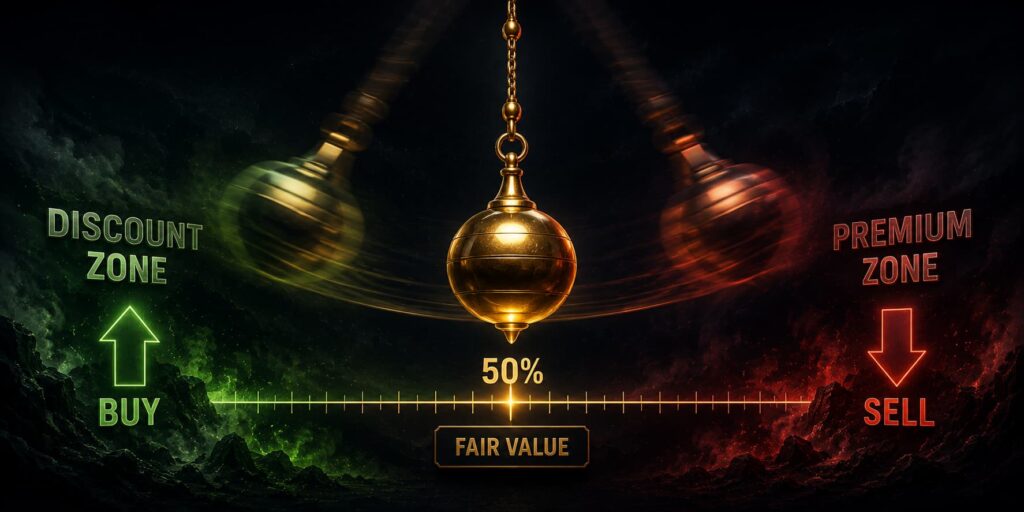
This is the psychological edge of discount and premium zones. They align you with the smart money, not the crowd.
Bottom Line
Discount and premium zones are one of the simplest and most effective tools for improving trade location. They answer a question every trader faces: where should I be looking to enter?
The framework is simple: buy in discount, sell in premium. But the discipline is harder. Waiting for price to come to you. Avoiding the temptation to chase. Respecting the trend and the structure.
When used correctly, discount and premium zones transform your trading. You stop chasing. You start positioning with intention. You trade like a professional.
Price is either cheap or expensive. Trade accordingly.
Disclaimer
This article is for educational and informational purposes only. It does not constitute financial advice, trading recommendations, or an offer to buy or sell any asset. Trading forex, commodities, indices, cryptocurrencies, and futures carries significant risk and may not be suitable for all investors. You can lose more than your initial deposit. Past performance does not guarantee future results. Always read full terms, contract specifications, and risk disclosures before trading. Do your own research. Consult a licensed financial advisor if you need professional investment advice.