


The debate over AI public ownership has moved from academic theory to active policy discussion. OpenAI has proposed giving the U.S. government a 5% stake in the company, the Financial Times reported Thursday, as the $852 billion AI startup seeks to clear political obstacles by securing financial buy-in from the Trump administration. The proposal would value the stake at roughly $42.6 billion.
This is the most significant development in the AI debate since the technology went mainstream. Sam Altman, chief executive of the ChatGPT maker, has argued that giving the public a financial interest in the company is the best way to share the upside of AI. The proposed arrangement envisions other U.S. AI companies ceding similar stakes to the government, though it is unclear whether rival labs like Anthropic, Google, or Meta would agree.
The move would mark an attempt to address political blowback by sharing the wealth generated by AI with the public. AI labs have faced an increasingly challenging environment in Washington as the American public and politicians grow more concerned about vast data center construction, job displacement, and cybersecurity implications. This is why AI public ownership has become a central topic in Washington policy circles.
President Trump has signaled support for the concept of the U.S. taking an ownership stake in AI giants, calling it “a beautiful thing” that would make Americans “partners in this revolution.” The idea has been a recurring theme in his administration’s approach to critical technologies, following the U.S. government’s 10% stake in Intel after an $8.9 billion investment in the chipmaker.
For a deeper look at [how government policy shapes markets], this article explores the intersection of regulation and market dynamics.
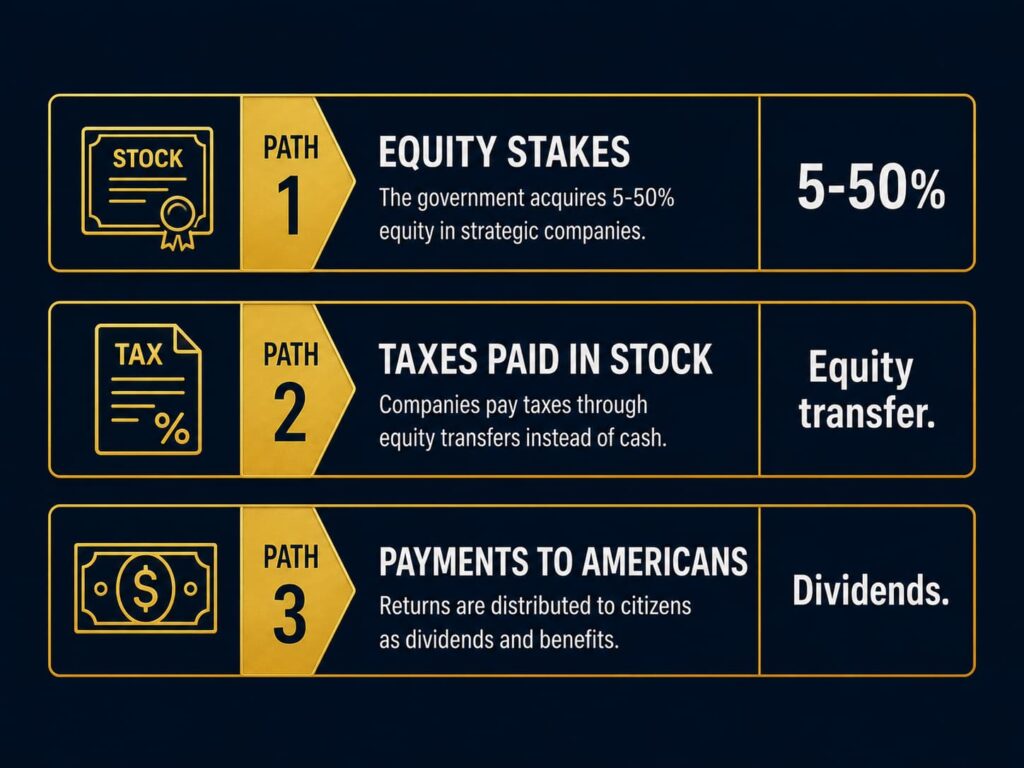
The Three Pathways to AI Public Ownership
Policymakers, companies, and advocates have proposed several pathways for Trump’s idea of AI companies “giving back” to the public. Each represents a different approach to AI public ownership.
1. Equity Stakes
OpenAI’s 5% Proposal: Altman and other OpenAI executives have suggested that each of America’s leading AI developers allot 5% of their equity to a vehicle like the Alaska Permanent Fund, a sovereign fund that invests the state’s oil wealth and pays dividends to residents. This is the most concrete proposal for AI public ownership to date.
Government’s Existing Precedent: The U.S. government already holds a 10% stake in Intel. In May, President Trump said he should have asked for a bigger stake in the company. This precedent makes AI public ownership politically feasible.
Political Context: Altman has been in active talks with the administration about public ownership, including Trump, Commerce Secretary Howard Lutnick, and Treasury Secretary Scott Bessent. He has also spoken to Senator Bernie Sanders in recent weeks.
The Sanders Proposal: Senator Bernie Sanders has proposed a far more ambitious plan. His American AI Sovereign Wealth Fund Act would impose a one-time 50% tax on the stock of the largest AI companies, creating a sovereign wealth fund estimated at $7 trillion at current valuations. This would be the most aggressive form of AI public ownership ever proposed.
Sanders argues that “AI was not created out of thin air. The foundation of AI is based on the collective knowledge of humanity and the creative work of tens of millions of people. The American people must have the ability to slow it down and make sure that AI benefits humanity, not just the richest people on the planet.” His vision for AI public ownership is about redistributing wealth, not just sharing profits.
2. Taxes Paid in Stock
The Law Professor Proposal: Two law professors have proposed imposing a tax payable in stock rather than cash, effectively transferring equity to the government without requiring public investment. The approach would not give the government a controlling stake, said Jeremy Bearer-Friend, a professor at George Washington University Law School. This alternative to AI is more gradual.
Sanders’ Remittance Tax: The Sanders bill would require large companies that operate both AI and non-AI businesses to “structurally separate” those businesses, ensuring the public receives an ownership stake in the AI business. The remittance would comprise equity interests, which for a corporation would mean stock. This version of AI public ownership is more aggressive.
3. Payments to Americans
OpenAI’s Public Wealth Fund: In April, OpenAI proposed creating a “public wealth fund” that “provides every citizen—including those not invested in financial markets—with a stake in AI-driven economic growth.” This is a softer version of AI public ownership.
Anthropic’s Digital Dividend: Anthropic said it is exploring a “digital dividend,” defined as payments to Americans funded by taxes on the AI sector. This is another approach to AI public ownership that focuses on cash payments rather than equity.
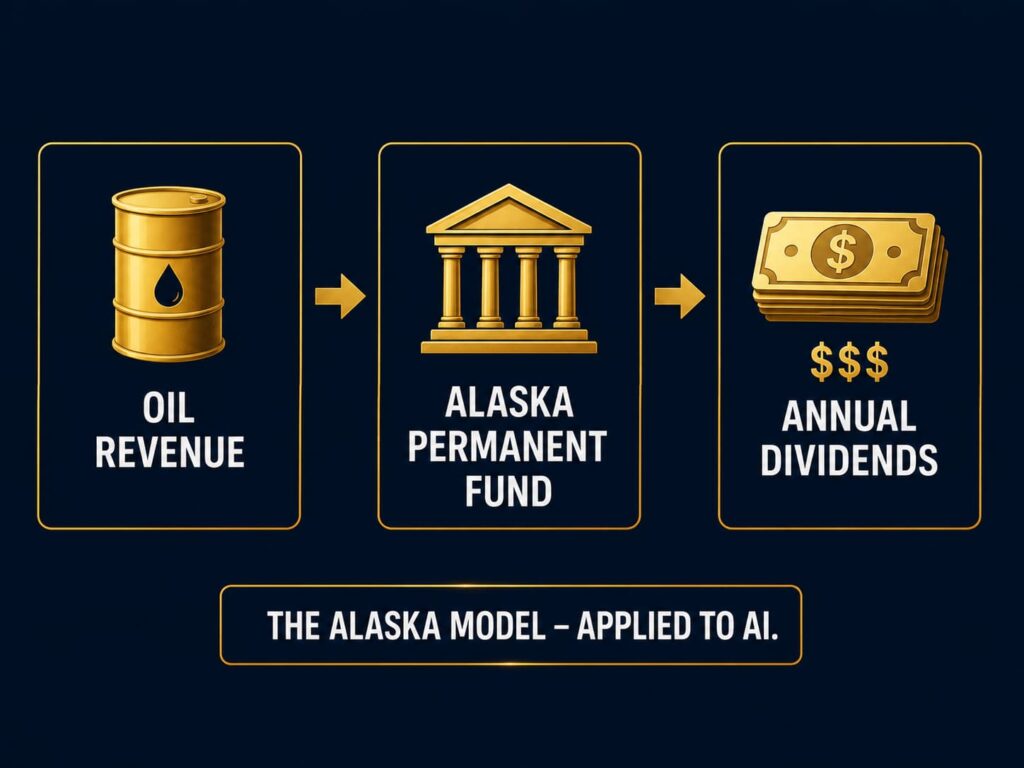
The Alaska Model: Both proposals have parallels with the Alaska Permanent Fund, a state-owned corporation seeded with oil revenues that provides annual dividends to residents. Proponents say a similar model could apply to AI, which relies heavily on publicly created data. This is the most tested model of AI public ownership.
The National Security Dimension of AI Public Ownership
The national security angle is the unspoken driver of the entire debate over AI public ownership. The U.S. government has already ordered Anthropic to suspend access to its frontier AI models, Fable 5 and Mythos 5, for foreign nationals over national security risks. OpenAI delayed a full public launch of GPT‑5.6 last week at the U.S. government’s request.
This is not just about money. It is about control. When the government holds equity in AI companies, it gains formal governance rights. Board representation, voting power, and the ability to block decisions that could compromise national security. That is far more powerful than any regulatory framework. This is why AI public ownership has become a national security issue.
The timing of the IPOs and the government stake proposal are not coincidental. Anthropic and OpenAI both filed confidentially this month, aiming for valuations near $1 trillion. Going public means greater transparency, regular financial disclosures, and quarterly earnings calls. For the government, it also means a clear mechanism to acquire shares. This makes AI public ownership more feasible.
The precedent is Intel. The U.S. government took a 10% stake in the chipmaker in exchange for $8.9 billion in funding to expand domestic manufacturing capacity. Trump has since said he should have asked for a bigger stake. The AI deal could be significantly larger, making AI public ownership a multi-trillion-dollar question.
China’s approach to AI is fundamentally different. The Chinese government exerts direct control over major tech companies through party committees embedded within corporate structures. Beijing recently launched a dedicated “National AI Industry Investment Fund” with a roughly $26 billion war chest, and another AI investment fund in Shanghai with a similar amount. This makes U.S. AI public ownership a strategic imperative.
In the U.S., the debate is not about direct control but about shared ownership. The question is whether a 5% stake or a 50% tax gives the government enough influence to achieve its national security objectives without stifling innovation. This is the core tension in the AI public ownership debate.
The IPOs That Change Everything
The timing of OpenAI’s proposal is no coincidence. Both OpenAI and Anthropic have confidentially filed for U.S. initial public offerings this month, with OpenAI targeting a valuation of up to $1 trillion. This makes AI public ownership immediately relevant.
Anthropic may be the bigger of the two right now, after raising $65 billion in May for a valuation of $965 billion. OpenAI’s most recent valuation was in March, following a fundraising round that brought in $122 billion, finishing with a valuation of $852 billion. The scale of these companies makes AI a significant financial issue.
The IPOs create a clear avenue for the government to acquire stakes. When OpenAI and Anthropic go public, the government could acquire shares through the open market. If the companies agree to transfer equity, those shares could be worth tens of billions of dollars. This is the most practical path to ownership.
Once going public, companies must issue regular disclosures, release financial results, conduct quarterly earnings calls, and meet other requirements, making it much easier for an investor to accurately evaluate the stock’s performance. This transparency would make AI public ownership more accountable.
For more on [market structure and IPOs], this guide covers how public listings affect broader asset classes.
The Global Race for AI Dominance and Public Ownership
The U.S. is not operating in a vacuum. The global race for AI dominance is intensifying, and the stakes could not be higher. This is why AI public ownership is not just a domestic policy debate.
China’s AI Ambitions: Beijing has made artificial intelligence a national priority. The Chinese government recently launched a dedicated “National AI Industry Investment Fund” with a roughly $26 billion war chest, and another AI investment fund in Shanghai with a similar amount. These funds are designed to accelerate the development of domestic AI capabilities and reduce reliance on foreign technology. The U.S. AI public ownership debate is partly a response to China’s state-led model.
The EU’s Regulatory Path: The European Union has taken a different approach, focusing on regulation rather than ownership. The EU AI Act, which came into force in 2024, imposes strict requirements on high-risk AI systems. The law requires transparency, human oversight, and robust risk management. This is a different model from U.S. AI public ownership.
The U.K.’s Balanced Approach: The United Kingdom has positioned itself as a middle ground. The government has committed to a pro-innovation approach, with light-touch regulation that encourages investment while addressing safety concerns. The U.K.’s AI Safety Institute, launched in late 2023, has become a hub for international collaboration on AI safety. This is yet another approach to AI governance, distinct from U.S. AI public ownership.
Implications for U.S. Policy: The global race means the U.S. cannot afford to be too aggressive with regulation or taxation. If the U.S. imposes a 50% tax on AI companies, those companies may relocate to jurisdictions with more favorable treatment. This is the risk of aggressive AI public ownership.
This is where the OpenAI 5% proposal looks strategically smart. It is enough to give the government a stake and align incentives without driving companies overseas. The Sanders 50% plan, by contrast, could be counterproductive if it pushes AI development to other countries. This is the central trade-off in the AI public ownership debate.
The Alaska Permanent Fund model offers a potential solution. By creating a sovereign wealth fund that invests in AI companies, the U.S. could capture value without taking direct control. The fund would be managed professionally, with a mandate to maximize long-term returns for the American public. This is the most market-friendly version of AI public ownership.
Joseph Blasi, who teaches corporate governance at Rutgers University, put it this way: “The public infrastructure in the United States is a citizen domain. It’s not something that a billionaire here or there or a trillionaire here or there can just grab.” His comment underscores the moral case for AI public ownership.
The Critical Perspectives on AI Public Ownership
The Free-Market Critique
Free-market analysts warn against the government mimicking the Intel arrangement, saying it could distort incentives. Neil Chilson, a Republican who leads AI policy at the Abundance Institute, warned: “It puts the government in the space where it’s no longer focused on ensuring the U.S. has the capacity it needs to protect the public interest and is more focused on ensuring that its investment pays off.” This is the strongest argument against AI public ownership.
Tad DeHaven, a policy analyst at the libertarian Cato Institute, warned that the federal government, as a regulator, cannot maintain neutrality if it owns a stake in AI companies. “It buys from them, taxes them, and investigates them. It can sue them, prosecute them, or even subsidize them,” he explained. This is a fundamental conflict of interest in any AI public ownership arrangement.
The Alaska Permanent Fund Model
The Alaska Permanent Fund is often cited as a real-world model for public ownership of shared resources. The $83 billion fund, which was created from oil proceeds, pays annual cash dividends between $1,000 and $3,000 to each Alaska resident. This is the closest existing model to AI public ownership.
As Bloomberg Law notes, just as states have safeguarded the profits from oil extraction for future generations through sovereign wealth funds, taxing AI businesses that generate revenue from AI models and investing that revenue in a sovereign wealth fund would help ensure the windfall is more fairly distributed over time. This is the economic logic behind AI public ownership.
The policy analog is clear: every barrel of oil extracted is one less left for future generations, but some of its value is preserved through taxation and investment. Similarly, AI models derive their value from ingesting articles, art, books, and other human-created works—a collective resource that should benefit the public. This is the moral case for AI public ownership.
The Political Landscape
The debate over AI public ownership has bipartisan dimensions. Trump has indicated support for the concept, while Sanders has introduced ambitious legislation. Polling shows around half of Americans fear AI could put them or someone in their household out of work, reflecting rising anxiety about automation’s economic impact. This public concern is driving the AI public ownership debate.
Trump said he would soon meet top technology executives to discuss the proposal. “I’m going to have meetings with the top 12 or 15 executives very shortly, and we’re talking about giving back something to the public, and if we do that, the public will become very rich,” Trump said. His endorsement makes AI public ownership more likely.
OpenAI’s proposal appears to be a preemptive move to shape the debate before legislation like Sanders’ bill gains momentum. The “conceptual” talks between the government and OpenAI were in the early stages, and any deal might require an act of Congress to implement. This means AI public ownership is still in its early stages.
The discussions point to a potential mechanism to distribute the financial gains from the technology while also addressing the regulatory and political pressure facing AI labs in Washington. This is the ultimate goal of AI public ownership.
Market Implications for Investors
The debate over AI public ownership has significant implications for investors.
Valuation Impact: A 5% government stake in OpenAI would represent approximately $42.6 billion at the company’s $852 billion valuation. A 50% stake under the Sanders plan would be worth $426 billion. These are not small numbers. The market will need to price in AI public ownership as a factor.
Sector Rotation: AI stocks have been the best-performing sector of the market over the past two years. Government ownership could change the dynamics of this sector. If the government becomes a significant shareholder, it may push for policies that favor broader distribution of AI wealth, potentially at the expense of concentrated corporate profits. This is the risk of AI public ownership for investors.
The Alaska Model as a Market Signal: If the U.S. creates a similar AI Sovereign Wealth Fund, it could become a major institutional investor. The Sanders plan envisions a $7 trillion fund, which would be larger than any existing sovereign wealth fund. That scale of capital could have significant market impact. This is the upside of AI public ownership for long-term investors.
Private vs. Public Markets: The shift from private to public markets will be the next major milestone. OpenAI and Anthropic’s IPOs will provide a clear valuation for the companies and create a mechanism for the government to acquire stakes. This makes AI public ownership a near-term reality.
Once going public, companies must issue regular disclosures, release financial results, conduct quarterly earnings calls, and meet other requirements. This transparency will make it much easier for investors to evaluate the stocks’ performance. This is good for AI public ownership.
The Regulatory Overhang: The market has already shown that regulatory uncertainty can be a headwind. Alphabet, Microsoft, and other tech companies have faced antitrust investigations and regulatory scrutiny, which has weighed on their valuations. AI public ownership adds another layer of regulatory uncertainty.
The Investment Opportunity: For long-term investors, the AI sector represents one of the most significant growth opportunities of the next decade. The question is not whether AI will create enormous value, but who will capture it. AI public ownership is one answer to that question.
Bottom Line
The AI industry is at a crossroads. OpenAI’s 5% stake proposal, Sanders’ 50% sovereign wealth fund bill, and Anthropic’s digital dividend concept all point to a growing consensus that the public deserves a share of AI’s enormous wealth creation. AI public ownership is no longer a theoretical concept.
The debate is not about whether AI public ownership will happen—it is about how. The three pathways—equity stakes, taxes paid in stock, and direct payments to Americans—represent different approaches to solving the same problem. The IPOs of OpenAI and Anthropic, expected to value each company near $1 trillion, provide a clear mechanism for the government to acquire stakes.
For investors, this represents both opportunity and uncertainty. Government ownership of AI companies could reshape valuations, influence corporate governance, and create new revenue streams for the federal government. But it could also introduce political risk into one of the most dynamic sectors of the global economy.
The Alaska Permanent Fund model suggests that AI public ownership can coexist with private sector growth. The $83 billion fund has consistently outperformed its benchmarks while providing annual dividends to residents. If applied to AI, the model could ensure that the benefits of the technology are broadly shared.
As OpenAI’s CEO Sam Altman has argued, “society will likely need new approaches that give people durable stakes in the systems creating value.” The coming months will determine whether the U.S. government becomes a partner in the AI revolution or remains a regulator on the sidelines. The answer will shape AI public ownership for decades to come.
Disclaimer
This article is for educational and informational purposes only. It does not constitute financial advice, trading recommendations, or an offer to buy or sell any asset. Trading stocks, cryptocurrencies, and other assets carries significant risk and may not be suitable for all investors. Past performance does not guarantee future results. Always read full terms, contract specifications, and risk disclosures before trading. Do your own research. Consult a licensed financial advisor if you need professional investment advice.