


Trading success is not just about strategy. It is about mindset.
Even the most profitable trading systems fail without the right trading psychology. The difference between consistent winners and struggling traders often comes down to discipline, patience, and emotional control.
Studies show that 90% of trading failures stem from psychological errors, not strategy flaws. This trading psychology guide will break down the emotional traps that destroy traders, proven techniques to strengthen discipline, and how to stay consistent in volatile markets.
Understanding trading psychology is not optional. It is the invisible foundation of success.
As Alexander Elder wrote in Trading for a Living: “Markets don’t defeat traders – their own emotional reactions do.” Fear, greed, hope, and frustration sabotage decision-making long before the chart ever does.

If you have ever hesitated on a valid setup, entered late out of fear of missing out, moved a stop loss because “it might come back,” or overtraded after a win or loss, this trading psychology guide is for you.
For a deeper look at risk management strategies, this trading psychology guide recommends reviewing how emotional control connects to position sizing.
Why Trading Psychology Always Comes First
Trading combines uncertainty, money, and ego. That is a perfect environment for emotional overload. Unlike most professions, you receive immediate feedback in profit and loss, which amplifies emotional responses.
Elder emphasizes that successful trading stands on three pillars: trading psychology, analysis, and money management – in that order. If trading psychology collapses, the other two cannot function properly.
The 60/30/10 rule from behavioral finance research (Van K. Tharp) breaks it down:
- 60% trading psychology
- 30% position sizing
- 10% strategy
Most traders focus on the 10% and ignore the 90%. That is why traders with solid technical knowledge still fail. They know what to do but cannot consistently do it. Strategy failure is usually a symptom, not the root cause. The real battlefield is internal. Trading psychology decides whether a good setup is executed well, poorly, or not at all.
This is why trading psychology must be paired with risk rules. Without predefined exits, emotions fill the vacuum.
For more on trading discipline and emotional control, this trading psychology guide covers the mental frameworks used by professional traders.
Core Emotions in Trading
Let us break down the main emotions that affect traders. Recognizing them is the first step in mastering trading psychology.
| Emotion | Effect | Fix |
|---|---|---|
| Fear | Premature exits, missed opportunities, widening stop losses | Strict entry/exit rules |
| Greed | Overtrading, ignoring risk, holding winners too long | Define risk limits (1% rule) |
| Hope | Holding losing trades, moving stops, averaging down | Lock stop loss before entry |
| Regret | Revenge trading after a loss | Cooling-off rule |
| Overconfidence | Larger positions after wins, ignoring setups | Stick to 1% rule |
Fear causes traders to exit winning trades too early or avoid valid setups entirely. Greed leads to overtrading and ignoring risk management. Hope is the most dangerous emotion in trading psychology because it delays acceptance. Acceptance restores control.
This trading psychology guide emphasizes that professionals still experience these emotions. The difference is they do not let emotions make decisions.
For a deeper look at how cognitive biases affect trading decisions, this trading psychology guide covers the research behind each bias.
Emotional Traps That Destroy Traders
A. Fear and Greed – The Twin Killers
Fear causes premature exits. Greed leads to overtrading. Together, they destroy more accounts than any market crash.
Fix: Define strict rules for entries and exits before trading. Do not decide in the moment.
B. Revenge Trading
After a loss, traders often increase position size to “win back” money quickly. This is revenge trading. It combines fear of losing more and greed to recover.
Result: Larger losses and blown accounts.
Fix: After two consecutive losses, step away for the rest of the day. No exceptions. The market will be there tomorrow.
C. Confirmation Bias
Confirmation bias is ignoring signals that contradict your trade idea. Example: holding a losing position because “the market should turn.”
Fix: Journal every trade. Record why you entered and why you exited. Data does not lie.
This trading psychology guide emphasizes that self-sabotage often comes from tying self-worth to profit and loss, needing to be right, or fear of missing opportunities.
The Role of Discipline in Trading
If trading psychology is the mind, discipline is the practice. Discipline means sticking to your trading plan, following rules, and controlling impulses.
Key aspects of discipline in trading psychology:
- Following a Trading Plan: A plan defines entry, exit, risk, and money management. Discipline ensures you do not deviate.
- Risk Management: Never risking more than 1-2% of your capital per trade.
- Patience: Waiting for the right setup instead of forcing trades.
- Consistency: Small, regular gains build wealth – not random big wins and losses.
- Avoiding Emotional Trading: No revenge trades, no fear of missing out entries.
This guide teaches that discipline is not natural. It is built. The difference between successful and failed traders is not intelligence or strategy. It is rule-following.
Building Unshakable Trading Discipline
Rule 1: Treat Trading Like a Business
Set daily and weekly goals. Example: “Maximum 3 trades per day.” Track performance like a CEO reviews financial reports. This trading psychology approach removes emotion from evaluation.
Rule 2: Use a Pre-Trade Checklist
Before every trade, ask:
- Does this meet my strategy’s criteria?
- Is my risk 1-2% of my account?
- Am I entering because of logic or emotion?
Rule 3: The 24-Hour Rule
For major strategy changes, wait 24 hours before acting. This prevents impulsive decisions during drawdowns.
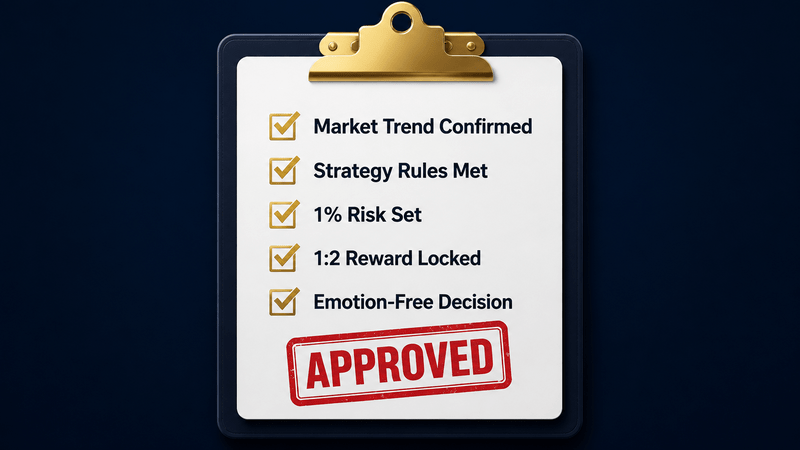
Pre-Trade Checklist
| Check | Status |
|---|---|
| Market Trend Confirmed | ☐ |
| Strategy Rules Met | ☐ |
| 1% Risk Set | ☐ |
| 1:2 Reward Locked | ☐ |
| Emotion-Free Decision | ☐ |
This trading psychology checklist takes 30 seconds. It can save you 30% of your account.
For more on position sizing and risk management, this guide covers the formulas you need.
How Top Traders Stay Patient
A. Accept Inactivity as a Strategy
Markets provide few high-quality setups. Professional traders might wait weeks for one trade. Amateurs force ten bad ones. This trading psychology principle is hard to learn but essential.
B. Set “Trade Conditions”
Example: “I will only trade if the trend aligns with the 4-hour chart and RSI is below 30 (for longs) or above 70 (for shorts).”
C. Meditation and Mental Rehearsal
Breathing exercises reduce knee-jerk reactions. Visualize taking a loss and walking away calmly. This trading psychology technique prepares you for the worst so you can trade for the best.
The driving without brakes analogy: Imagine driving a fast car with no brakes. You might enjoy the speed at first, but eventually fear takes over because you know you cannot stop safely. That is exactly how trading feels without psychological control and risk limits. Brakes do not slow you down unnecessarily – they allow you to drive faster safely. In trading, rules and discipline serve the same function.
The Most Dangerous Emotion in Trading: Hope
Fear often gets blamed, but hope is far more destructive in trading psychology.
Hope shows up when:
- A losing trade is held without invalidation
- A stop loss is moved
- A losing position is “given more room”
Hope delays acceptance. Acceptance restores control.
This is why trading psychology must be paired with risk rules. Without predefined exits, emotions fill the vacuum. The cure is simple. Lock your stop loss before entry. Never move it wider. Ever.
The Overtrading Epidemic
Overtrading is one of the most common symptoms of poor trading psychology. It happens when a trader takes too many trades, stays in the market too long, or trades outside their plan. The root cause is not a lack of strategy. It is emotional discomfort.
Traders overtrade for several reasons. Boredom leads them to create trades where none exist. The fear of missing out pushes them to chase momentum after a move has already happened. The need for excitement overrides the need for discipline. And revenge trading after a loss is a specific form of overtrading that compounds mistakes.
The numbers are brutal. A study of day traders found that those who traded more frequently had lower returns after fees. The most active traders were the worst performers. Overtrading gives you more chances to be wrong, more exposure to slippage, and more transaction costs. It also amplifies emotional damage because each loss triggers another round of impulsive decision-making.
The fix for overtrading is structural, not emotional. Set a daily trade limit. Example: maximum three trades per day. Set a daily loss limit. Example: stop trading after losing 2% of your account. And set a time limit. Example: only trade during your highest-conviction session. These constraints force discipline. They do not rely on willpower.
For more on position sizing and trade limits , this guide recommends hard rules over soft promises.
5 Common Cognitive Biases That Destroy Traders
| Bias | Effect |
|---|---|
| Confirmation bias | Seeking information that supports your trade, ignoring danger signs |
| Recency bias | Believing the last few trades predict the next one |
| Overconfidence bias | Winning trades make you feel invincible → larger positions |
| Loss aversion bias | Holding losers too long, cutting winners too short |
| Anchoring bias | Fixating on entry price instead of market reality |
Understanding these biases is essential for mastering trading psychology. They are wired into your brain. You cannot eliminate them. You can only manage them.
For more on prospect theory and loss aversion, this guide recommends studying how losses feel 2.5 times more intense than gains.
The 5-Step Daily Psychological Routine
Step 1: Pre-market preparation (10 minutes)
Review your journal from yesterday. Set your daily loss limit (2-3% of account). Write down your job: “Follow the rules, not the profit and loss.”
Step 2: First trade of the day (half size)
Reduce position size to warm up. Prove discipline before proving profit. This trading psychology technique prevents early mistakes from ruining your day.
Step 3: Hourly emotional check
Set a timer. Ask: “Am I calm? Am I following my plan?” If not, walk away for 15 minutes.
Step 4: After a loss (cooling-off period)
One loss is fine. Two consecutive losses means walk away for the rest of the day. No exceptions. The market will be there tomorrow.
Step 5: End-of-day journaling (10 minutes)
Record every trade, win or loss. Log your emotional state before entry. Write one lesson learned.
For a deeper look at building a trading journal that works, this guide provides templates and examples.
The Trading Journal – Your Most Powerful Tool
A trading journal is the single most powerful tool for improving trading psychology. It turns subjective feelings into objective data.
Why most journals fail: they record trades without analysis. A proper journal includes emotional state, lessons learned, and patterns over time.
Trading Journal Template
| Field | Entry |
|---|---|
| Date and time | |
| Asset and direction | |
| Entry, stop, target | |
| Position size (% risk) | |
| Emotional state before entry (1-10) | |
| What actually happened | |
| What I did right | |
| What I would change | |
| Lesson learned |
A trading journal turns your mistakes into data. Data does not lie. Data does not get emotional. Data shows you exactly where you are breaking the rules. That is the essence of trading psychology improvement.
Recovery from a Losing Streak
Every trader experiences losing streaks. The question is not whether you will have one. It is whether you will survive it. This guide provides a five-step recovery protocol.
Step 1: Stop trading immediately. Do not try to trade your way out. The market will not give you back your money because you need it.
Step 2: Review your journal. Find the pattern. Are you breaking rules? Are you trading in unfavorable conditions? Is your strategy failing or is your execution failing?
Step 3: Reduce size. Cut your position size in half. Prove that you can follow rules before you try to make money.
Step 4: Take a break. Two days. One week. Whatever it takes to reset. The market will be there when you return.
Step 5: Return with one goal. Follow the rules for one day. Not to make money. Just to follow the rules.
For more on risk management during losing streaks, this guide covers position sizing and drawdown limits.
Real Trader Case Studies
Case 1: The Fearful Trader (Ravi)
Ravi has a solid strategy. But every time he enters a trade, he exits quickly with a tiny profit because he fears losing. Over time, his small wins cannot cover occasional big losses. His fear costs him consistency. This trading psychology trap is common among beginners.
Case 2: The Greedy Trader (Anita)
Anita makes 15% in a stock but does not exit. She wants 25%. The market reverses, and her profit turns into a 10% loss. Greed made her lose a winning trade. This trading psychology mistake is about knowing when to take profits.
Case 3: The Disciplined Trader (Arjun)
Arjun risks 1% per trade, follows stop loss strictly, and journals his trades. His profits are steady, and he grows his account slowly but surely. He survives where others blow up. This trading psychology profile is the goal.
Case 4: The Stop Loss Mover
A trader had a $10,000 account. He entered a gold trade with a 1% stop loss. The trade moved against him. He moved the stop. Then again. Then again. What started as a $100 risk became a $1,500 loss. The emotion: hope. The cure: lock the stop loss before entry. This trading psychology failure is preventable.
The Growth Path of a Trader
| Stage | Description |
|---|---|
| Unconscious Incompetence | You do not know what you do not know |
| Conscious Incompetence | You realize mistakes but still repeat them |
| Conscious Competence | You follow rules with effort and discipline |
| Unconscious Competence | Trading psychology and discipline become second nature |
This trading psychology growth path shows that mastery takes time. Do not rush the process.
Final Thoughts
Trading psychology and discipline are not “soft skills.” They are the foundation of trading success.
Without trading psychology, strategies fail. Without discipline, emotions take over. With the right mindset, even an average strategy can outperform.
The market is not your enemy. Your emotions are. Treat trading like a business, not a gamble. Consistency beats occasional brilliance.
As this guide has shown, the only unstable variable in trading is the trader.
Bottom Line
Trading psychology is the invisible foundation of success. Strategy failure is usually a symptom, not the root cause. The real battlefield is internal.
Build the system. Follow the rules. The results will follow.
Remember: the market does not care about your analysis. It cares about your execution. Fear and greed are wired into your brain. You cannot eliminate them. You can only manage them. Discipline is not a personality trait. It is a system.
This trading psychology guide has given you the tools. Now use them.
Disclaimer: This article is for educational and informational purposes only. It does not constitute financial advice, trading recommendations, or an offer to buy or sell any asset. Trading forex, commodities, indices, cryptocurrencies, and futures carries significant risk and may not be suitable for all investors. You can lose more than your initial deposit. Past performance does not guarantee future results. Always read full terms, contract specifications, and risk disclosures before trading. Do your own research. Consult a licensed financial advisor if you need professional investment advice.